





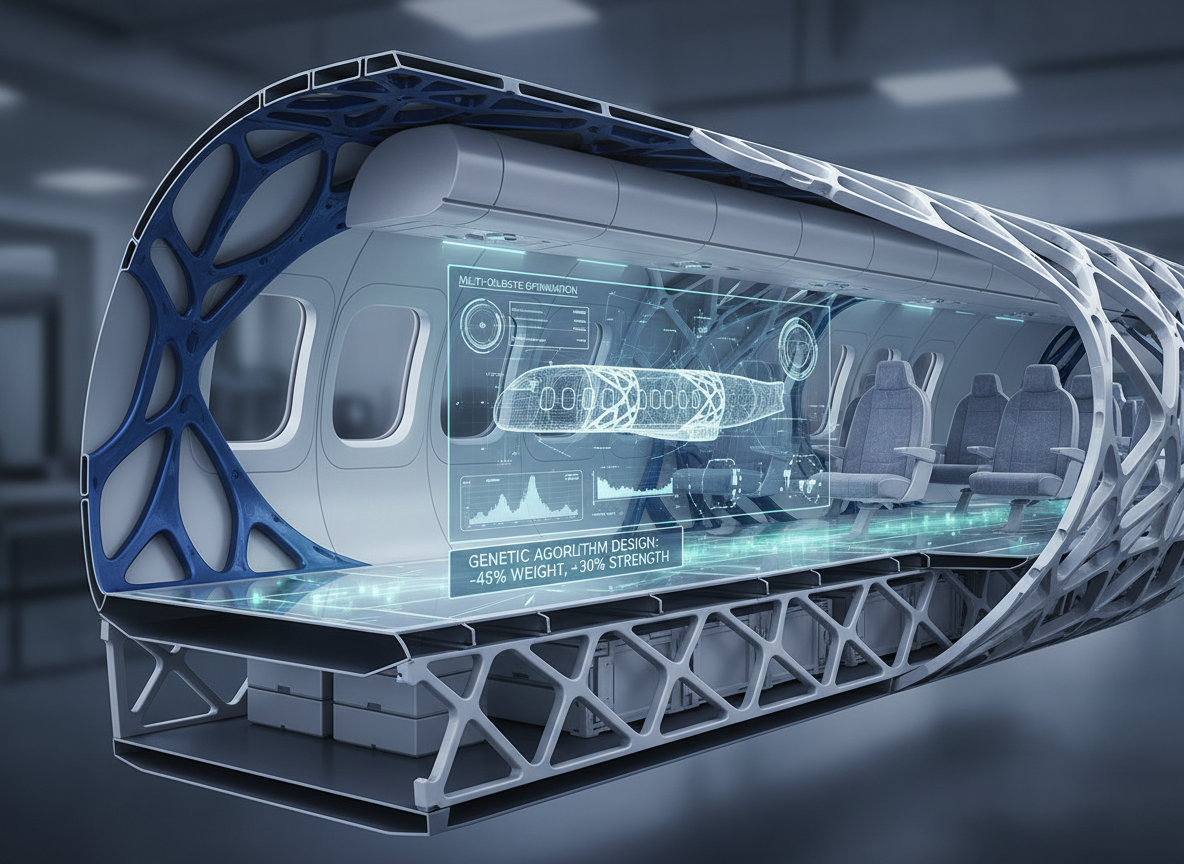
Genetic algorithms have transformed fuselage optimization, moving it from conservative, margin-heavy designs to precise, data-driven structural solutions.
Engineering teams using these methods are discovering fuselage geometries that traditional approaches overlook, where weight savings, structural performance, and manufacturing simplicity align in configurations that challenge decades-old design assumptions.
Recent applications demonstrate 12–18% weight reduction, 15% lower drag coefficients, 20–30% fewer structural components, and 8–12% lower manufacturing costs while maintaining or exceeding safety factors required by certification standards.
Still, genetic algorithms demand careful implementation. They require validation against nonlinear finite element models, integration with legacy structural analysis tools, management of thousands of load cases simultaneously, and close coordination between aerodynamics, structures, and manufacturing teams.
This article examines where genetic algorithms deliver measurable improvements in fuselage design, how engineering teams integrate them into certification-ready workflows, and how BQP accelerates the path from conceptual geometry to production tooling.
What are the Key Impacts of Genetic Algorithms on Fuselage Design?
1. Reducing Fuselage Weight Safely
Fuselage weight directly impacts fuel consumption, range, and payload capacity across every flight hour.
Traditional designs add material to guarantee safety margins, often resulting in over-engineered structures that carry unnecessary mass through millions of flight cycles. Engineers lack efficient methods to explore thousands of material thickness combinations, stringer spacing options, and frame geometries simultaneously.
Genetic algorithms test structural configurations across all critical load cases at once.
They identify layouts that meet ultimate load requirements, damage tolerance standards, and fatigue life targets while removing 12–18% of structural weight compared to baseline designs, translating to 3–5% fuel savings over the aircraft's operational life.
2. Multi-Load Case Optimization
Fuselages must withstand dozens of simultaneous load conditions including cabin pressurization, gust loads, and landing impacts.
Optimizing for one condition often weakens performance under others. Manual design iteration struggles to balance tension loads during pressurization, compression during gust encounters, shear forces at wing attachment points, and bending moments during hard landings without creating stress concentrations.
Genetic algorithms evaluate all load cases in parallel during each design iteration.
This integrated approach finds structural arrangements that satisfy every certification requirement simultaneously, reducing peak stress concentrations by 15–25% and eliminating costly redesigns during structural testing phases.
3. Integrating Skin, Stringers, and Frames
The interaction between skin panels, stringers, and frames determines fuselage structural efficiency and buckling resistance.
Traditional designs use standardized spacing and cross-sections based on historical precedent. This approach leaves performance on the table because it does not account for local load variations, manufacturing constraints specific to the production line, or opportunities to tailor geometry to stress patterns.
Genetic algorithms optimize skin thickness, stringer dimensions, and frame spacing as a unified system.
Optimized designs reduce part count by 20–30%, improve buckling margins by 18–22%, and simplify assembly sequences, cutting structural assembly time by 12–15% without introducing new tooling requirements.
4. Composite Layup Optimization
Composite fuselages require precise fiber orientations and stacking sequences to achieve target strength-to-weight ratios.
Each ply orientation affects stiffness in multiple directions. Engineers must balance in-plane loads, out-of-plane bending, shear resistance, and manufacturing limits like minimum ply thickness and maximum stacking angles. Manual layup design often converges on conservative, suboptimal configurations.
Genetic algorithms explore millions of stacking sequence combinations across different fuselage zones.
This method delivers 8–12% weight savings compared to baseline laminates while maintaining identical failure margins, and identifies cost-effective hybrid designs that use high-modulus fibers only where stress analysis proves they are necessary.
5. Improving Damage Tolerance
Fuselages must remain safe even after sustaining damage from tool drops, bird strikes, or fatigue cracks.
Predicting crack growth under cyclic pressurization requires fracture mechanics analysis at hundreds of potential initiation sites. Running full-scale simulations for every possible damage scenario takes weeks and often misses critical failure modes that emerge from unexpected load interactions.
Genetic algorithms use adaptive sampling to focus analysis effort on high-risk configurations.
They identify critical crack locations 40–60% faster than exhaustive search methods, guide reinforcement placement to arrest crack propagation, and reduce the number of physical tear-down tests required during certification by 25–35%.
6. Aerodynamic Drag Reduction
Fuselage shape impacts total aircraft drag, affecting fuel burn and cruise performance throughout the operational envelope.
Small changes in cross-sectional area distribution, nose fineness ratio, and tail upsweep angle create competing effects on wave drag, skin friction, and interference drag at wing-body junctions. Traditional streamlining methods optimize one region while inadvertently increasing drag elsewhere.
Genetic algorithms simultaneously shape the entire fuselage geometry to minimize total drag.
Optimized configurations reduce cruise drag by 3–6% compared to manually refined shapes, improving range by 2–4% without increasing structural weight or compromising cabin volume for passengers and cargo.
7. Enhancing Cabin Pressurization Efficiency
Maintaining cabin pressure at altitude generates hoop stress and longitudinal stress throughout the fuselage structure.
These stresses drive material thickness requirements and frame sizing. Inefficient pressure vessel shapes require additional structural reinforcement, adding weight that compounds over thousands of pressurization cycles and increases long-term fatigue crack susceptibility.
Genetic algorithms optimize fuselage cross-sections to distribute pressurization loads more evenly.
This approach reduces peak hoop stress by 10–15%, allows thinner skin gauges in low-stress regions, and extends pressurization fatigue life by 18–25% while maintaining the same factor of safety required by airworthiness regulations.
8. Manufacturing and Assembly Cost Reduction
Fuselage production involves complex tooling, precise part tolerances, and labor-intensive assembly processes that dominate airframe manufacturing costs.
Designs that ignore manufacturing realities create parts requiring non-standard tooling, manual fitting during assembly, or specialized fasteners that slow production rates. Engineers often discover these issues only during first article builds, leading to expensive redesigns.
Genetic algorithms embed manufacturing constraints directly into the optimization process from day one.
They enforce dimensional tolerances compatible with existing production equipment, limit part complexity to reduce machining time, and prefer designs that minimize unique part numbers, cutting overall production costs by 8–12% and accelerating time-to-rate production.
How Teams Apply Genetic Algorithms in Fuselage Design?
Genetic algorithms enter the fuselage design process early during preliminary sizing, before detailed CAD models exist.
Engineers define parametric representations of fuselage geometry, including cross-sectional shape, frame spacing, stringer layout, and skin thickness distributions. These models connect directly to structural analysis tools that evaluate stress, buckling, and fatigue under certification-level load cases.
The algorithm explores thousands of design configurations over several days, identifying 15–20 candidates that meet structural and regulatory requirements with the lowest achievable weight.
This early exploration minimizes late-stage redesigns and focuses engineering effort on structurally validated configurations with proven potential.
During detailed design, genetic algorithms drive iterative optimization loops that refine selected configurations for manufacturability and fatigue life.
A typical refinement cycle includes:
- 40–60 generations of population evolution
- 25–40 fuselage variants analyzed per generation using nonlinear FEA solvers
- Continuous monitoring of stress margins and buckling eigenvalues
- Mid-process extraction of promising designs for composite layup or joining method evaluation
Engineers adjust algorithm parameters when convergence slows, introduce new constraints as manufacturing reviews identify production limits, and validate top-performing geometries against physical test data from subscale specimens or prior aircraft programs.
Beyond active programs, structural teams conduct long-term GA studies to explore unconventional or next-generation configurations, such as:
- Blended wing–body geometries with non-circular cross-sections
- Fuselage structures optimized for thermoplastic composites
- Damage-tolerant configurations for high-cycle urban air mobility operations
Insights from these studies feed into response surface models, design guidelines, and institutional databases, accelerating future fuselage programs while reducing dependence on conservative, heritage-based sizing rules.
Integrating genetic algorithms into existing high-performance computing (HPC) systems requires minimal adaptation.
They operate within the same job schedulers, leverage the same FEA and CFD solvers, and export results in PLM-compatible formats used for configuration management.
The difference is that the algorithm automatically adjusts geometry and material parameters based on structural performance, replacing manual design iterations with a systematic, data-driven search across the feasible design space.
How BQP Enhances Genetic Algorithm Optimization for Fuselage Design?

BQP's platform turns quantum-inspired methods into practical tools that deliver immediate value for fuselage optimization. It helps structural engineering teams solve complex design problems today while preparing them for the next generation of quantum-accelerated workflows.
By combining quantum-inspired optimization with physics-validated structural simulations, BQP enables faster convergence, more accurate surrogate modeling, and scalable solutions across commercial aviation, business jets, and next-generation air mobility platforms.
Key Advantages:
- Quantum-inspired algorithms deliver up to 25× faster optimization on complex fuselage design problems with hundreds of coupled parameters and multiple load cases.
- Simulation-validated intelligence combines nonlinear FEA, damage mechanics models, and manufacturing constraints for reliable predictions that ensure every candidate design is structurally sound and production-ready.
- Scalable architecture handles single-section optimization through full fuselage studies without slowing performance or requiring additional compute infrastructure.
- Multi-objective optimization balances structural weight, manufacturing cost, damage tolerance, and aerodynamic performance simultaneously.
- Continuous learning loops update surrogate models with test data and full-scale validation results, improving accuracy across design iterations.
BQP transforms genetic algorithm workflows from exploratory searches into intelligent, adaptive systems that learn from every structural evaluation, optimize across competing certification requirements, and guide design decisions from conceptual geometry to production-ready fuselage structures.
Explore how BQP enables quantum-inspired fuselage optimization that accelerates development cycles and reduces structural weight. Book a demo or start your 30-day free trial today.
Conclusion
Genetic algorithms shift fuselage design from conservative, margin-heavy structures to optimized, data-validated configurations. They discover geometries that balance structural performance, weight efficiency, and manufacturing feasibility in ways traditional methods and manual iteration cannot match.
With BQP's quantum-inspired optimization platform, genetic algorithms become faster, more reliable, and scalable to certification-grade structural problems. From regional jets to wide-body transports, this approach enables rapid design exploration, robust performance under all regulatory load cases, and confident progression from finite element models to flight-test articles.
The competitive advantage belongs to teams that efficiently explore complex design spaces, validate candidates against physics-based failure criteria, and deliver production-ready fuselage structures ahead of program milestones.
FAQs
1. At what stage of design are genetic algorithms most valuable for fuselage optimization?
Genetic algorithms deliver the most value during preliminary design, when structural layout and material distributions are still flexible. They help identify the most promising configurations before committing to detailed CAD geometry and tooling investments.
2. How long does a typical fuselage optimization cycle take?
A standard GA-driven fuselage optimization runs 40–60 generations and typically completes within one to two weeks, depending on computing resources and the complexity of the nonlinear finite element models being evaluated.
3. Can genetic algorithms integrate with existing structural analysis software?
Yes. Genetic algorithms integrate seamlessly with commercial FEA tools like NASTRAN, ABAQUS, and ANSYS through scripting interfaces or APIs. They use the same compute clusters and job scheduling systems already in place for parametric studies.
4. How do engineers ensure GA-optimized fuselages meet certification requirements?
All optimization runs include airworthiness load cases as constraints. Promising designs are extracted mid-process for detailed damage tolerance analysis, manufacturing feasibility reviews, and validation against test data from component-level specimens.
5. What is a Genetic Algorithm?
A genetic algorithm is an optimization technique inspired by natural selection. It explores many design options simultaneously, selects the best-performing candidates, and iteratively improves them to find optimal solutions across multiple competing objectives.
.png)
.png)



.svg)
.svg)
.svg)
.svg)