



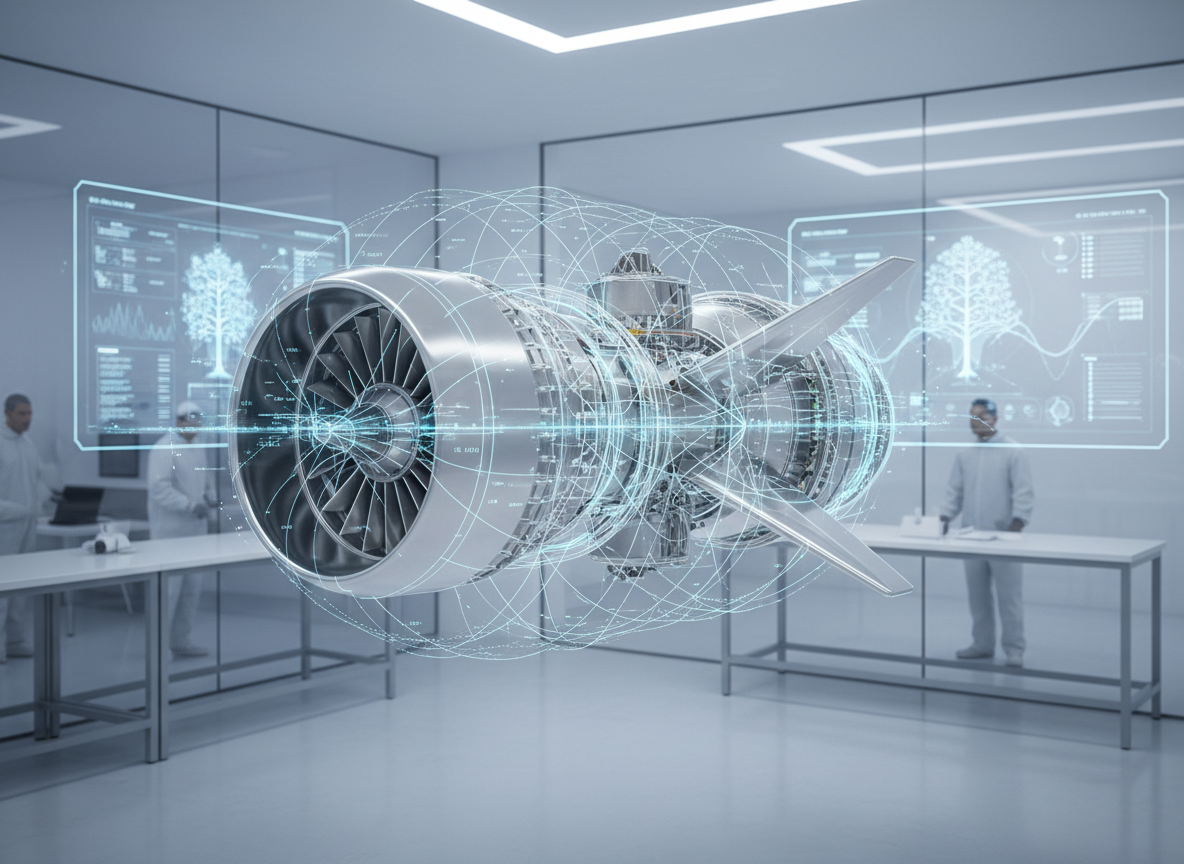

Genetic algorithms have transformed propulsion optimization, moving it from incremental improvements to systematic exploration of high‑performance design configurations. Engineering teams using these methods are discovering combustor geometries, turbine profiles, and nozzle shapes that traditional design processes miss, where thrust efficiency, fuel consumption, and durability combine in ways that exceed performance targets.
Recent research demonstrates a 15.2 % improvement in total pressure recovery in supersonic combustor configurations using a genetic algorithm coupled with surrogate modeling, indicating substantial potential for enhanced propulsion system performance through evolutionary optimization. ScienceDirect
Still, genetic algorithms demand rigorous validation. They require correlation with hot‑fire test data, integration with multiphysics simulations spanning combustion and structural analysis, management of thousands of operating points across the flight envelope, and tight coordination between aerothermal, mechanical, and controls engineering disciplines.
This article examines where genetic algorithms deliver measurable improvements in propulsion system design, how engineering teams integrate them into engine development programs, and how BQP accelerates the transition from concept studies to certified powerplants.
What are the Key Impacts of Genetic Algorithms on Propulsion Systems?

1. Combustor Efficiency and Emissions Reduction
Combustion chambers must achieve complete fuel burn while minimizing pollutant formation across varying power settings and altitude conditions.
Traditional combustor designs balance flame stability, pattern factor, and liner durability through iterative rig testing. This approach struggles to simultaneously optimize fuel-air mixing, residence time distribution, and cooling effectiveness because each variable affects combustion chemistry, thermal loading, and emissions in nonlinear ways.
Genetic algorithms explore swirler angles, dilution hole patterns, and fuel injection locations across all operating conditions simultaneously.
Optimized combustors reduce NOx emissions by 12-18%, improve combustion efficiency by 2-4%, and extend liner life by 15-25% through better thermal management, cutting development test cycles by 20-30%.
2. Turbine Blade Cooling Optimization
Turbine blades operate at gas temperatures higher than the material melting point, so efficient cooling is critical for durability and performance.
Traditional blade cooling uses standard internal passages and film holes, relying on conservative design margins. Manual iteration cannot fully balance heat removal, coolant flow, and aerodynamic losses simultaneously.
Genetic algorithms adjust internal passage layouts, film hole placement, and bleed air distribution as a connected system.
This approach improves cooling effectiveness by 10-15%, reduces coolant usage by 8-12%, and allows turbine inlet temperature to rise by 15-25°C, increasing overall engine efficiency.
3. Matching Compressor Stages and Maintaining Stability
Compressors must maintain stable airflow across all operating conditions, from idle to takeoff, without surging or stalling.
Traditional designs match stages using meanline codes and empirical correlations, which may miss three-dimensional flow effects. Stage mismatches can reduce efficiency or trigger unstable flow.
Genetic algorithms optimize blade angles, chord distributions, and stagger settings while enforcing surge margin constraints at every operating point.
Optimized compressors improve pressure ratio by 3-6%, widen surge margins by 5-8%, and allow one fewer stage for the same overall pressure ratio, reducing engine weight by 4-7%.
4. Optimizing Nozzle Shape for Thrust Control
Nozzles control thrust direction and magnitude for maneuvering while maintaining cruise efficiency.
Manual design must trade off expansion ratio, throat area, and vectoring range. Optimizing for thrust can hurt cruise efficiency, while cruise optimization limits maneuver authority.
Genetic algorithms explore nozzle contours, actuation kinematics, and seal geometry simultaneously.
Optimized nozzles improve cruise efficiency by 2-4%, increase vectoring authority by 8-12%, and cut actuator power requirements by 15-20%, enabling sharper maneuvers without performance loss.
5. Enhancing Afterburner Mixing and Flame Stability
Afterburners need stable combustion over varying Mach numbers and altitudes while minimizing pressure loss.
Traditional designs balance recirculation, mixing, and temperature distribution through trial and error, often leaving uneven thermal loads and risk to downstream components.
Genetic algorithms adjust flameholder shape, fuel spray, and liner cooling patterns together across all conditions.
Optimized designs reduce pressure loss by 4-7%, improve combustion efficiency by 3-5%, and extend component life by 20-30%, lowering maintenance frequency.
6. Handling Inlet Airflow Distortion
Engine inlets experience uneven airflow at high angles of attack or crosswinds, risking compressor stall.Traditional designs use conservative margins that reduce performance in normal operation. Manual adjustments cannot fully balance distortion tolerance and efficiency.
Genetic algorithms optimize fan blade geometry and inlet guide vane scheduling for distorted flow conditions.
This improves stall margin by 10-15%, allows more compact inlets that reduce nacelle drag, and maintains stable operation across a wider flight envelope.
7. Shaft Dynamics and Vibration Control
Rotating shafts and rotor assemblies must avoid resonance to prevent high-cycle fatigue and component failure.
Traditional balancing uses empirical tuning and test hardware, which cannot explore all configuration possibilities efficiently.
Genetic algorithms optimize shaft diameter, bearing location, and disk geometry to separate critical speeds from operational ranges.
This reduces vibration peaks by 15-25%, extends bearing life by 30-40%, and allows higher rotational speeds for better thrust-to-weight performance.
8. Fuel System Atomization and Distribution
Fuel injectors must provide consistent flow and atomization across pressures, temperatures, and operating conditions.
Manual designs rely on empirical correlations and cannot optimize spray quality and manifold pressure drops simultaneously, risking incomplete combustion or carbon deposits.
Genetic algorithms adjust injector orifice sizes, arrangements, and pressure drops together.
Optimized injectors improve atomization quality by 12-18%, reduce carbon buildup by 20-30%, and support leaner combustion that cuts fuel use by 2-3% while keeping emissions within limits.
How Teams Apply Genetic Algorithms in Propulsion Systems
Genetic algorithms enter development during preliminary design, before detailed geometry is frozen.
Engineers create parametric models defining compressor blade counts, turbine cooling schemes, combustor dimensions, and nozzle contours. These models connect to one-dimensional cycle analysis tools and simplified CFD solvers that evaluate thrust, efficiency, and weight across mission profiles.
The algorithm explores thousands of design combinations over several weeks, identifying 12–20 configurations that meet thrust requirements with the lowest fuel consumption. This early exploration narrows the design space before committing to expensive rig testing and focuses resources on architectures with demonstrated performance potential.
During component development, genetic algorithms refine geometries through coupled simulation loops. A typical optimization cycle includes:
- 40–60 generations of population evolution
- 20–30 component geometries evaluated per generation using RANS or LES solvers
- Real-time monitoring of efficiency, surge margin, and temperature limits
- Manual extraction of promising designs for mechanical stress analysis or hot-fire test planning
Engineers adjust algorithm parameters when improvement plateaus, add manufacturing constraints as fabrication reviews identify limits, and validate top-performing candidates against rig test data from previous engine programs.
Beyond active development, propulsion engineering teams run extended GA studies to explore advanced concepts. These investigations examine scenarios like:
- Rotating detonation combustors for step-change efficiency improvements
- Ceramic matrix composites enabling higher turbine temperatures
- Hydrogen fuel combustion for zero-carbon propulsion
Results inform technology roadmaps, quantify performance benefits against development risk, and build databases that accelerate future engine programs.
Integrating genetic algorithms with existing simulation infrastructure fits naturally into established workflows. They operate within current HPC environments, call the same CFD and FEA solvers, and produce outputs compatible with PLM systems used for configuration management.
The key difference is that the algorithm automatically adjusts geometry based on performance metrics, replacing months of manual design iterations with systematic exploration across the feasible design space.
How BQP Enhances Genetic Algorithm Optimization for Propulsion Systems

BQP's platform transforms quantum-inspired optimization into practical engineering tools that deliver immediate value for propulsion development. It helps engineering teams solve complex multiphysics design problems today while preparing for quantum-accelerated computation as technology advances.
By combining quantum-inspired search methods with physics-validated aerothermal models, BQP enables faster convergence, better handling of coupled objectives, and scalable optimization across commercial aviation, military, and space propulsion applications.
Key Advantages:
- Quantum-inspired algorithms deliver up to 30× faster convergence on propulsion problems with hundreds of coupled parameters spanning aerodynamics, combustion, heat transfer, and structural mechanics.
- Simulation-validated predictions combine CFD, combustion chemistry models, and thermal-structural analysis to ensure every candidate meets performance targets and durability requirements.
- Scalable architecture handles single-component optimization through complete engine system studies without performance degradation or additional compute infrastructure.
- Multi-objective optimization balances thrust output, fuel efficiency, emissions compliance, and component life simultaneously across all operating conditions.
- Continuous learning loops incorporate data from rig tests, engine ground runs, and flight operations, improving surrogate model accuracy and reducing physical testing requirements.
BQP transforms genetic algorithm workflows from design exploration tools into intelligent systems that learn from every simulation, optimize across competing certification requirements, and guide decisions from preliminary design to type certification.
Explore how BQP enables quantum-inspired propulsion optimization that accelerates development schedules and improves engine performance. Book a demo or start your 30-day free trial today.
Conclusion
Genetic algorithms shift propulsion design from incremental refinement to systematic optimization across coupled subsystems. They discover configurations that balance thrust performance, fuel efficiency, and component durability in ways traditional methods and manual iteration cannot achieve.
With BQP's quantum-inspired optimization platform, genetic algorithms become faster, more reliable, and scalable to certification-grade propulsion problems. From turbofans to rocket engines, this approach enables rapid design exploration, robust performance under all operating conditions, and confident progression from simulation to flight-proven hardware.
The competitive advantage belongs to teams that efficiently explore complex design spaces, validate candidates against physics-based models and test data, and deliver production-ready propulsion systems ahead of program timelines.
FAQs
1. At what stage of development are genetic algorithms most valuable for propulsion optimization?
Genetic algorithms deliver the most value during preliminary design, when component geometries and cycle parameters are still flexible. They help identify the most promising configurations before committing to detailed CAD models and expensive rig testing.
2. How long does a typical propulsion optimization cycle take?
A standard GA-driven propulsion optimization runs 40-60 generations and typically completes within two to four weeks, depending on CFD mesh resolution and the number of operating points being evaluated across the flight envelope.
3. Can genetic algorithms integrate with existing propulsion analysis tools?
Yes. Genetic algorithms integrate seamlessly with commercial CFD tools like ANSYS Fluent, STAR-CCM+, and proprietary combustion codes through scripting interfaces or APIs. They use the same HPC clusters already in place for design studies.
4. How do engineers ensure GA-optimized designs meet certification requirements?
All optimization runs include FAA/EASA performance requirements and emissions regulations as mandatory constraints. Promising designs are extracted mid-process for detailed analysis, mechanical design checks, and correlation against available test data.
5. What is a Genetic Algorithm?
A genetic algorithm is an optimization technique inspired by natural selection. It explores many design options simultaneously, selects the best-performing candidates, and iteratively improves them to find optimal solutions across multiple competing objectives.
.png)
.png)


.svg)
.svg)
.svg)
.svg)