



Genetic algorithms have transformed turbine blade optimization, shifting it from guesswork and repeated trials to a more systematic and data-based search.
Engineering teams using these methods are discovering blade shapes that traditional design studies often miss, where aerodynamic efficiency, structural strength, and ease of manufacturing come together in ways even experienced engineers did not expect.
Recent studies show up to 5.9% higher annual energy production, 25% longer fatigue life, 8% weight reduction, and 7% lower blade costs without reducing aerodynamic performance.
Still, genetic algorithms are not simple tools. They come with challenges such as adjusting algorithm parameters, checking simplified models against detailed simulations, managing the high computing effort for hundreds of CFD runs, and ensuring that simulation results match real-world prototypes.
This article looks at where genetic algorithms make a real difference in turbine blade design, how engineering teams include them in their workflows, and how BQP helps move from early testing to production-ready optimization.
What are the key impacts of Genetic Algorithms on Turbine Blades?

1. Multi-Objective Trade-Off Resolution
Turbine blade design requires balancing several goals at once improving aerodynamic efficiency while reducing weight and keeping manufacturing costs low.
Traditional optimization focuses on one goal at a time. Engineers often have to test designs manually to find a middle ground between competing priorities such as:
- Structural strength vs. aerodynamic performance
- Fatigue life vs. production cost
Genetic algorithms test thousands of design options in parallel, allowing engineers to find combinations that satisfy all objectives together.
2. Convergence Speed in Complex Design Spaces
Turbine blades depend on many connected parameters such as chord length, twist angle, airfoil thickness, and leading-edge shape. The variables influence each other, creating many possible choices. Traditional optimization methods can stop at a “good enough” solution instead of finding the best one.
Genetic algorithms explore this space through guided random search, avoiding these traps and finding better overall solutions.
- Traditional optimization: about 200–300 CFD runs
- Genetic algorithms: about 80–120 runs to reach near-optimal results
This reduction cuts design cycles from weeks to days.
3. Aerodynamic Performance Across Operating Conditions
Turbine blades must perform well under many operating conditions changing flow speeds, angles of attack, and temperatures.
Designs optimized for a single condition (like cruise or rated wind speed) often lose efficiency in off-design scenarios. Genetic algorithms test designs across multiple operating conditions simultaneously, penalizing those that perform well only in narrow ranges.
The result is robust designs that perform consistently across 15–20 operating points, reducing power fluctuations by 12–18% in real-world use.
4. Manufacturing Constraint Satisfaction
Even the best aerodynamic design must be feasible to produce. Blades must respect limits like minimum wall thickness for casting, maximum aspect ratios for machining, or draft angles for mold release.
Genetic algorithms include these constraints directly during optimization. They filter out designs that are too complex or impossible to manufacture, ensuring that every viable design can be produced.
This approach reduces the typical 3–6 month delay between design approval and factory readiness.
5. Fatigue Life and Structural Optimization
Turbine blades must endure millions of stress cycles without failure during decades of continuous operation.
Predicting fatigue and crack initiation under varying aerodynamic loads, thermal gradients, and rotational stresses demands extensive finite element analysis. Each simulation can take hours, making full-scale studies slow and expensive.
Genetic algorithms introduce selective modeling that focuses computational effort only where it matters most.
They use surrogate models and adaptive sampling to identify high-risk regions before running detailed FEA. This approach cuts 40–60% of simulations while maintaining 3–5% accuracy compared to full-scale fatigue testing.
6. Working with Limited or Incomplete Data
Turbine testing data is often sparse, inconsistent, or partially missing.
Incomplete calibration data makes simulation results uncertain, increasing the risk of prototype failures and wasted iterations during early testing.
Genetic algorithms address this uncertainty using probability-based scoring instead of single-point results.
This method identifies designs that reliably perform even with incomplete data, reducing early prototype failure rates by 20–30% while improving overall design confidence.
7. Thermal Management and Cooling Channel Optimization
Turbine blades require internal cooling channels to survive extreme combustion temperatures above 1,400°C.
Designing these passages is challenging because they must balance effective heat removal, structural integrity, and minimal airflow disruption, all while preserving external aerodynamic performance.
Genetic algorithms optimize both the blade’s outer surface and internal cooling channels simultaneously.
This integrated approach boosts cooling efficiency by 8–12% while keeping aerodynamic losses below 1.5%, resulting in safer, more durable, and high-performing blades.
8. Noise Reduction
Blade tips and trailing edges generate noise due to vortices and flow separation.
Reducing acoustic output is difficult because traditional methods often compromise aerodynamic efficiency, requiring careful multi-objective balancing.
Genetic algorithms find geometries that lower noise without sacrificing performance.
These optimized shapes reduce acoustic output by 4–7 dB in critical frequency bands while maintaining efficiency losses below 2%, achieving quieter turbines with high performance.
How Teams Apply Genetic Algorithms in Turbine Blades
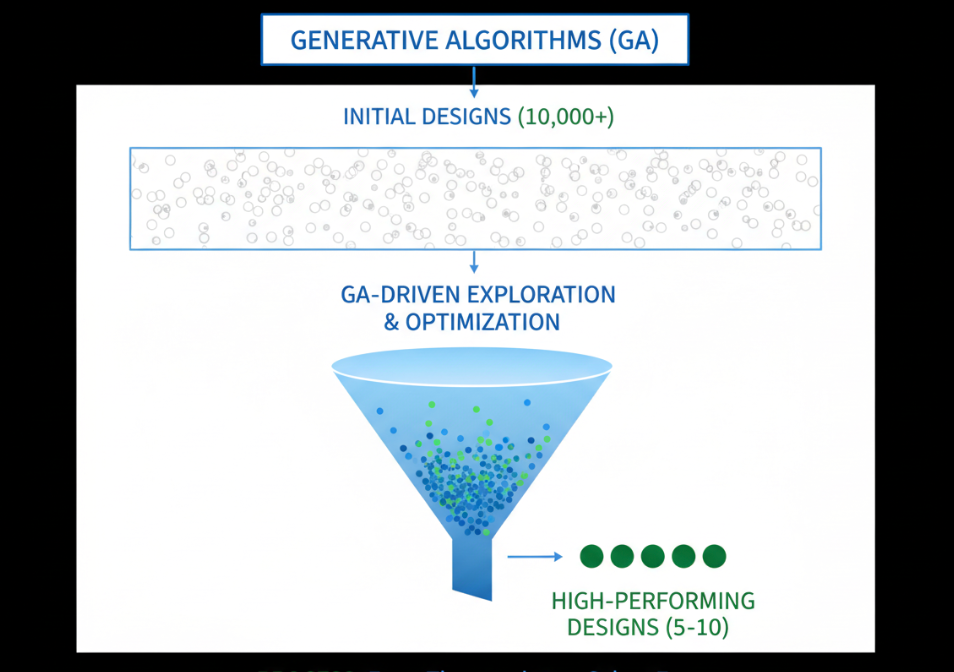
Genetic algorithms are used early, before CAD geometry is finalized, to explore a wide range of blade designs.
Engineers create parameterized models with adjustable features like chord profiles, twist angles, and stackable airfoils, linking them to fast aerodynamic solvers or simplified physics models.
The algorithm tests thousands of design combinations overnight, identifying 10–15 top-performing candidates for detailed CFD analysis.
This approach accelerates the design process, lets teams focus on the most promising options, and ensures efficient, data-driven decision-making from the very start.
During refinement, genetic algorithms are used in optimization loops alongside full-scale simulations.
A typical optimization cycle includes:
- 50–80 generations of evolution
- 30–50 blade geometries tested per generation using RANS or LES solvers
- Real-time monitoring of convergence metrics
- Parameter adjustments when the algorithm shows slow improvement
Promising designs are pulled out mid-process for structural analysis or manufacturing feasibility checks, helping engineers identify practical options sooner.
Outside active design cycles, engineering teams also run longer GA studies to build design databases. These multi-week projects explore extreme scenarios, such as:
- High-altitude or high-temperature conditions
- New materials or composite structures
The data collected feeds into simplified response models that speed up future design work and preserve institutional knowledge across projects.
Integrating genetic algorithms with existing high-performance computing (HPC) systems is simple. They use the same compute clusters, CFD software, and job schedulers already in place for parametric studies.
The key difference is that, instead of engineers manually setting each test, the algorithm automatically adjusts the search based on ongoing performance results.
How BQP Enhances Genetic Algorithm Optimization for Turbine Blades ?
BQP's platform turns quantum-inspired methods into practical tools that deliver immediate value for turbine blade optimization. It helps engineering teams solve complex design problems today while preparing them for the next generation of quantum-accelerated workflows.
By combining quantum-inspired optimization with physics-informed simulations, BQP enables faster convergence, more accurate surrogate modeling, and scalable solutions across aerospace, defense, and energy applications.
Key Advantages:
- Quantum-inspired algorithms deliver up to 20× faster optimization on complex blade design problems with dozens of coupled parameters.
- Simulation-validated intelligence combines physics-based models and real-world data for reliable predictions that reduce the sim-to-real gap.
- Scalable architecture handles single-blade optimization through full fleet-wide design studies without slowing performance.
- Multi-objective optimization balances aerodynamic efficiency, structural integrity, manufacturing feasibility, and cost simultaneously.
- Continuous learning loops update surrogate models with CFD results and physical test data, improving accuracy across design iterations.
BQP transforms genetic algorithm workflows from exploratory searches into intelligent, adaptive systems that learn from every evaluation, optimize across conflicting objectives, and guide design decisions from conceptual geometry to production-ready blades.
Explore how BQP enables quantum-inspired turbine blade optimization that accelerates design cycles and reduces prototyping costs. Book a demo or start your 30-day free trial today.
Conclusion
Genetic algorithms change turbine blade design from manual iteration to intelligent exploration. They find geometries that balance aerodynamic performance, structural integrity, and manufacturing constraints in ways parametric sweeps and gradient-based methods miss.
With BQP's quantum-inspired optimization platform, genetic algorithms become faster, more accurate, and scalable to complex multi-objective problems. From wind turbines to jet engines, this approach enables rapid design iteration, robust performance across operating conditions, and confident transitions from simulation to physical testing.
The competitive edge belongs to teams that can explore high-dimensional design spaces efficiently, validate results against physics-based models, and deliver production-ready blade geometries ahead of project timelines.
FAQ’s
1. At what stage of design are genetic algorithms most useful?
Genetic algorithms are most effective during the conceptual design phase, when blade geometry is still flexible. They help identify the most promising design directions before detailed CAD work begins.
2. How long does a typical optimization cycle take?
A standard GA-driven optimization can run 50–80 generations and usually completes within a few days, depending on computing resources and the complexity of CFD or FEA simulations.
3. Can genetic algorithms work with existing CFD tools?
Yes. Genetic algorithms can be integrated easily with existing CFD software through job schedulers or APIs. They use the same solvers and computing clusters already set up for parametric studies.
4. How do engineers ensure GA results are practical for manufacturing?
Promising blade designs are extracted mid-run and checked for manufacturing feasibility and structural performance. This ensures only physically and economically viable designs move forward.
5.What is a Genetic Algorithm?
A genetic algorithm is an optimization technique inspired by natural selection. It explores many design options simultaneously, selects the best candidates, and iteratively improves them to find optimal solutions.
.png)
.png)



.svg)
.svg)
.svg)
.svg)