



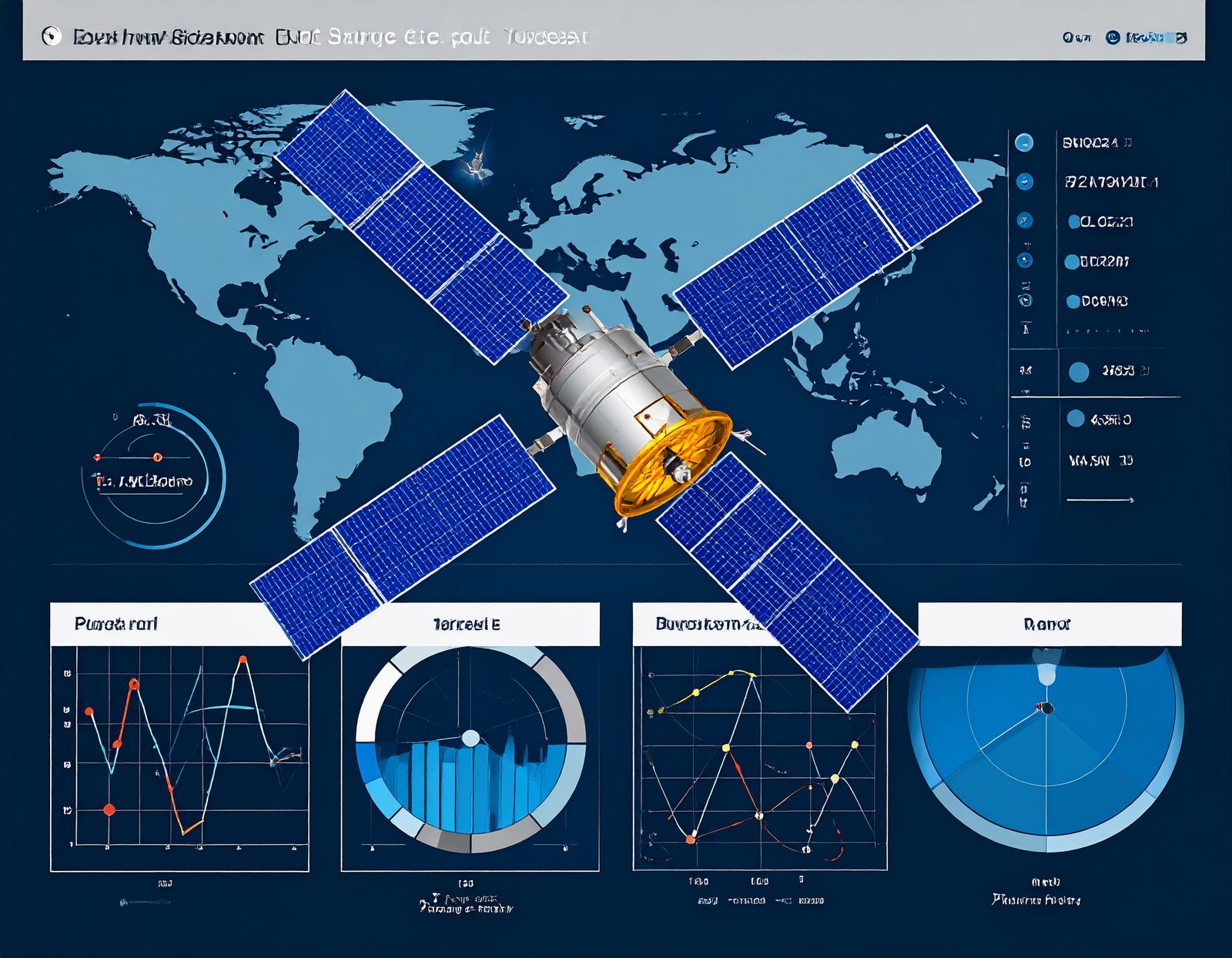

Satellite propulsion systems determine mission capability across station-keeping, orbit transfer, constellation deployment, and end-of-life disposal operations.
Engine performance directly impacts payload mass fraction, mission lifetime, orbital accuracy, and operational flexibility in an industry where every kilogram costs tens of thousands of dollars to launch.
The question isn't whether to optimize propulsion but whether your design framework can simultaneously resolve thrust-power trade-offs, trajectory constraints, thermal limits, and propellant budgets that classical methods address sequentially.
Steps to Optimize Satellite Engine Performance
Satellite engine optimization requires systematic integration of propulsion technology selection, performance parameter definition, trajectory-propulsion coupling, subsystem constraint management, simulation-driven validation, and advanced optimization methodologies. The steps below represent the complete design framework from mission requirements definition through on-orbit performance verification that ensures propulsion systems deliver maximum capability within mass, power, and operational constraints.
Step 1: Propulsion Families and Mission Fit
Chemical propulsion for high-thrust applications
Monopropellant hydrazine thrusters deliver 220-230s specific impulse with thrust levels from 0.5N to 400N, providing rapid orbit adjustments and attitude control for communications satellites and Earth observation platforms. Bipropellant systems using nitrogen tetroxide and hydrazine achieve 290-320s specific impulse, enabling efficient orbit raising and station-keeping for geostationary satellites where transfer time minimization justifies added system complexity and propellant storage requirements.
Electric propulsion for high-efficiency missions
Hall effect thrusters and gridded ion engines achieve specific impulses between 1,500s and 4,200s, reducing propellant mass by 5-10× compared to chemical systems for missions tolerating extended transfer times. Electric propulsion enables constellation deployment where individual satellites perform autonomous orbit raising over weeks or months, freeing launch vehicle upper stages for immediate separation and maximizing rideshare manifest utilization.
Hybrid architectures and emerging technologies
Hybrid systems combine chemical thrusters for rapid maneuvers with electric propulsion for efficient long-duration operations, optimizing overall propellant budget across diverse mission phases. Electrospray and colloid thrusters provide micro-Newton thrust levels for precision formation flying and drag compensation on scientific missions. Green propellants like AF-M315E offer performance approaching hydrazine with reduced toxicity and simpler ground handling.
Step 2: Key Performance Parameters and Propellant Budgeting
Specific impulse and thrust-to-power trade-offs
Specific impulse quantifies propellant efficiency as seconds of thrust per unit mass flow, directly determining propellant mass for given mission delta-v requirements. Electric propulsion specific impulse increases with input power but thrust decreases, creating fundamental trade-offs between transfer time and propellant savings. Optimal specific impulse balances propellant mass reduction against mission timeline constraints and power system sizing impacts.
Propellant mass allocation across mission phases
Satellite lifetime propellant budgets must cover orbit transfer, station-keeping, momentum management, collision avoidance, and end-of-life disposal with margins for uncertainties in atmospheric drag, solar pressure, and third-body perturbations. Station-keeping propellant scales linearly with mission duration, while orbit transfer dominates initial mass budgets. Accurate propellant allocation requires statistical analysis of historical perturbation data and probabilistic collision avoidance frequency predictions.
Thrust duty cycles and operational constraints
Electric thrusters operate continuously during spiral transfers but intermittently during station-keeping, imposing duty cycle requirements that drive component lifetime predictions and redundancy strategies. Thermal cycling from on-off operation accelerates component degradation compared to steady-state operation. Optimal thrust scheduling balances propellant efficiency against thermal stress and component life consumption, trading incremental propellant savings against increased failure risk.
Step 3: Trajectory Coupling and Low-Thrust Maneuver Optimization
Spiral transfer optimization and continuous thrust modeling
Low-thrust orbit raising follows spiral trajectories where continuous tangential thrust gradually increases orbital energy over hundreds of revolutions. Optimal thrust direction varies continuously along each orbit, requiring calculus of variations or direct trajectory optimization to minimize transfer time or propellant consumption. Eclipse periods interrupt thrusting on solar-powered satellites, creating discontinuous thrust arcs that complicate optimization and extend transfer durations by 20-40%.
Gravity assist and multi-body trajectory exploitation
Interplanetary missions employ gravity assists at planets and moons to modify spacecraft velocity without propellant expenditure, enabling missions impossible with direct trajectories. Low-thrust propulsion combines with gravity assists in hybrid trajectories, using continuous thrust during cruise phases and ballistic flyby geometry during planetary encounters. Trajectory optimization couples thrust direction with flyby timing and approach geometry across mission-length time horizons.
Station-keeping strategy and propellant minimization
Geostationary satellites maintain orbital slot assignments through periodic maneuvers correcting east-west drift from longitudinal gravity harmonics and north-south drift from lunar-solar perturbations. Optimal station-keeping minimizes propellant while maintaining position within assigned deadbands, trading maneuver frequency against individual maneuver size. Coordinate multiple satellites in shared slots through synchronized station-keeping strategies that prevent orbital overlap while minimizing collective propellant consumption.
Step 4: Subsystem Constraints and Propulsion Design Trade-Offs
Power system sizing and solar array impacts
Electric propulsion power requirements drive solar array sizing, adding mass that partially offsets propellant savings compared to chemical systems. Optimal power allocation balances propulsion thrust capability against payload operations and spacecraft bus loads across mission lifetime as solar array degradation reduces available power. Beginning-of-life array sizing must accommodate end-of-life degradation while supporting peak propulsion demands during orbit raising when payload operations remain inactive.
Thermal management and heat rejection requirements
Electric thrusters dissipate kilowatts of waste heat that radiators must reject to maintain component temperatures within operating limits. Radiator area scales with thermal load, adding mass and imposing spacecraft configuration constraints on thruster and radiator placement. Optimal thermal design trades radiator mass against thruster operating temperature, accepting higher temperatures that reduce radiator requirements but accelerate component degradation and shorten operational lifetime.
Pointing accuracy and thrust vector control
Thrust misalignment from the center of mass creates unwanted torques that attitude control systems must counteract, consuming reaction wheel momentum or attitude control propellant. Optimal thruster placement minimizes moment arms while satisfying thermal clearances and plume impingement constraints on sensitive surfaces. Gimbal systems provide thrust vector control that eliminates torques but add mass, complexity, and potential failure modes requiring trade studies balancing propellant savings against reliability impacts.
Step 5: Simulation-Driven and Surrogate-Assisted Optimization Workflows
High-fidelity trajectory and propulsion modeling
Accurate mission analysis requires propagating orbital dynamics with complete gravity field models, atmospheric drag, solar radiation pressure, and third-body perturbations while modeling thruster performance degradation over thousands of operating hours. Coupled thermal-electrical-propulsion models capture interactions between power system output, thruster efficiency variations with temperature, and radiator performance across sun angles and orbit positions throughout mission duration.
Reduced-order models and surrogate approximations
High-fidelity simulations consuming hours per trajectory evaluation prohibit direct use in optimization loops requiring thousands of function evaluations. Surrogate models constructed from limited high-fidelity runs approximate system responses using polynomial chaos expansions, Gaussian processes, or neural networks, enabling rapid design space exploration. Adaptive sampling strategies refine surrogates in promising design regions, balancing exploration of unfamiliar parameter combinations against exploitation of known high-performance areas.
Multi-fidelity optimization and progressive refinement
Initial design space screening employs low-fidelity models with simplified physics, identifying candidate architectures for detailed analysis. Progressive refinement increases model fidelity as design converges, using coarse trajectory propagation during conceptual design and full numerical integration with operational constraints during final validation. Multi-fidelity approaches balance computational expense against design confidence, reserving expensive high-fidelity analysis for final design verification rather than exhaustive parameter sweeps.
Step 6: Modern Optimization Approaches for Propulsion Systems
Multi-objective formulation of competing requirements
Satellite propulsion design balances contradictory objectives where propellant mass minimization competes with transfer time reduction, system complexity limitations, and cost constraints. Single-objective optimization produces extreme solutions like minimum-propellant designs requiring decades for orbit transfer or minimum-time chemical systems consuming excessive propellant mass. Multi-objective algorithms generate Pareto frontiers revealing trade-offs, enabling mission planners to select designs balancing performance against practical constraints.
Gradient-based methods for trajectory optimization
Direct trajectory optimization discretizes continuous thrust profiles into control variables, formulating propulsion problems as large-scale nonlinear programs with thousands of decision variables and constraints. Sequential quadratic programming and interior-point methods exploit problem structure, computing analytic gradients through adjoint equations to efficiently navigate high-dimensional design spaces. Gradient methods converge rapidly when initialized near feasible solutions but require multiple starting points to identify global optima in non-convex problems.
Evolutionary algorithms for system-level design
Genetic algorithms and differential evolution handle discrete design choices like thruster selection, propellant type, and hybrid architecture configurations that gradient methods cannot address. Population-based search explores design spaces globally, handling arbitrary constraints and black-box simulation tools without requiring derivative information. Evolutionary approaches require hundreds to thousands of function evaluations, making them suitable for system-level trade studies using surrogate models or parallel computing resources rather than direct high-fidelity optimization.
Why Choose BQP for High-Fidelity Satellite Engine Optimization?
BQP delivers quantum-powered optimization that transforms satellite propulsion design from sequential component selection to integrated system-trajectory co-optimization across complete mission profiles. It integrates directly into spacecraft engineering workflows, enabling simultaneous evaluation of propulsion technologies, power system configurations, trajectory strategies, and thermal management approaches that classical optimization methods cannot explore at mission-relevant timescales.
What makes BQP different
- Quantum-inspired solvers for coupled propulsion-trajectory optimization: QIEO algorithms evaluate thousands of design combinations in parallel, converging on Pareto-optimal configurations up to 20× faster than sequential classical methods that cannot handle combinatorial complexity of thruster selection, power system sizing, trajectory design, and thermal management simultaneously across multi-year mission durations.
- Physics-Informed Neural Networks embedding orbital mechanics: Governing equations for orbital dynamics, propellant consumption, and power system performance are built directly into neural network architectures, ensuring trajectory predictions respect fundamental astrodynamics without requiring full numerical propagation for every design candidate, accelerating trade space exploration by orders of magnitude during preliminary design.
- Quantum-Assisted PINNs for sparse operational data: Accelerate training on limited datasets representing rare but mission-critical conditions where traditional regression models fail. QA-PINNs reduce model size by 10× while improving generalization to uncommanded scenarios like thruster degradation, power system anomalies, and off-nominal attitude conditions that dominate mission risk.
- Mission-level trade-off analysis balancing propellant, time, and power: Quantify how propulsion technology choices affect mission capability across geostationary transfer, constellation deployment, and interplanetary trajectories. Evaluate whether electric propulsion propellant savings justify extended transfer times or whether hybrid architectures deliver better performance than pure chemical or electric systems for specific mission profiles.
- Real-time performance tracking for design iteration and mission operations: Monitor QIEO solver convergence through live dashboards during preliminary design reviews, comparing quantum-optimized propulsion systems against heritage spacecraft performance. Plug hybrid quantum-classical algorithms into existing trajectory tools like STK, GMAT, and FreeFlyer without replacing validated astrodynamics infrastructure.
- Satellite-specific workflows with validated propulsion and power models: Pre-configured templates for Hall thrusters, ion engines, monopropellant, and bipropellant systems with accurate performance curves, degradation models, and thermal characteristics. Integration with industry-standard spacecraft design tools enables seamless adoption within established aerospace development processes and mission assurance requirements.
Book a demo to see how BQP optimizes satellite propulsion on your exact mission requirements from geostationary communications platforms to deep-space exploration spacecraft.
Frequently Asked Questions
What propulsion system provides the best satellite performance?
No single propulsion technology dominates across all missions. Chemical systems deliver high thrust for rapid maneuvers but consume more propellant. Electric propulsion achieves superior specific impulse reducing propellant mass but requires extended transfer times and substantial power systems. Optimal selection depends on mission delta-v requirements, timeline constraints, power availability, and launch vehicle integration that varies across geostationary, LEO constellation, and interplanetary applications.
How does trajectory optimization improve propulsion efficiency?
Trajectory-propulsion co-optimization identifies thrust profiles that minimize propellant consumption while satisfying orbital accuracy, transfer time, and operational constraints. Low-thrust spirals optimize continuous thrust direction across hundreds of orbits rather than using fixed tangential thrust that wastes propellant. Station-keeping strategies coordinate maneuver timing and magnitude to maintain orbital slot requirements with minimum propellant expenditure over multi-year mission durations.
Why is multi-objective optimization essential for satellite propulsion design?
Satellite propulsion balances contradictory requirements where propellant minimization competes with transfer time reduction, power system mass, and operational complexity. Single-objective approaches produce impractical extreme solutions. Multi-objective frameworks generate Pareto frontiers revealing fundamental trade-offs between performance metrics, enabling mission planners to select designs aligned with programmatic priorities whether emphasizing rapid deployment or maximum payload mass fraction.
How do power system constraints affect electric propulsion design?
Electric thruster performance couples directly to available electrical power from solar arrays or nuclear sources. Higher power enables greater thrust reducing transfer time but adds solar array mass that partially offsets propellant savings. Optimal power allocation balances propulsion performance against payload operations across mission lifetime as solar degradation reduces available power, requiring beginning-of-life sizing that accommodates end-of-life capability while supporting orbit raising and station-keeping.
Can quantum-inspired optimization handle satellite mission design constraints?
BQP integrates with validated astrodynamics tools, maintaining traceability and verification standards required for mission-critical spacecraft design. Quantum-optimized propulsion systems undergo the same trajectory validation, propellant margin analysis, and failure mode assessment as conventionally designed satellites. Integration with industry-standard tools like STK and GMAT enables seamless adoption within established spacecraft development processes while role-based access supports multi-organization collaboration across satellite programs.
.png)
.png)

.svg)
.svg)
.svg)
.svg)