



Coordinating multiple UAVs to perform different missions at the same time is never simple. Modern operations often involve mixed fleets handling surveillance, delivery, rescue, or strike missions under tight timelines and changing conditions.
Traditional planning methods like the Hungarian algorithm or greedy heuristics work fine for small missions. But as the number of UAVs and tasks increases, they become slower, less accurate, and struggle to adapt when mission conditions change.
Genetic Algorithms (GA) offer a smarter, more flexible way to solve these complex assignment challenges. In this blog, you’ll learn how GAs work, their key variants for UAV missions, real-world applications and results, common challenges, and how BQP’s simulation platform helps test and validate GA-based strategies before they’re used in real operations.
What is a Genetic Algorithm?
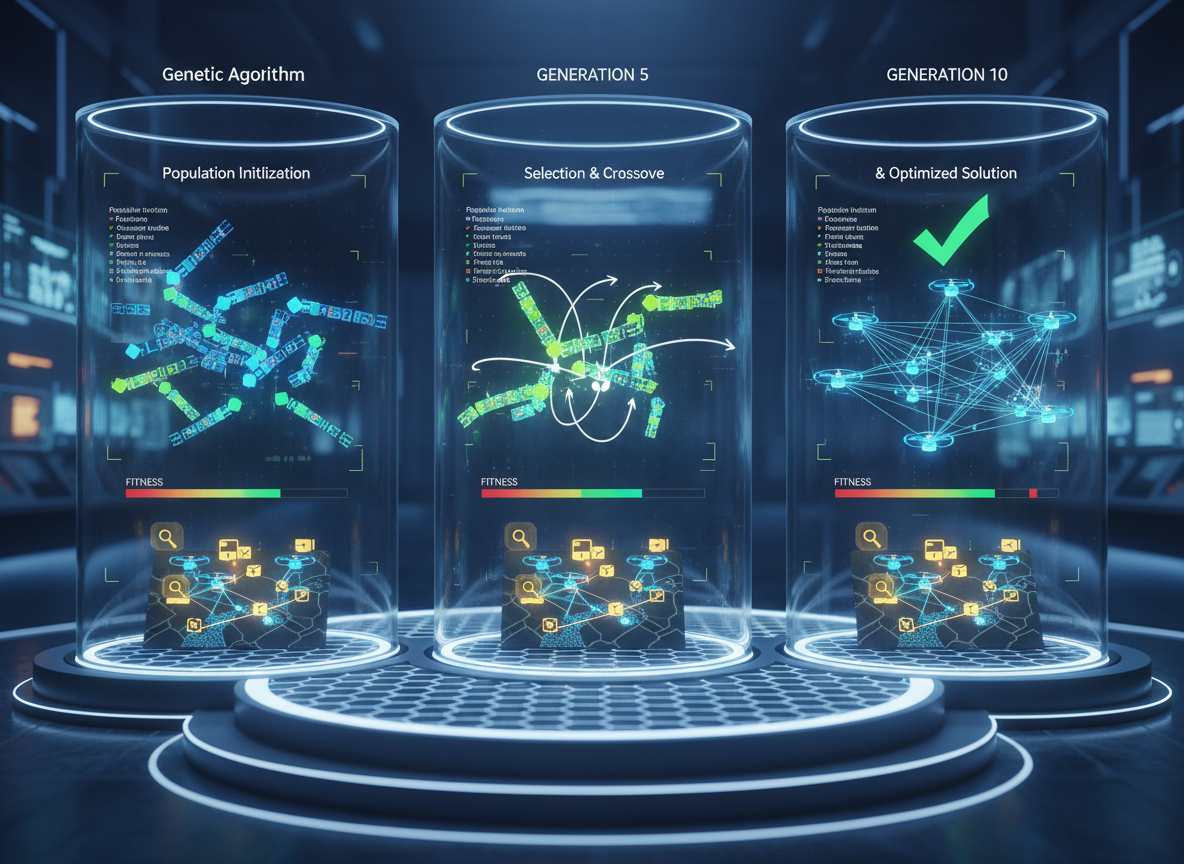
A Genetic Algorithm (GA) is an optimization method inspired by natural evolution. Instead of testing every possible plan, it starts with several random options and improves them over time using simple rules selection, crossover, and mutation.
How it works:
- Start with random task plans (each called a “chromosome”).
- Keep the better ones based on performance.
- Mix and slightly change them to create new plans.
- Repeat until results stop improving.
In UAV missions, each chromosome represents a full task plan who does what, when, and in what order. The algorithm measures how well each plan meets mission goals like fuel efficiency, timing, and coverage.
Why GA works well for UAV task planning:
- Manages multiple constraints like fuel, timing, and UAV limits.
- Adapts easily to different mission types.
- Find strong solutions fast without checking every option.
That’s why GA is widely used in both research and real UAV operations, especially for missions that involve many objectives or constantly changing conditions.
Why Extending Standard GA is Necessary for Multi-UAV Task Problems
A basic Genetic Algorithm works for simple UAV assignments, but real missions are more complex. As fleets and tasks increase, standard GA struggles to keep up.
1. Scalability limits
When missions scale from 5 UAVs and 10 tasks to 20 UAVs and 50 tasks, the number of possible combinations explodes. Basic GA takes too long or gets stuck exploring the same options without finding better ones.
2. Limited view of trade-offs
Real missions have multiple goals: save fuel, finish on time, reduce risk, and maintain communication. A standard GA combines all this into one score, hiding valuable trade-offs. Planners need several good options that balance these goals differently.
3. Different UAV types need special handling
In mixed fleets, some UAVs are built for speed, others for long endurance or better sensors. A basic GA treats them all the same. You need custom encodings and scoring methods that match UAV strengths to the right tasks.
4. Poor adaptability to change
Missions rarely go exactly as planned. Weather shifts, UAVs fail, and new targets appear. Standard GA isn’t built for quick re-assignment; it often has to start over. Advanced GA versions can adapt on the fly without losing progress.
These limits don’t make GA a bad choice; they highlight why extended GA methods are essential for modern UAV task assignment. The next section explains the key variants designed to overcome these challenges.
Key GA Variants & Extensions Used in Multi-UAV Task Assignment
Different missions require different versions of Genetic Algorithms (GA). Over time, researchers and engineers have developed several GA variants to handle the unique challenges of multi-UAV planning.
Choosing the Right Approach
- Standard GA: Use for small tests or limited computing resources.
- Distributed GA: Use for large fleets (15+ UAVs) where local computation is faster.
- MOGA: Use when missions have multiple competing goals and planners need trade-off options.
- Hybrid GA: Use when pure GA slows down or misses good solutions.
- Adaptive GA: Use when conditions or constraints change often.
In real operations, teams often combine these methods. For example, a distributed MOGA might run across multiple stations, or an adaptive hybrid GA might adjust its settings while refining solutions locally.
The key is to match the variant to your mission needs, not just pick the most complex one. A well-chosen GA setup always beats an over-engineered one.
Applications of GA for Multi-UAV Task Assignment
Genetic Algorithms (GA) have shown strong results across a wide range of UAV missions. They’re used in real-world operations where efficiency, adaptability, and quick decision-making matter most.
Disaster Response and Search Operations
In disaster zones, time is critical. GA helps assign UAVs to search areas, coordinate communication relays, and prioritize rescue zones based on factors like population density or damage level.
Studies show GA-based planning can generate effective search routes 30–40% faster than manual methods saving crucial minutes during emergency missions.
Surveillance and Reconnaissance
In wide-area monitoring, fleets often include UAVs with different sensors, cameras, and flight ranges. GA assigns each UAV to the targets that best match its capabilities—high-resolution drones for key targets, long-endurance drones for extended coverage.
This approach improves coverage quality and mission duration, balancing UAV strengths across the field.
Logistics and Delivery
Both military and commercial delivery missions use GA to plan efficient routes and assignments. It factors in payload limits, battery life, delivery windows, and return paths.
Tests show GA-based planning can improve delivery efficiency by 25–35% compared to simple nearest-location methods.
Intelligence, Surveillance, and Reconnaissance (ISR)
ISR missions are dynamic targets move, threats appear, and priorities change. Adaptive GA variants continuously update task assignments in real time, ensuring UAVs respond quickly to new intelligence or risks.
Some systems re-optimize assignments every few minutes, keeping missions effective even under shifting conditions.
Multi-Objective Mission Planning
In missions that balance fuel, time, and risk, Multi-Objective GA (MOGA) generates multiple strong solutions instead of just one. This gives planners a clear view of trade-offs and helps choose the most practical plan for real operations.
Together, these applications prove that GA isn’t just a research tool—it’s a proven, field-ready approach for real UAV missions where adaptability, precision, and speed are essential.
Challenges When Using GA for Multi-UAV Task Assignment
Genetic Algorithms are powerful, but real UAV missions bring practical challenges that need careful planning:
1. Scalability
When you have more UAVs and tasks, there are way too many possible assignments. For example, 20 UAVs and 50 tasks make an almost impossible number of options. GA can’t check them all, and finding good plans can take a long time. Using Distributed or hybrid GA can help, but it’s more complicated.
2. Real-Time Adaptation
UAVs can fail mid-mission, or new high-priority tasks may appear. Standard GA is too slow to restart from scratch. Solutions include maintaining partial populations ready for updates or warm-start techniques that adjust existing solutions quickly.
3. Handling Constraints
Real missions have limits like fuel, communication range, timing, sensor coverage, and no-fly zones. It’s tricky to include all these in GA. Too strict, and most solutions won’t work; too loose, and the best-looking plans might fail in real life.
4. Parameter Tuning
GA performance depends on population size, crossover rate, mutation rate, and selection pressure. What works for one mission may fail for another. Finding good settings often requires trial, error, and testing.
5. Validation for Real Operations
Assignments that look good in simulation may fail in the real world due to wind, communication issues, or sensor limits. Extensive testing in realistic conditions is essential to ensure plans actually work.
These challenges aren't reasons to avoid GA, they're factors to plan for. Understanding them helps you choose the right GA variant, set realistic expectations, and design systems that work reliably in operational conditions.
How BQP Enhances GA-Driven Multi-UAV Task Assignment
Using genetic algorithms (GA) for UAV task assignment is only part of the solution. You also need to make sure GA-generated plans actually work in real missions. BQP’s simulation platform turns theoretical GA assignments into proven operational plans.
High-fidelity mission simulation
BQP simulates real UAV flight dynamics, sensor performance, and communication links. When GA suggests a task assignment, the simulator checks if UAVs can reach targets on time, maintain communication, and meet fuel limits. This catches problems that simple GA calculations might miss.
Built-in GA support
BQP supports standard GA, distributed GA, multi-objective GA, and hybrid approaches. You don’t need to build or connect external tools. The platform handles population management, parallel evaluation, and tracking results automatically.
Real-time re-assignment testing
BQP lets you test GA plans under changing conditions. You can simulate UAV failures, new tasks, or emerging threats mid-mission to ensure GA can quickly update assignments. This proves your system works in real operational scenarios.
Faster optimization with surrogate models
Full physics simulations for every GA assignment can be slow. BQP uses fast surrogate models to quickly screen options, then runs full simulations only on the most promising ones. This speeds up optimization without losing accuracy.
Digital twin rehearsal and performance tracking
Rehearse GA-optimized plans in a digital twin of your operational area. Test across weather changes, communication dropouts, and UAV performance variations. Dashboards show real-time GA progress, compare results with other methods, and highlight which constraints matter most. This helps fine-tune GA settings and build confidence in mission-ready assignments.
Ready to validate your GA-based task assignment system?
Schedule a consultation with BQP to see how high-fidelity simulation can prove your genetic algorithm strategies work before field deployment.
Conclusion
Genetic algorithms are a practical choice for multi-UAV task assignment, especially when missions are complex. Standard GA is a good starting point, but real operations often need extensions of distributed GA for large fleets, multi-objective GA for balancing competing goals, or hybrid GA for tough constraints.
Success isn’t just about using a smart algorithm, it's about making sure the assignments work in real missions.
BQP’s simulation platform fills that gap. By testing GA-generated plans in realistic, high-fidelity environments before actual deployment, you can confidently use task assignment systems that are proven to perform in the real world, not just in theory.
FAQs
What’s the difference between standard GA and distributed GA?
Distributed GA runs multiple smaller populations in parallel and shares the best solutions, making it faster for large fleets. Standard GA uses a single population, which can slow down as problems grow.
When should I use a hybrid GA?
Use hybrid GA when the search is large or complex, and standard GA gets stuck. It combines GA’s broad search with local refinements like PSO or Simulated Annealing for faster, better results.
How many UAVs and tasks can GA handle?
GA can handle 20–30 UAVs with 50+ tasks when optimized. Larger problems usually need distributed GA or surrogate-assisted methods.
Can GA handle dynamic mission changes?
Yes, with adaptive features like warm-starts or distributed updates. These allow GA to reassign tasks quickly when UAVs fail or new tasks appear.
How do I ensure GA assignments are safe?
Test assignments in high-fidelity simulations and digital twins, use constraint-aware encoding, and start with simple missions before scaling up.
.png)
.png)



.svg)
.svg)
.svg)
.svg)