




Classical computing has driven decades of progress in aerospace and mission planning. But as problems grow simulating complex physics, optimizing large fleets, or processing massive sensor data traditional algorithms start hitting limits. They can take too long, require huge memory, or produce rough answers that miss critical details.
Quantum algorithms work differently. They use quantum properties like superposition and entanglement to explore solutions in ways classical computers cannot. For the right problems, this can mean dramatic speed-ups turning calculations that would take years into hours or minutes.
Full-scale quantum computers aren’t ready yet. Hardware still faces limits, with few qubits and high error rates. Yet the algorithms themselves are already useful: quantum-inspired methods on classical systems and hybrid approaches are delivering results today, letting engineering teams gain practical benefits while preparing for future quantum hardware.
In this guide, we’ll explain what quantum algorithms are, highlight key types and their engineering applications, outline current challenges, and show how platforms like BQP help turn quantum theory into real mission-ready solutions.
What Is a Quantum Algorithm?
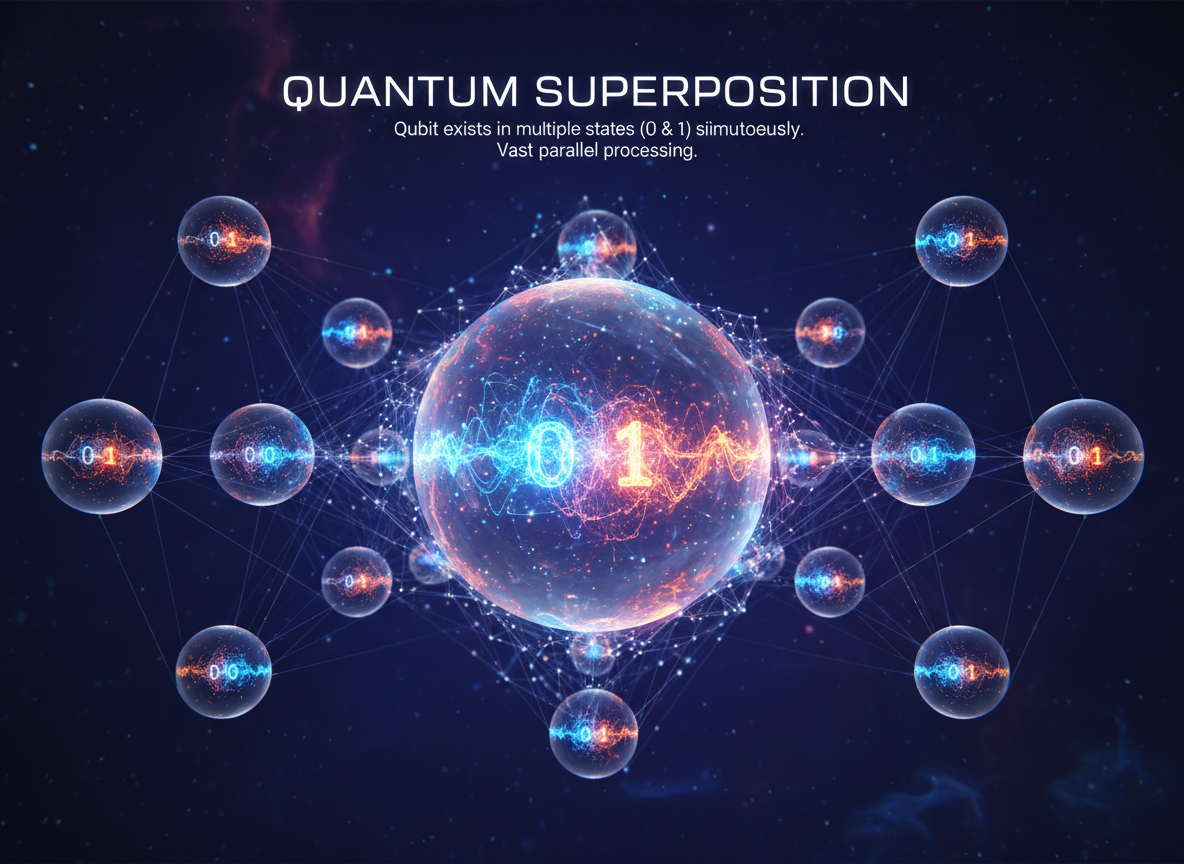
A quantum algorithm is a set of steps designed to run on a quantum computer. Unlike classical algorithms, which work with bits (0s and 1s), quantum algorithms use qubits. Qubits can represent multiple values at once, thanks to a property called superposition.
How they differ from classical algorithms:
- Quantum operations: Instead of simple on/off switches, quantum gates rotate and link qubits in complex ways.
- Parallel processing: Superposition lets a qubit explore many possibilities at the same time, while entanglement links qubits so their states affect each other.
- Targeted speed-ups: Quantum algorithms aren’t faster for everything—they excel at problems where classical methods struggle.
- Delicate design: Qubits are sensitive, so algorithms must amplify correct answers and suppress wrong ones before reading results.
Performance gains:
- Quadratic: Some algorithms solve problems in √N steps instead of N.
- Exponential: Others turn problems that grow exponentially with size into ones solvable in polynomial time. These are game-changing for certain tasks.
Key techniques used:
- Amplitude amplification – improves the chance of the correct solution.
- Phase estimation – extracts important properties from qubit states.
- Quantum walks – explores structured search spaces efficiently.
- Quantum Fourier transforms – analyzes patterns and frequencies in data.
For engineering teams, the focus isn't physics—it’s understanding which problems gain from quantum approaches and how to use them in practice.
Key Quantum Algorithm Types & How They’re Used
Quantum algorithms come in different types, each suited to certain problems. Here’s a simple guide for engineering and mission planning:
How to pick the right one:
- Quantum search – best for finding items in huge, messy datasets.
- Fourier methods – useful when you need frequencies or patterns.
- Algebraic algorithms – good for problems with hidden math structure.
- Quantum simulation – necessary when classical simulations can’t handle the system.
- Hybrid algorithms – practical now, since full quantum computers aren’t ready.
Most engineering work today relies on hybrid algorithms and quantum simulation, since they run on current or near-term hardware. Pure algorithms like Shor’s need error-free quantum computers, which don’t exist at scale yet.
How Quantum Algorithms Work?
Quantum algorithms don’t work like classical ones that follow step-by-step instructions. Instead, they manipulate quantum bits (qubits) in ways that let them explore many possibilities at once. Here’s the basic idea:
Superposition lets qubits explore multiple options at once:
Classical bits are either 0 or 1. Qubits can be 0 and 1 at the same time, representing many possible states simultaneously. This doesn’t mean they test every option, but it allows the algorithm to explore solutions in ways classical computers can’t.
Entanglement links qubits for coordinated work:
When qubits are entangled, changing or measuring one affects the others. This helps algorithms understand relationships between variables faster than classical methods, which handle each separately.
Interference favors the right answers:
Quantum algorithms are designed so wrong answers cancel out and correct ones are strengthened. By the end, the most likely outcome is the correct solution.
Measurement gives usable results:
After processing, qubits are measured and collapse to classical 0s and 1s. Well-designed algorithms make it likely that the measured result is correct. Sometimes multiple runs are needed, but far fewer than testing all possibilities classically.
Types of speed-up:
- Quadratic: Finds items in √N steps instead of N (like Grover’s algorithm).
- Exponential: Reduces some problems from exponential time to polynomial (like Shor’s algorithm).
- Small gains: Some algorithms give modest but useful improvements.
Quantum algorithms excel in specific problem types, especially where superposition and entanglement provide a natural advantage. They won’t replace classical computers for everything but can solve certain challenges much faster.
Applications of Quantum Algorithms in Engineering & Mission Systems
Quantum algorithms aren’t just theoretical—they are starting to provide real benefits in engineering, even before full-scale quantum computers exist.
1.Simulating physical systems for design:
Classical simulation of molecules, materials, or chemical reactions becomes extremely hard as the system grows. Quantum algorithms can model these systems directly, helping engineers design better materials, improve propulsion systems, or analyze structures more accurately.
Early work focuses on optimizing materials and understanding failures at the molecular level.
2.Signal processing and sensor fusion:
Quantum techniques like Fourier transforms and phase estimation can analyze signals and detect patterns faster. For missions with multiple sensors needing real-time data processing, quantum methods can handle streams more efficiently than classical filtering.
3.Secure communications and encryption:
Quantum algorithms like Shor’s can break traditional encryption methods (RSA, elliptic curve), which pushes the need for quantum-safe approaches. At the same time, quantum methods can create new, highly secure communication protocols that are provably safe.
4.Large-scale mission planning and optimization:
Hybrid quantum algorithms, such as QAOA, help solve complex planning problems—like allocating resources, routing, and scheduling under many constraints. They show promise where classical methods struggle or take too long.
5.Real-time diagnostics and fault detection:
Quantum search methods can quickly explore possible failure scenarios in complex systems, helping engineers detect issues faster than classical methods.
Challenges of Quantum Algorithms in Current Engineering Contexts
Quantum algorithms have great potential, but there are real challenges before they become standard engineering tools:
Hardware limitations:
Today's quantum computers have few qubits (usually under 1000), short operational times, and high error rates. Most algorithms need many more qubits and lower error rates than currently available.
Problem-specific requirements:
Many quantum algorithms only work efficiently on problems with certain patterns or structures. Real-world engineering problems don’t always match these requirements.
Integration with existing systems:
Using quantum algorithms alongside classical workflows requires building hybrid systems. This involves new software, specialized skills, and careful coordination between classical and quantum parts.
Validation for critical systems:
Aerospace and defense demand high reliability and safety. Quantum algorithms, especially on noisy hardware, need thorough testing and validation, which are not fully established yet.
Gap between theory and practice:
Theoretical speed-ups often assume ideal conditions. In reality, overhead from error correction, state preparation, and classical-quantum communication can reduce or cancel the advantages until hardware improves.
How BQP Harnesses Quantum Algorithms for Engineering Missions
Quantum algorithms have great potential, but engineering teams need practical ways to use them now, without waiting for perfect quantum hardware. BQP bridges that gap.
Quantum-inspired algorithms on classical hardware:
BQP runs quantum-inspired methods on standard computers. These borrow ideas from quantum computing but work today, giving teams optimization and simulation benefits while preparing for future quantum hardware.
Hybrid simulation platforms:
BQP combines classical and quantum-inspired approaches. Quantum-inspired methods handle complex optimization, while classical simulations manage detailed system modeling. This ensures the right tool is used for each part of the mission.
Digital twin validation:
Before real deployment, quantum algorithm outputs can be tested in high-fidelity digital twin environments. This confirms that solutions will work under real mission conditions, not just in theory.
Surrogate modeling for safer testing:
BQP uses surrogate models to approximate quantum algorithm behavior. This allows exploration of quantum advantages with less risk and lower resource investment.
Ready to explore quantum algorithms for your missions?
Contact BQP to see how quantum-inspired methods can improve your system design and mission planning today, while preparing for tomorrow's quantum hardware.
Conclusion
Quantum algorithms are changing what's possible in simulation, optimization, and mission planning. They’re not just theory; the methods exist today and can provide real value for engineering projects.
Even though full quantum computers are still in development, teams don’t need to wait. Quantum-inspired and hybrid approaches deliver benefits now using regular computers.
With BQP’s platform for quantum-inspired optimization and simulation, teams can start applying these advantages immediately, preparing for the future while making practical progress today.
FAQs
What's the difference between quantum and classical algorithms?
Quantum algorithms use superposition, entanglement, and interference to process many possibilities at once enabling speed-ups classical algorithms can't match for certain problems. Classical algorithms process sequentially or in parallel, but can't exploit quantum effects.
Are quantum algorithms ready for real missions today?
Not fully hardware limits remain significant. But quantum-inspired methods and hybrid workflows deliver benefits in simulation, design, and optimization today on classical systems, preparing teams for when full quantum hardware matures.
Which engineering problems benefit most?
Problems with large-scale search or combinatorial complexity optimization, routing, physical system simulation gain the most from quantum techniques. Problems with specific math structure (factoring, hidden patterns) also benefit significantly.
What platforms exist to experiment with quantum algorithms?
Several cloud quantum services IBM Quantumand open-source tools (Qiskit, Cirq) let teams learn and test quantum algorithms. These provide access to real quantum hardware and simulators for development.
When will quantum algorithms become mainstream in aerospace?
Broad adoption depends on quantum hardware advances, error correction, and system integration. Hybrid workflows today bridge the gap, enabling early adoption while full quantum capability develops over the next 5-10 years.
.png)
.png)



.svg)
.svg)
.svg)
.svg)