



The quantum computing market is projected to grow from $3.52 billion in 2025 to $20.2 billion by 2030, a 41.8% CAGR driven by optimization use cases in aerospace, defense, logistics, and finance. Companies building the hardware, software, and integrated platforms behind this shift are making decisions that will define who leads the next decade of mission-driven engineering.
Engineering and mission-planning teams need clarity on which companies focus on quantum optimization, quantum-inspired simulation, cloud access, or full-stack quantum hardware. Knowing each player's strengths helps align technology choices with operational requirements, reducing risk and accelerating results.
In this guide, we highlight seven leading quantum computing companies in 2026, exploring their focus areas, strategic advantages, key features, use cases, and what makes them suitable for mission and engineering teams helping you evaluate partners, plan adoption, and leverage quantum technologies effectively today.
Top 7 Leading Quantum Computing Companies in 2026
These companies represent the forefront of quantum computing, each with unique strengths in hardware, software, and quantum-inspired solutions. Understanding their focus helps engineering and mission teams choose the right tools and partners.
1. BQP
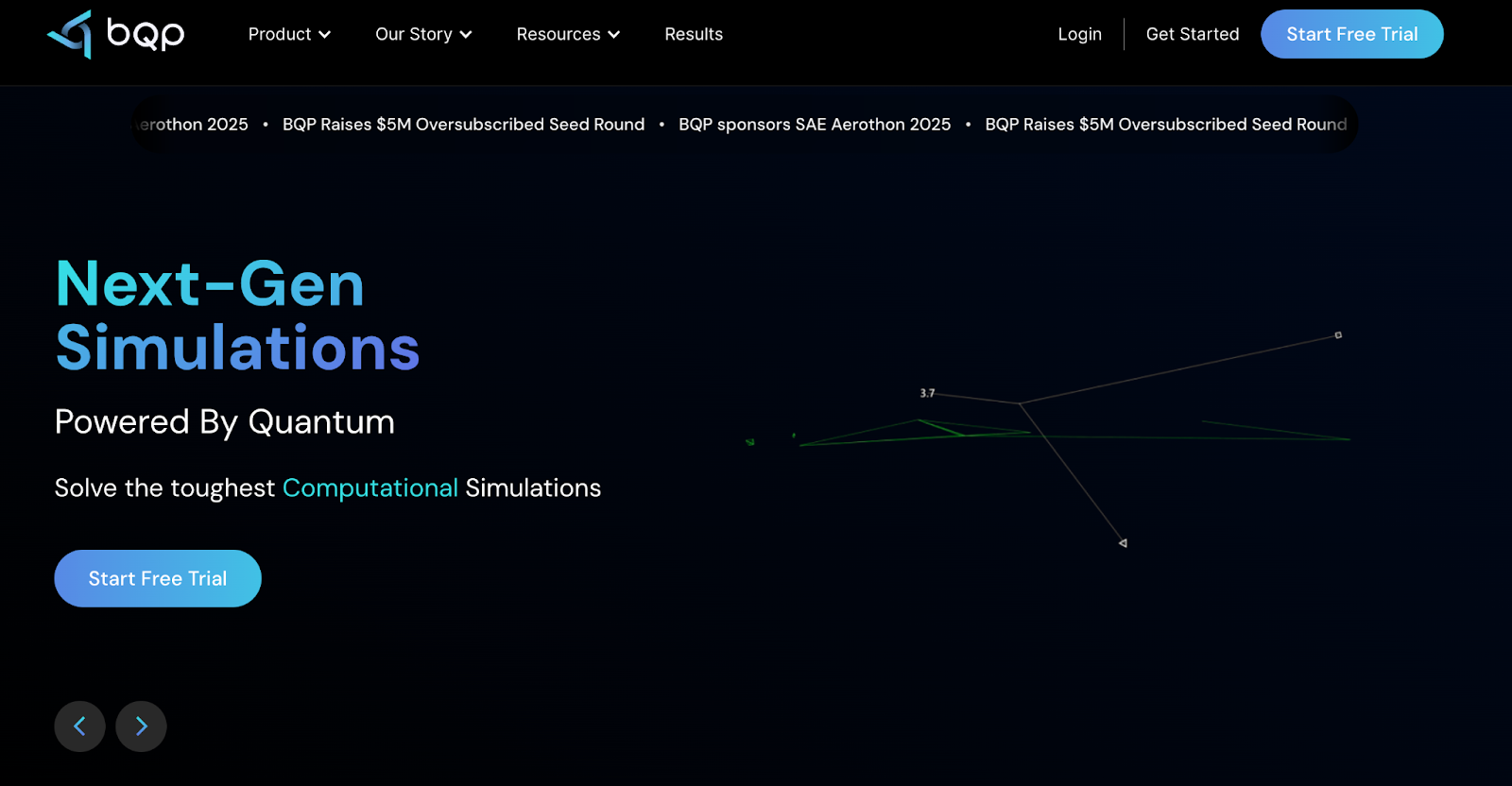
BQP provides quantum optimization software designed specifically for aerospace and defense mission planning. By leveraging advanced quantum-inspired algorithms, it enables teams to tackle complex optimization problems like multi-UAV task assignment, satellite scheduling, and trajectory planning directly on classical hardware, delivering measurable results today.
Focused on mission-specific workflows, BQP integrates seamlessly with simulation pipelines and digital twin environments. Teams gain practical quantum-style benefits now while preparing for future quantum hardware, accelerating adoption without disrupting existing systems.
Key Features:
- QIO-powered solvers delivering up to 20× faster optimization than classical methods
- Hybrid quantum-classical workflows for trajectory planning, UAV coordination, satellite scheduling
- Digital twin environments for testing quantum algorithms under realistic mission conditions
- Physics-Informed Neural Networks (PINNs) and Quantum-Assisted PINNs
- Seamless integration with existing simulation pipelines no system overhauls required
Use Case: Multi-UAV task assignment, aerospace trajectory optimization, mission scheduling under constraints, digital twin simulation for defense systems
Best For: Aerospace and defense teams needing practical quantum-inspired optimization today without waiting for quantum hardware maturity
Pros:
- Works on existing infrastructure (no quantum hardware needed)
- Mission-specific tools rather than generic quantum programming
- Proven results in operational aerospace applications
- Lower barrier to entry than full quantum platforms
Cons:
- Requires familiarity with existing simulation pipelines for seamless integration.
2. IBM
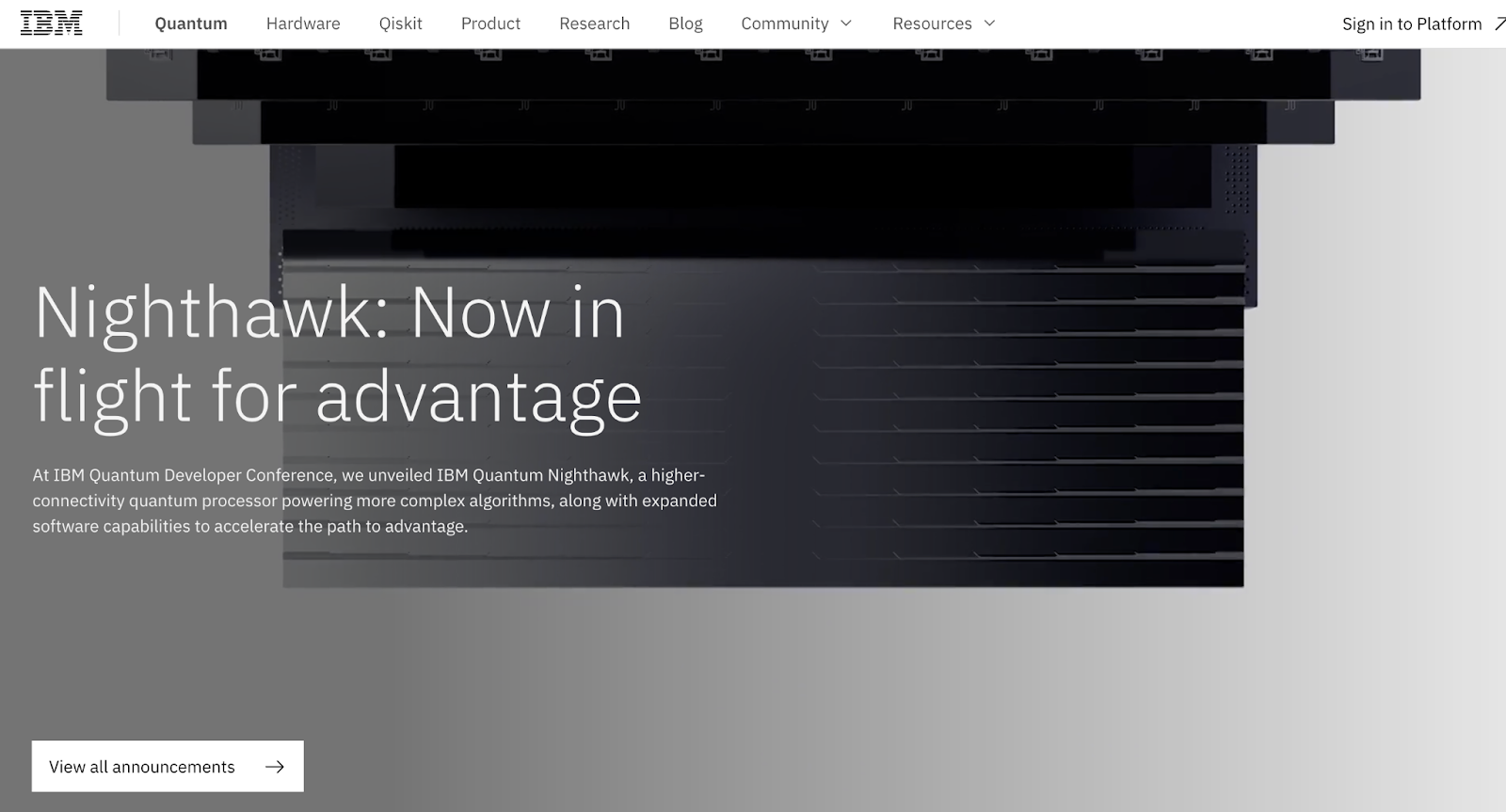
IBM leads the quantum hardware race with superconducting processors and a robust cloud platform. Their tools enable engineering teams to experiment with real quantum systems while integrating with classical workflows.
With Qiskit, developers access open-source software, tutorials, and a large community, making it easier to model complex optimization, simulation, and mission-planning problems. IBM provides a clear roadmap toward fault-tolerant quantum computing, supporting hybrid workflows today.
Key Features:
- Nighthawk processor (120 qubits, 5000+ gate capability by end 2025)
- Quantum Loon processor demonstrating all fault-tolerant computing components
- Qiskit SDK with massive community support and extensive documentation
- IBM Quantum Platform providing cloud access to real quantum hardware
- Roadmap to fault-tolerant quantum computing by 2029
Use Case: Algorithm research, quantum chemistry simulation, optimization problems, quantum machine learning experiments
Best For: Organizations wanting access to cutting-edge quantum hardware with robust software tools and large developer community
Pros:
- Most mature quantum ecosystem with extensive learning resources
- Regular hardware access through cloud platform
- Open-source Qiskit reduces vendor lock-in
- Clear roadmap with consistent delivery
Cons:
- Superconducting qubits require cryogenic cooling
- Error rates still limit practical applications
- Premium pricing for extended hardware access
3. Microsoft (Azure Quantum)
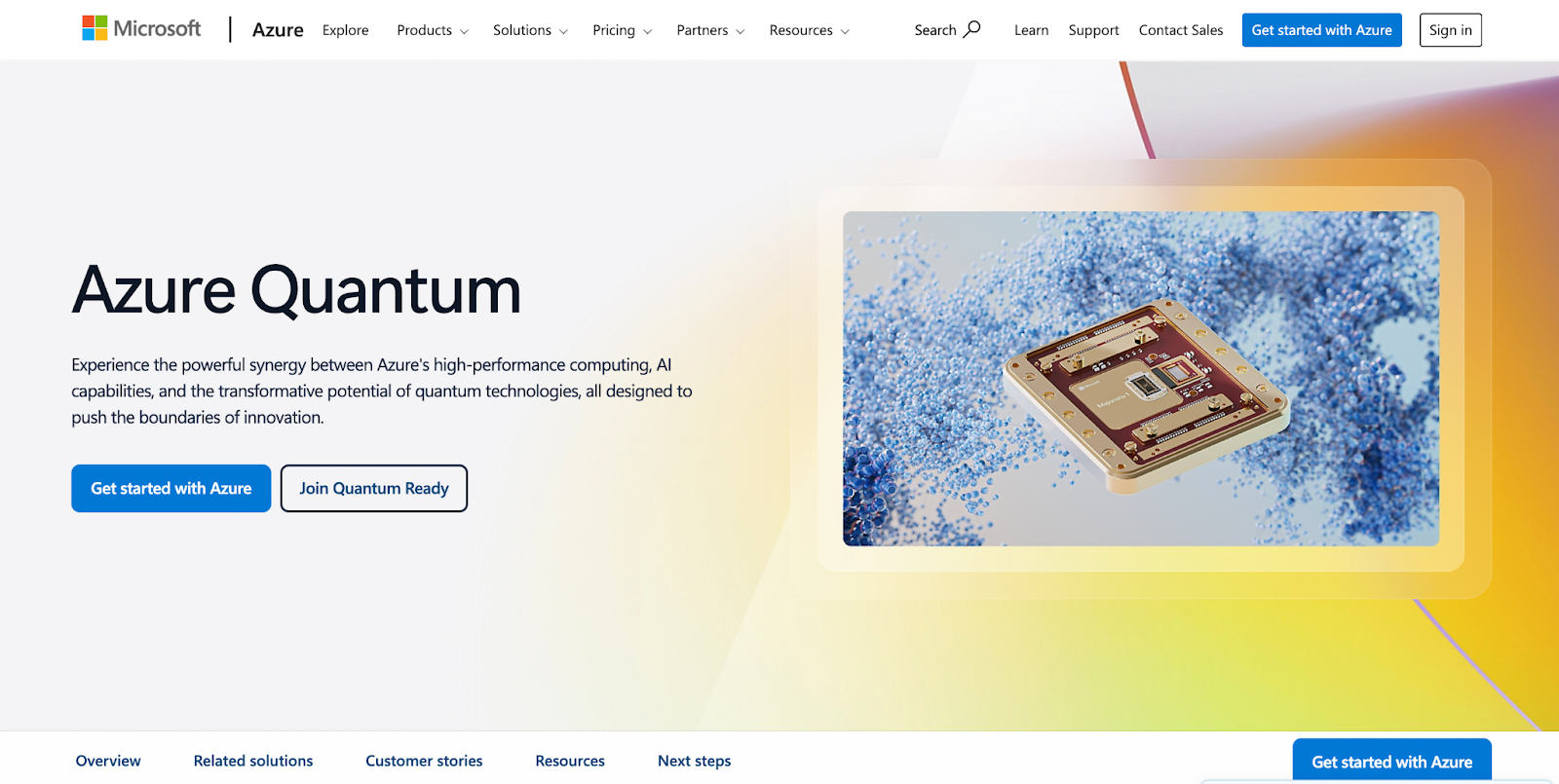
Microsoft combines topological qubits with access to multiple hardware partners, giving engineering teams flexible quantum solutions integrated into Azure’s cloud ecosystem. Its platform supports hybrid quantum-classical workflows for mission planning and optimization.
Q# programming language and the Quantum Ready program help teams model complex problems and prepare for quantum adoption. Microsoft’s ecosystem enables mission-critical simulations, secure cryptography testing, and alignment with existing Azure infrastructure.
Key Features:
- Majorana 1: world's first topological qubit processor
- 24 entangled logical qubits demonstrated with Atom Computing
- Q# programming language designed specifically for quantum
- Access to multiple hardware providers (IonQ, Quantinuum, Atom Computing)
- Quantum Ready program helping organizations prepare strategies
Use Case: Hybrid quantum-classical workflows, Azure-integrated quantum applications, quantum-safe cryptography preparation
Best For: Enterprises already using Azure infrastructure wanting quantum capabilities without switching cloud providers
Pros:
- Hardware diversity through multiple partnerships
- Seamless Azure ecosystem integration
- Topological approach promises inherently lower error rates
- Strong enterprise support and consulting
Cons:
- Topological qubits still in early development stages
- Requires Azure commitment for full integration benefits
- Steeper learning curve for Q# vs. Python-based tools
4. Amazon (Braket)
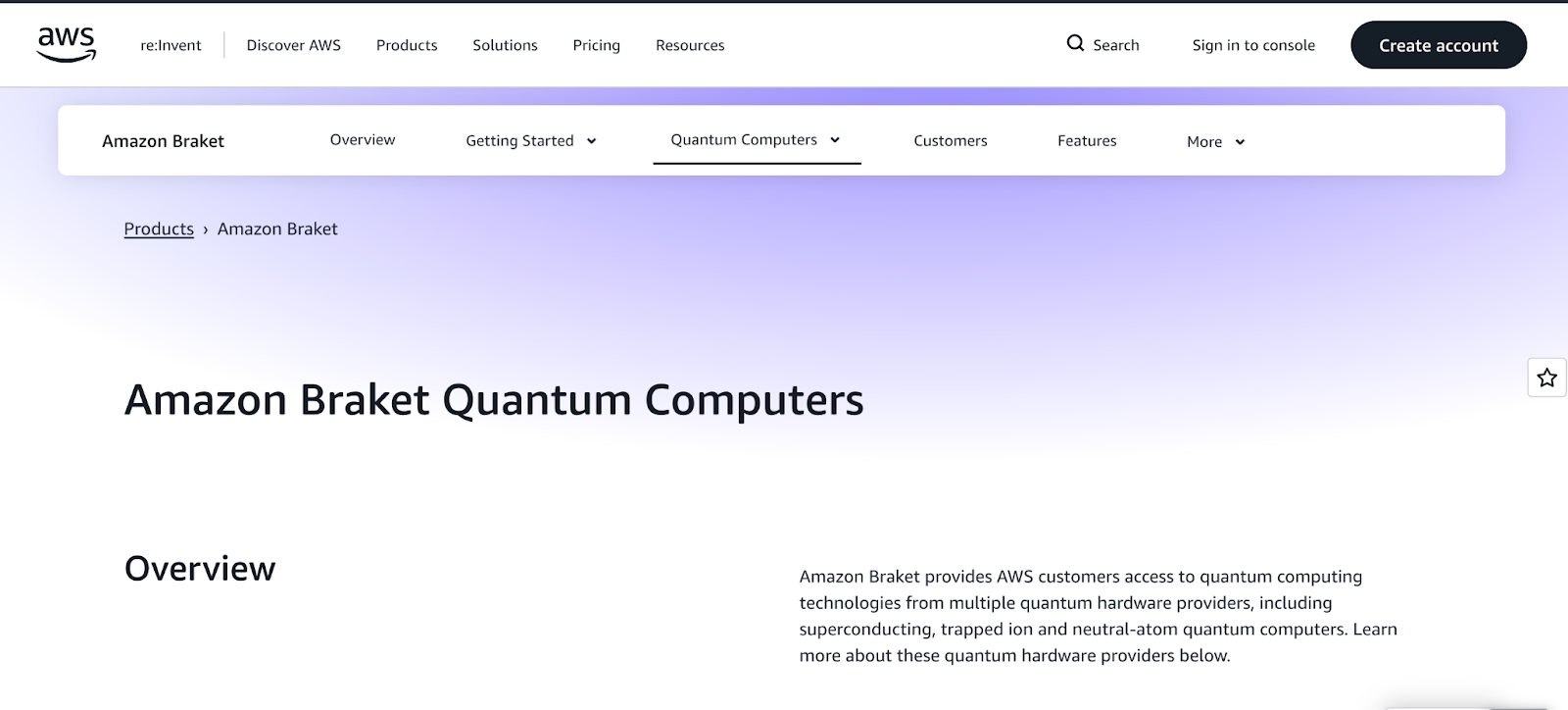
Amazon Braket provides a cloud-based interface to multiple quantum hardware types, allowing teams to experiment across superconducting, trapped-ion, and neutral-atom systems without vendor lock-in. It simplifies hybrid workflows by integrating seamlessly with AWS compute and storage services.
The platform supports batched execution, variational quantum algorithms, and multi-vendor experimentation, making it suitable for optimization, simulation, and exploratory mission planning. Braket helps teams adopt quantum-inspired solutions today while staying hardware-agnostic.
Key Features:
- Access to superconducting (IQM, Rigetti), trapped-ion (IonQ, AQT), and neutral-atom (QuEra) hardware
- Program sets feature enabling up to 24× faster execution for batched circuits
- Braket SDK supporting multiple quantum frameworks (Qiskit, PennyLane, CUDA-Q)
- European data residency options with hardware in Stockholm region
- Hybrid Jobs for priority access to quantum processors
Use Case: Multi-vendor quantum experimentation, hybrid quantum-classical algorithms, variational quantum eigensolvers
Best For: Teams wanting hardware flexibility and AWS integration without committing to single quantum technology
Pros:
- Broadest hardware selection in one platform
- Familiar AWS interface and pricing model
- No vendor lock-in test multiple technologies easily
- Strong integration with AWS compute and storage services
Cons:
- Less specialized support compared to single-vendor platforms
- Hardware availability varies by provider
- Requires AWS familiarity for optimal use
5. D-Wave Systems
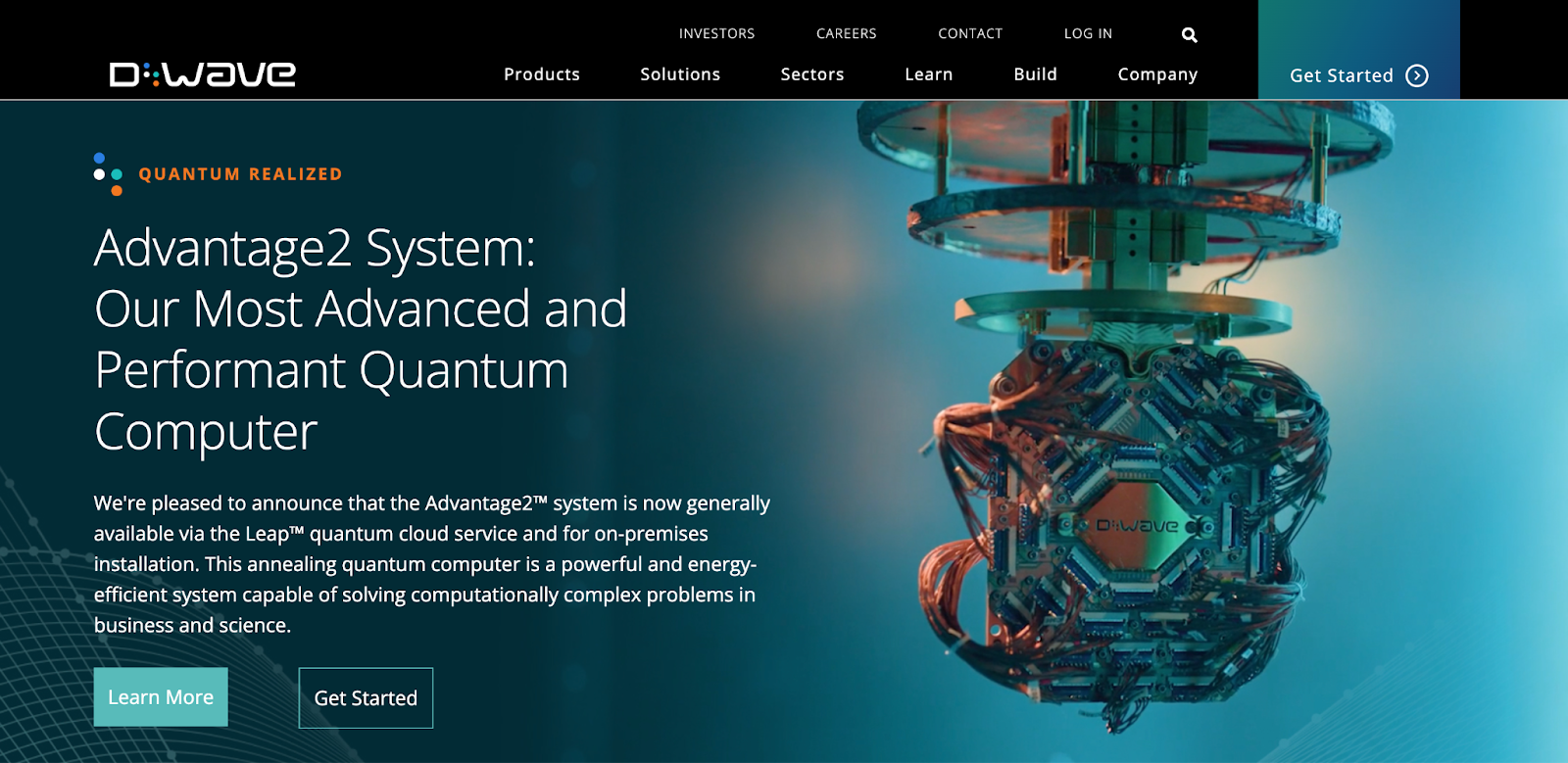
D-Wave specializes in quantum annealing hardware, optimized for solving combinatorial and complex optimization problems. Its Advantage2 processor with 4400+ qubits delivers fast solutions for mission-critical logistics, scheduling, and resource allocation.
Through the Leap cloud service, teams can access D-Wave’s systems for experimentation and real-world problem solving. The platform is ideal for organizations looking for specialized optimization capabilities today, without needing full general-purpose quantum computing.
Key Features:
- Advantage2 processor with 4400+ qubits
- Fast Anneal feature for extended coherence and reduced noise
- Specialized for optimization, not general-purpose computing
- Cloud access through Leap quantum cloud service
- Recently demonstrated quantum advantage in materials simulation
Use Case: Combinatorial optimization, scheduling problems, logistics routing, materials simulation, machine learning optimization
Best For: Organizations with specific optimization problems that fit quantum annealing approaches
Pros:
- Largest qubit counts available commercially
- Proven results in optimization applications
- Several customers using in production workflows
- More accessible than gate-based quantum for optimization tasks
Cons:
- Not suitable for general quantum algorithms (Shor's, Grover's, etc.)
- Quantum advantage claims remain debated
- Limited to optimization problem class
6. IonQ
IonQ leverages trapped-ion qubits for high-fidelity quantum computation, offering all-to-all qubit connectivity and low error rates. This architecture is suited for quantum chemistry simulations, optimization, and machine learning tasks requiring precise computation.
Cloud access via AWS, Azure, and Google allows teams to integrate IonQ’s hardware into existing workflows. With a clear roadmap toward scaling to millions of qubits, IonQ provides both immediate experimentation capabilities and long-term growth potential for mission-driven teams.
Key Features:
- Trapped-ion architecture with all-to-all qubit connectivity
- Roadmap to 20,000 physical qubits by 2028, 2M by 2030
- Oxford Ionics acquisition brings 300× higher trap density
- Lightsynq integration enables 50× faster ion-ion entanglement
- Available through major cloud providers (AWS, Azure, Google Cloud)
Use Case: Quantum chemistry, optimization algorithms, quantum machine learning, cryptographically-relevant quantum computing
Best For: Teams wanting high-fidelity qubits with clear scaling path and low error rates
Pros:
- Superior gate fidelity compared to superconducting qubits
- All-to-all connectivity simplifies algorithm implementation
- Aggressive scaling roadmap with clear milestones
- Room-temperature operation (no cryogenics for quantum layer)
Cons:
- Slower gate operations than superconducting qubits
- Roadmap timelines carry execution risk
- Higher cost per circuit execution
7. Classiq
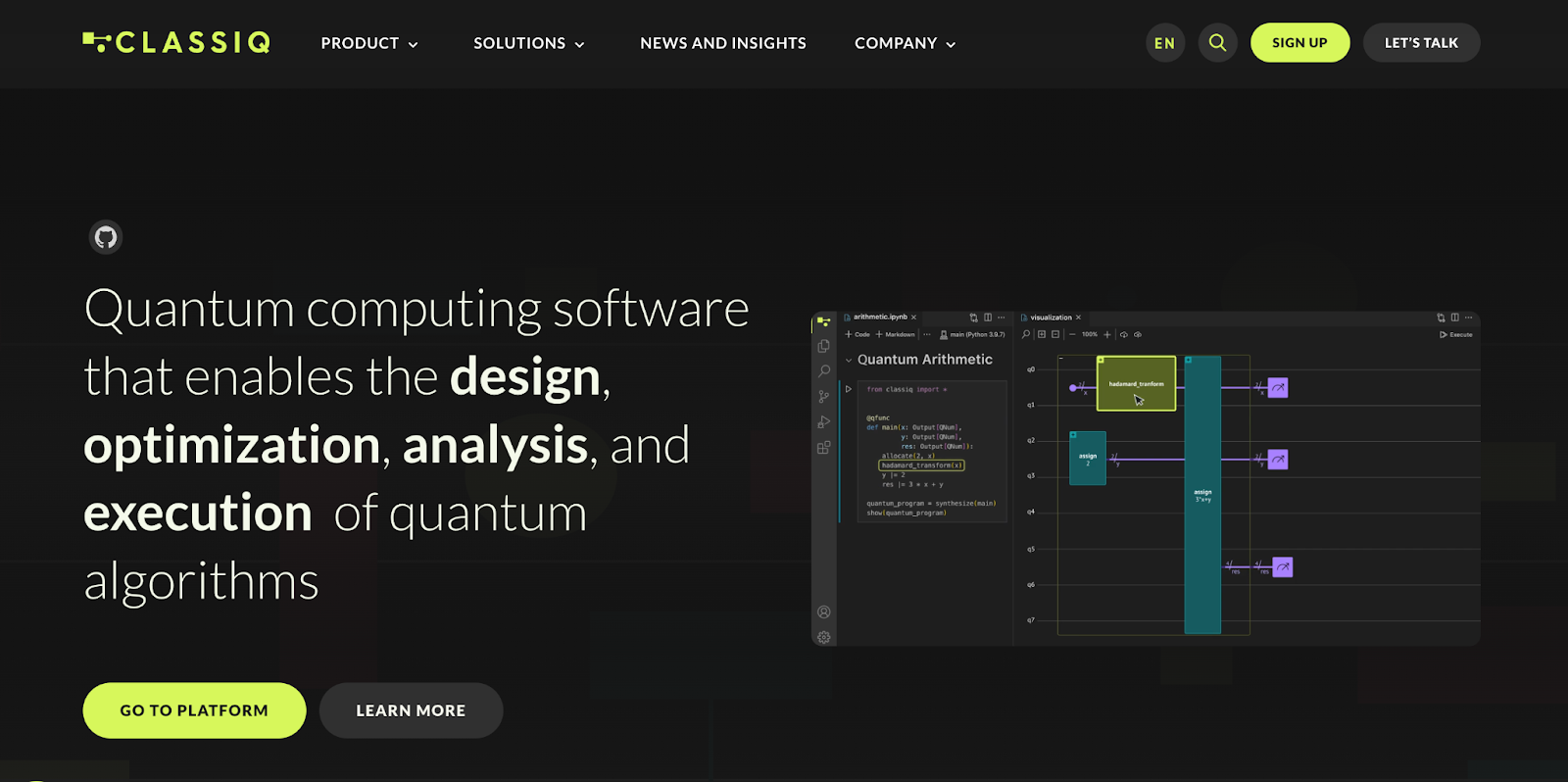
Classiq focuses on quantum software for algorithm design and circuit synthesis, enabling teams to generate optimized quantum circuits from high-level problem descriptions. This removes the need to program low-level quantum gates directly.
Its hardware-agnostic platform supports multiple quantum backends and integrates with cloud providers like AWS, accelerating simulation, optimization, and mission-driven applications. Classiq bridges classical engineering teams to quantum workflows quickly and efficiently.
Key Features:
- Qmod high-level modeling language
- Automated synthesis engine generating optimized circuits
- Hardware-agnostic platform supporting multiple quantum backends
- Circuit compression up to 97% compared to manual design
- Integration with AWS Marketplace and major cloud providers
Use Case: Rapid quantum algorithm development, circuit optimization, bridging classical teams to quantum programming
Best For: Organizations wanting to develop quantum applications without deep quantum programming expertise
Pros:
- Dramatically reduces development time for complex algorithms
- Abstracts away low-level quantum details
- Hardware flexibility prevents vendor lock-in
- Strong partnerships (BMW, NVIDIA, CERN)
Cons:
- Software-only platform (requires hardware from other vendors)
- Smaller community compared to Qiskit
- Optimization focused on specific problem types
What Engineering & Mission Teams Should Look for in a Quantum Company
Technology maturity
Look beyond qubit count. Evaluate coherence times, gate fidelity, and error rates. Ensure the company has demonstrated results on real hardware, not just simulations.
Hardware-agnostic access
Choose platforms that support multiple hardware types to reduce vendor lock-in. Being able to switch between superconducting, trapped-ion, and neutral-atom systems ensures flexibility as technology evolves.
Application fit
Align the platform’s strengths with your problem. D-Wave excels at optimization, IBM supports general-purpose computing, and BQP specializes in mission-focused aerospace and defense workflows. Avoid hype-driven choices.
Ecosystem & partnerships
Integration with cloud platforms, classical HPC, and existing workflows matters more than standalone capability. Check if the quantum system works seamlessly with tools your team already uses and if it has strong vendor partnerships.
Support & services
Consider consulting support, hybrid workflow enablement, digital twin compatibility, and quantum-inspired options for near-term results. Mission-critical applications need hands-on guidance, not just documentation.
Conclusion
The quantum computing ecosystem includes hardware innovators, software platforms, and solution providers each critical for mission-driven engineering. Understanding their strengths helps teams choose the right partners, optimize workflows, and accelerate adoption of quantum technologies.
BQP bridges the gap between quantum potential and practical use. With mission-specific optimization, digital twin validation, and hybrid workflows, teams can achieve real results today while preparing for future quantum hardware, turning innovation into operational advantage.
FAQs
Are all quantum computing companies building hardware?
No many focus on software, cloud platforms, or quantum-inspired optimization rather than physical quantum processors. Classiq builds software tools, Amazon Braket provides cloud access to others' hardware, and BQP delivers quantum-inspired solutions on classical systems.
Should mission teams partner only with the largest quantum companies?
Not necessarily. Larger players provide scale, robustness, and ecosystem integration. But specialized companies may offer better fits for specific problems D-Wave for optimization, IonQ for high-fidelity gates, BQP for mission-ready aerospace solutions. Match the company to your needs.
How soon will quantum companies deliver mission-ready systems?
It varies widely. Quantum-inspired methods (BQP) work today. Quantum annealing (D-Wave) handles specific optimization problems now. General-purpose fault-tolerant quantum computing remains 5-10 years away for most applications. Hybrid approaches bridge the gap.
Can I work with more than one quantum company in my project?
Yes many platforms support multi-vendor access, and being vendor-agnostic reduces lock-in risk. Amazon Braket and Azure Quantum provide access to multiple hardware types. Open-source tools like Qiskit work across vendors. Diversification makes sense given technology uncertainty.
How does BQP help me evaluate quantum company offerings?
BQP bridges the gap by modeling your mission problem, selecting relevant provider offerings, and validating quantum-inspired/quantum workflows within digital twin simulation. We help teams understand which quantum approaches fit their specific needs and provide practical optimization today while preparing for future quantum adoption.
Are quantum computing companies relevant if my team already uses HPC and classical solvers?
Yes. Quantum and quantum-inspired approaches often complement existing HPC and optimization pipelines rather than replace them. By integrating with your current solvers and simulation tools, quantum computing companies can accelerate difficult subproblems, expand design-space exploration, and improve mission outcomes.
.png)
.png)



.svg)
.svg)
.svg)
.svg)