



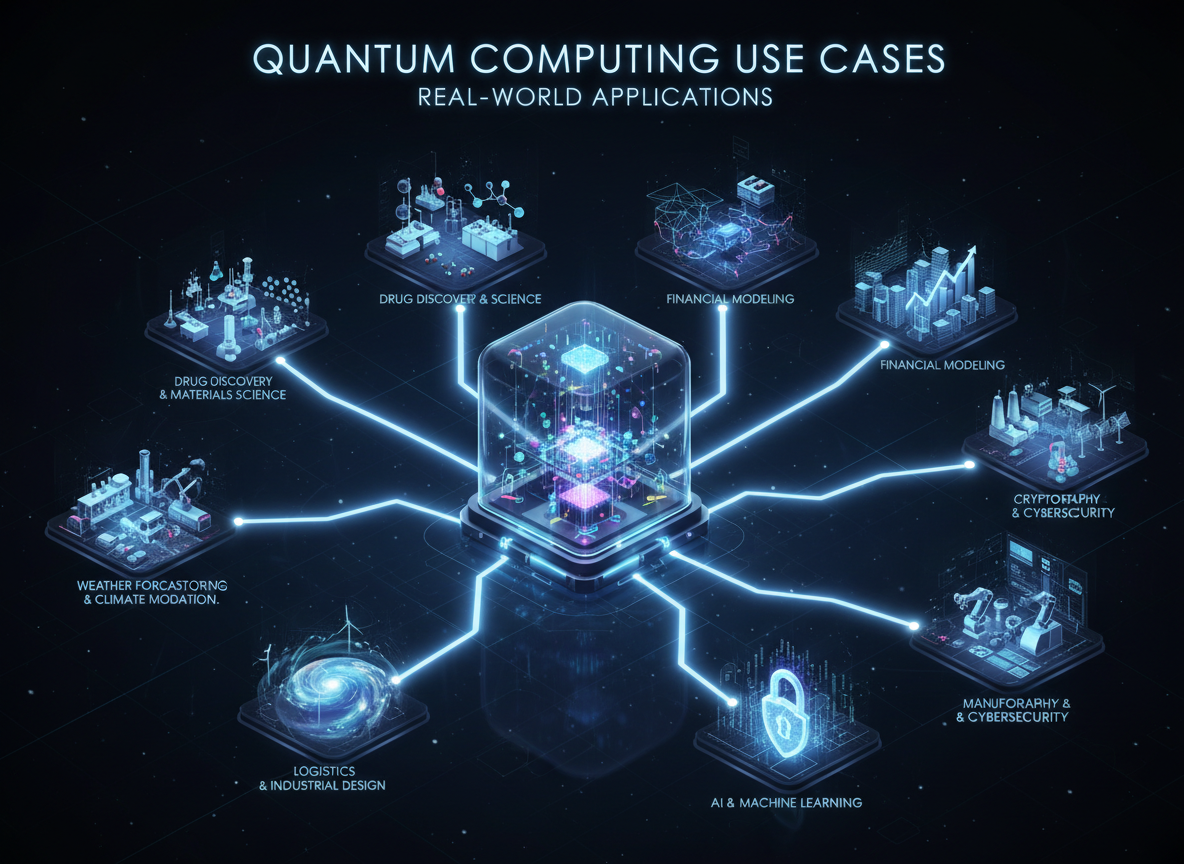

Classical computers are powerful, but they reach their limits with complex problems. Tasks like planning large missions, modeling advanced materials, or analyzing huge data sets can quickly become too slow or too costly. Quantum computing and quantum-inspired methods offer a new path forward, solving these challenges faster and more efficiently.
Across industries, teams are already testing and applying these methods for optimization, simulation, and data processing. The results are not small gains they’re major improvements in speed, accuracy, and insight.
Knowing where quantum computing truly helps allows organizations to focus their time and investment where it matters most.
In this guide, we’ll explore:
- The main types of quantum computing use cases
- Real-world industry applications where quantum is making an impact
- Current challenges and what’s practical today
- How BQP helps organizations adopt quantum-inspired solutions that deliver results now
Core Categories of Quantum Use Cases
Quantum computing is built to handle problems that classical systems find too large or complex. Its applications generally fall into four main categories simulation, optimization, machine learning, and cryptography. Understanding these helps identify where quantum methods can create real value today or in the near future.
1. Quantum Simulation
Used to model molecules, materials, and atomic interactions with quantum-level precision.
What it does:
- Simulates chemical reactions, molecular bonds, and new materials
- Replaces costly trial-and-error lab testing with accurate digital models
Where it helps:
- Drug discovery: Predicts how new drugs will behave at the molecular level
- Battery & material design: Develops stronger, lighter materials for aerospace and energy storage
- Structural testing: Models how materials perform under extreme conditions like heat or radiation
Current reality:
Quantum simulation already supports R&D in pharma and materials science, but large-scale applications are limited by qubit availability. Hybrid quantum–classical models are the practical path for now.
2. Quantum Optimization
Quantum optimization focuses on finding the best solution among millions of possibilities faster and more efficiently than classical solvers.
What it does:
- Solves routing, scheduling, and resource allocation challenges
- Handles large, constraint-heavy problems that grow exponentially with scale
Where it helps:
- Mission logistics & trajectory planning: Optimizes routes for aircraft, UAVs, and spacecraft
- Production & supply scheduling: Balances workloads and timelines in manufacturing and logistics
- Resource allocation: Distributes limited assets across competing priorities
Real impact:
Quantum-inspired optimization already improves logistics efficiency by 10–30% in trials by global manufacturers and airlines.
3. Quantum Machine Learning (QML)
Combines quantum methods with machine learning to process high-dimensional data and detect complex patterns.
What it does:
- Speeds up pattern recognition and anomaly detection
- Handles massive datasets and correlations more efficiently
Where it helps:
- Predictive maintenance: Detects early failure signs in aircraft or satellites
- Sensor fusion: Integrates data from radar, lidar, and imaging systems
- Security & anomaly detection: Identifies unusual behavior in networks or system logs
Current reality:
QML is still emerging. Some hybrid systems are proving useful, but fully quantum ML will need more stable hardware.
4. Quantum Cryptography & Security
Uses quantum physics to secure communication and protect data against future quantum attacks.
What it does:
- Enables encryption that can’t be intercepted or decoded without detection
- Builds defense systems ready for post-quantum security standards
Where it helps:
- Secure communications: Quantum key distribution (QKD) for satellite and defense networks
- Post-quantum encryption: New cryptographic algorithms resistant to quantum attacks
- Critical infrastructure: Protects sensitive data in finance, government, and energy systems
Current reality:
Quantum security is already being deployed in satellite networks and defense systems, with post-quantum standards now in early adoption.
Industry-Specific Quantum Computing Use Cases
Quantum computing is already showing measurable value across industries where classical computing struggles with complex optimization, simulation, or high-dimensional data. Here’s how different sectors are leveraging these capabilities today.
1. Aerospace & Defense
Aerospace and defense face some of the most computationally demanding problems from flight trajectory optimization to mission logistics. Quantum approaches provide faster, more precise solutions to these critical challenges.
Key use cases:
- Trajectory optimization: Computes fuel-efficient flight paths for aircraft, spacecraft, and missiles under multiple constraints, including weather, threats, timing, and payload. Quantum-inspired methods find optimal paths faster than classical approaches.
- Swarm coordination: Enables real-time assignment and routing of multiple UAVs or satellites. Quantum-inspired algorithms can handle exponentially growing problem spaces as fleet size increases.
- Mission scheduling: Optimizes complex mission timelines, balancing payload, communication windows, orbital mechanics, and operational constraints to improve success rates.
- Material design: Uses quantum simulation to accelerate development of lightweight, high-strength aerospace materials, reducing testing cycles and costs.
Impact:
Organizations running hybrid or quantum-inspired programs report faster mission planning, reduced fuel costs, and improved R&D efficiency.
2. Logistics & Supply Chain
Complex delivery networks and resource allocation problems make logistics a natural fit for quantum optimization. Companies are already using quantum-inspired methods to increase efficiency and reduce costs.
Key use cases:
- Routing and scheduling: Finds optimal delivery paths and schedules for fleets, balancing distance, time windows, vehicle capacity, and fuel usage.
- Resource distribution: Allocates warehouse space, loading equipment, and vehicles dynamically as demand changes.
- Demand prediction: Integrates quantum optimization with machine learning to anticipate demand fluctuations and proactively adjust supply networks.
Impact:
Major logistics firms report 10–30% improvements in route planning, fleet utilization, and inventory management, directly translating to reduced operational costs and faster deliveries.
3. Finance & Risk Analysis
Financial systems involve massive datasets, stochastic modeling, and complex optimization problems. Quantum computing helps institutions process these faster and with higher accuracy.
Key use cases:
- Portfolio optimization: Balances risk versus return across large numbers of assets with complex correlations, producing solutions faster than classical methods.
- Fraud detection: Quantum ML identifies anomalous patterns in transaction data, improving detection rates and reducing false positives.
- Derivatives pricing: Simulates a wide range of market scenarios for pricing options and derivatives efficiently, reducing time-to-decision in trading.
Impact:
Banks and financial institutions gain faster decision-making capabilities, enhanced risk management, and improved accuracy in predictive modeling.
4. Healthcare & Life Sciences
Drug discovery, protein modeling, and clinical optimization involve quantum-scale processes where quantum computing can deliver natural advantages.
Key use cases:
- Drug discovery: Simulates molecular interactions to predict drug efficacy and binding properties faster than classical approaches.
- Protein folding: Accelerates understanding of protein structures critical for disease research and drug design.
- Clinical trial optimization: Improves patient selection, dosing schedules, and trial designs to reduce cost and duration while ensuring statistical validity.
Impact:
Pharmaceutical companies using quantum-inspired methods can shorten R&D cycles, reduce experimental costs, and advance novel therapies more efficiently.
5. Energy & Climate Modeling
Energy grids and climate systems are highly complex and dynamic. Quantum computing can simulate these systems and optimize their operation in ways classical computers cannot.
Key use cases:
- Grid optimization: Manages renewable energy integration, storage, and distribution in real time, balancing supply and demand efficiently.
- Climate simulation: Models atmospheric and oceanic processes, carbon capture materials, and energy feedback loops with higher fidelity.
- Exploration planning: Optimizes drilling, mining, or renewable energy placement using geospatial and resource data under multiple constraints.
Impact:
Organizations using quantum-inspired solutions can reduce energy waste, improve renewable integration, and make more accurate climate predictions.
Emerging Trends and Practical Limitations
Quantum computing is advancing rapidly, but practical deployment still faces constraints. Here’s what organizations need to know:
- Hybrid approaches deliver immediate value: Most real-world applications combine quantum algorithms with classical computation, allowing complex tasks to be solved today while waiting for scalable quantum hardware.
- Hardware limitations exist: Current quantum computers have limited qubits, short coherence times, and high error rates. Problems needing millions of error-corrected qubits remain out of reach, so quantum-inspired methods on classical systems provide near-term benefits.
- Problem structure matters: Quantum computing excels in complex, exponential, or quantum-mechanical problems. Routine or linear tasks remain faster on classical systems.
- Quantum optimization software bridges the gap: These algorithms emulate quantum strategies on classical HPC systems, enabling testing and optimization today while preparing for future hardware.
- Industry adoption is cautious but growing: Organizations run pilot programs and build expertise, capturing measurable value now while preparing for broader quantum deployment.
- Realistic adoption timeline: Large-scale, error-corrected quantum computing is likely 5–10 years away, but hybrid and quantum-inspired solutions are already driving results in aerospace, logistics, finance, healthcare, and energy.
How BQP Accelerates Quantum Use Case Adoption
BQP bridges the gap between quantum computing potential and practical deployment, making quantum-inspired optimization and simulation accessible for engineering and mission teams today.
- Quantum-inspired optimization without quantum hardware: Solve complex optimization problems using quantum principles superposition-like exploration and entanglement-inspired correlations directly on classical systems. Gain quantum-style benefits without needing qubits or specialized quantum expertise.
- Mission-specific simulations: Focused on aerospace, UAVs, satellites, and defense logistics, BQP provides tools tailored to real operational challenges, not generic quantum circuit programming.
- Digital twin validation: Test solutions in realistic digital twin environments to ensure optimized strategies perform under actual mission conditions, not just in theory.
- Seamless integration with quantum ecosystems: Complement leading quantum hardware and software platforms through seamless hybrid workflows that combine classical and quantum processing where it makes sense.
- Practical deployment path: Start with quantum-inspired optimization on classical systems, add quantum processing as it becomes viable, and scale based on actual results avoiding hype-driven decisions.
Conclusion
Quantum computing is opening new frontiers in optimization, simulation, and data analytics. Early use cases in aerospace, logistics, finance, healthcare, and energy demonstrate measurable impact, even as full-scale quantum hardware continues to develop.
The most effective path combines quantum-inspired solutions that deliver results today with strategic preparation for future quantum adoption. Organizations don’t need to wait for perfect quantum computers to capture the advantages of quantum approaches.
With BQP, teams can:
- Identify high-value quantum use cases for their missions.
- Test quantum-inspired solutions in realistic digital twin environments.
- Operationalize quantum principles safely and efficiently.
BQP makes it possible to drive measurable outcomes now, while building readiness for tomorrow’s quantum opportunities.
FAQs
What makes a problem suitable for quantum computing?
Problems with exponential scaling, large search spaces, or complex constraints. Linear or simple problems are better on classical systems.
Can quantum use cases deliver results today?
Yes. Quantum-inspired and hybrid approaches on classical HPC systems already provide measurable improvements.
Which industries are adopting quantum computing first?
Aerospace, defense, pharmaceuticals, logistics, and finance sectors with complex, computation-heavy problems.
What's the difference between quantum-inspired and true quantum computing?
Quantum-inspired runs on classical systems using quantum strategies. True quantum uses qubit-based hardware and quantum effects.
How does BQP fit into quantum use cases?
BQP brings quantum-inspired optimization, simulation, and mission planning to classical systems delivering real value today while preparing for full quantum adoption.
.png)
.png)



.svg)
.svg)
.svg)
.svg)