



Choosing the right quantum software platform is one of the most consequential decisions an engineering team can make in 2026. The global quantum computing market is growing at over 30% annually, and the software layer is where that growth translates into real engineering decisions, faster optimization, and competitive advantage.
With IBM, Google, Amazon, Microsoft, Classiq, and Quantinuum all offering distinct capabilities, the choice is genuinely complex. The wrong platform wastes time on integration overhead and limits your ability to scale. The right one connects algorithm development to hardware access to mission workflows without friction.
This guide covers what quantum software platforms are, how the six leading options compare, what to prioritize when selecting one, and how quantum-inspired tools like BQP deliver immediate results for engineering teams that cannot wait for quantum hardware to mature.
What Are Quantum Software Platforms?
A quantum software platform is the complete environment for designing, testing, and running quantum algorithms. It abstracts the physics of qubits and gives engineers structured tools to build and validate quantum computations without deep hardware expertise.
Quantum computing operates on fundamentally different computational logic than classical systems. Quantum software platforms bridge that gap, giving engineering teams a practical entry point into real quantum workflows.
Core Components of a Quantum Software Platform
- SDKs (Software Development Kits): Libraries and frameworks for writing quantum algorithms in Python, Q#, or other supported languages
- Circuit compilers and optimizers: Translate high-level algorithms into hardware instructions, optimizing gate sequences for specific device constraints
- Simulators: Classical programs that replicate quantum behavior for testing and debugging before committing to hardware runs
- Hardware access: Cloud-based connections to physical quantum processors, including superconducting, trapped-ion, and photonic systems
- Integration tools: Interfaces connecting quantum tasks to classical systems, enabling hybrid workflows and data coordination
What These Platforms Enable
Quantum software platforms close the gap between theoretical quantum research and practical engineering application. They let teams focus on problem formulation rather than qubit-level physics, test algorithms at scale before hardware validation, and build hybrid workflows where quantum and classical computations run together.
For engineering teams, the platform determines how quickly you can experiment, which algorithm types you can run, and how easily quantum capabilities integrate into existing simulation and mission planning pipelines.
Best Quantum Software Platforms Compared (2026)
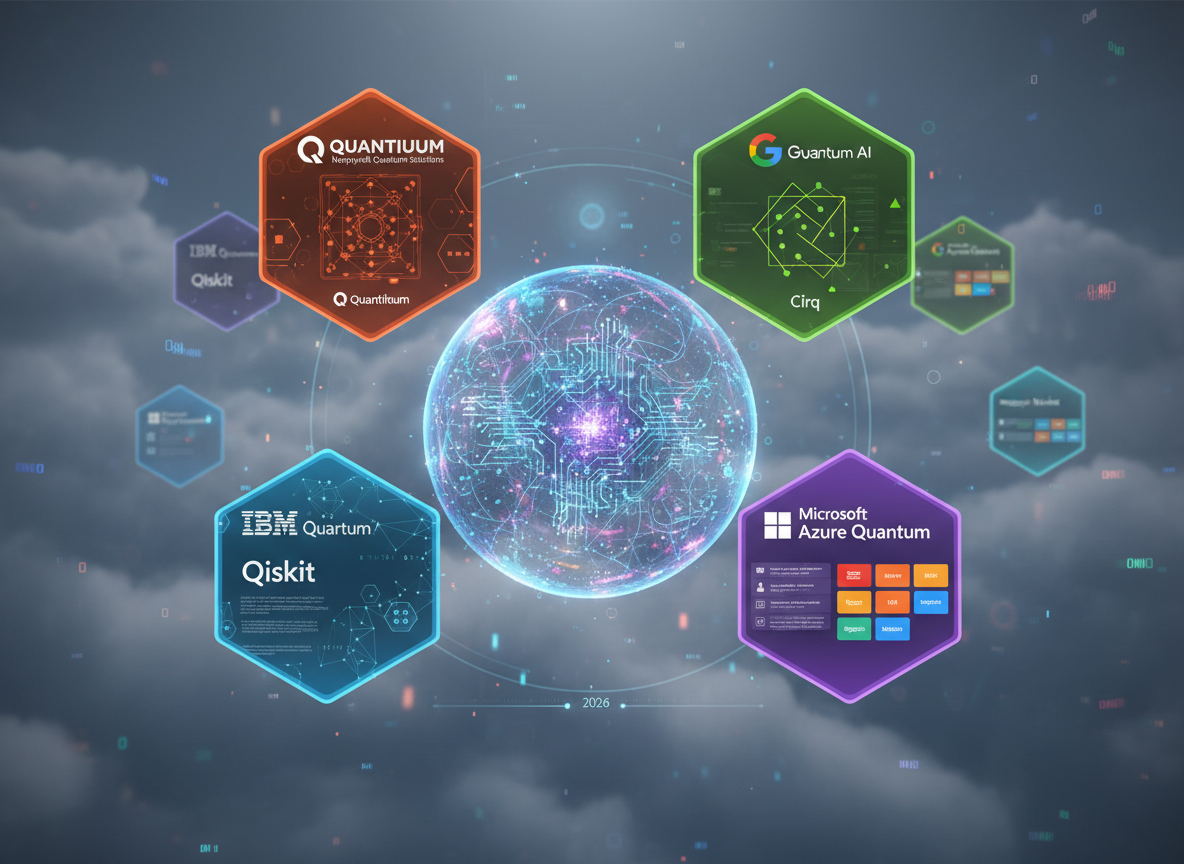
Several platforms lead the quantum computing landscape today. Each serves a distinct set of priorities, from open-source research to enterprise-grade hybrid deployment.
IBM Quantum (Qiskit)
IBM Quantum is the most widely used quantum software platform in the world. Its open-source SDK Qiskit gives developers full access to circuit construction, simulation, and real hardware via IBM's cloud. With over 600,000 registered users globally, it has the largest ecosystem of tutorials, community support, and published research of any quantum platform.
Best for: Teams prioritizing learning resources, community support, and regular access to production quantum hardware without vendor lock-in.
Google Quantum AI (Cirq)
Cirq is Google's open-source framework for writing, optimizing, and running quantum circuits. Its hardware-agnostic design means algorithms written in Cirq can target different quantum processors without full rewrites. The TensorFlow Quantum integration makes it a leading choice for teams working at the intersection of quantum computing and machine learning.
Best for: Algorithm researchers and ML teams building quantum-classical hybrid models.
Amazon Braket
Amazon Braket gives teams access to multiple quantum hardware types, including IonQ's trapped-ion systems, Rigetti's superconducting processors, and D-Wave's annealing hardware, through a single AWS-integrated interface. Its pay-as-you-go pricing model keeps early-stage experimentation cost-effective. Native integration with S3 and SageMaker simplifies data management across hybrid workflows.
Best for: Teams already operating on AWS who need hardware flexibility without building separate cloud infrastructure.
Microsoft Azure Quantum
Azure Quantum combines Microsoft's Q# programming language with access to multiple hardware providers and a detailed resource estimation tool that lets teams model future quantum requirements before hardware is available. Its deep integration with the Azure ecosystem and enterprise-grade compliance tools make it the natural choice for large organizations in Microsoft environments.
Best for: Enterprise teams building long-term hybrid workflows with existing Azure infrastructure.
Classiq
Classiq operates at a higher abstraction level than other platforms. Rather than requiring engineers to construct circuits gate by gate, Classiq's synthesis engine takes high-level functional descriptions and automatically generates optimized quantum circuits. This significantly reduces development time for teams without deep quantum circuit expertise.
Best for: Engineering teams who need to move quickly from problem specification to algorithm output without low-level circuit coding.
Quantinuum
Quantinuum offers an end-to-end quantum stack from hardware to application software. Its trapped-ion processors deliver some of the lowest error rates in commercial quantum computing, making it the preferred platform for applications where result fidelity is critical. Its TKET compiler and InQuanto chemistry platform round out a complete enterprise solution.
Best for: High-fidelity quantum chemistry, materials science, and optimization applications requiring the most accurate available hardware.
How to Choose a Quantum Software Platform
Selecting a quantum software platform is not about finding the most technically advanced option. It is about matching capabilities to your specific mission requirements, technical constraints, and timeline.
1. Define Your Use Case First
Start by identifying what you are actually trying to solve: optimization, simulation, cryptography, machine learning, or algorithm research. Platforms built for quantum chemistry perform differently than those built for logistics or scheduling. Matching platform strengths to your domain is the most important selection factor.
2. Balance Simulation and Hardware Access
For exploration and algorithm development, classical simulators on platforms like Qiskit or Cirq are sufficient and cost nothing per run. For performance benchmarking against real quantum noise and decoherence, you need on-demand access to physical processors. Identify which phase of development your team is in before committing to a hardware-heavy platform.
3. Evaluate SDK and Language Compatibility
Most platforms support Python, which minimizes retraining costs for engineering teams. Microsoft's Q# has a steeper onboarding curve but integrates deeply with Azure. Classiq's constraint-based interface requires the least quantum expertise. Choose the abstraction level that matches your team's current skills.
4. Prioritize Integration With Existing Systems
A quantum platform that cannot connect cleanly to your simulation tools, mission planning software, or data pipelines will slow adoption regardless of raw capabilities. Platforms with strong hybrid support, such as Azure Quantum and Amazon Braket, are safer choices for teams with established classical infrastructure.
5. Avoid Vendor Lock-In
Open-source platforms like Qiskit and Cirq allow you to switch hardware providers or migrate algorithms as the market evolves. Multi-vendor platforms like Braket and Azure Quantum provide flexibility within a managed environment. Avoid platforms that tie your algorithms tightly to proprietary gate sets or hardware formats without clear export paths.
6. Factor in Total Cost of Ownership
Quantum hardware time is billed per shot, and costs scale quickly during validation runs. Simulators are generally free but have qubit limits. Factor in development time, onboarding overhead, support quality, and platform roadmap stability, not just per-run compute costs, when comparing platforms.
Challenges of Quantum Software Platforms
Quantum software platforms are advancing rapidly, but engineering teams still face real operational challenges that require planning before committing to a platform.
Hardware and Software Misalignment
Not all platforms support every hardware type. Some are tied to specific vendors or qubit technologies. When the hardware you need is unavailable on your chosen platform, integrating multiple systems adds cost and complexity to already intricate workflows.
Steep Onboarding Curve
Quantum SDKs require familiarity with quantum gates, circuits, and measurement principles that differ fundamentally from classical computing. Even experienced software engineers need significant ramp-up time. Platforms like Classiq reduce this, but the learning investment remains real across most options.
Simulation-to-Hardware Gap
Results from classical simulators frequently diverge from physical quantum hardware due to noise, decoherence, and gate error rates. Algorithms that perform well in simulation often require substantial re-tuning on real hardware, creating unpredictable development timelines for engineering teams.
Integration and Validation Overhead
Combining quantum and classical systems requires careful data encoding, workflow synchronization, and output validation. Without established error correction and verification protocols, mission-critical applications demand extensive testing cycles before deployment.
Resource Constraints and Vendor Risk
Quantum hardware access remains limited, expensive, and concentrated among a small number of providers. With the market still consolidating, dependence on a single vendor creates long-term risk. Open-source and multi-vendor approaches offer more durable foundations for teams building for the long term.
How BQP Bridges the Gap for Engineering Teams
Most quantum software platforms focus on programming qubits and constructing circuits. Engineering teams need practical optimization and simulation results now, not research prototypes pending hardware validation.
BQP is a quantum optimization software platform built for real engineering missions. Rather than waiting for quantum hardware to mature, BQP applies quantum-inspired algorithms to solve complex optimization and simulation problems on classical HPC systems today.
No Circuit Design Required
Traditional quantum platforms require engineers to construct circuits gate by gate. BQP removes that complexity entirely. Teams specify their engineering problem and operational constraints. BQP handles the optimization logic and returns validated results without requiring quantum programming expertise.
Quantum-Inspired Optimization on Classical Systems
BQP applies quantum mathematical principles, including superposition-like sampling and entanglement-inspired variable correlation, to explore solution spaces that classical solvers cannot efficiently cover. The result is Quantum optimization performance delivered on current GPU and HPC infrastructure, with no quantum hardware dependency.
Integration With Leading Platforms
BQP is designed to complement gate-based quantum platforms, not replace them. It manages hybrid workflows where classical and quantum computations run together, applying quantum hardware where it provides genuine advantage and classical systems where speed and reliability matter most.
Mission-Ready Today
With built-in digital twins, surrogate models, and performance tracking, BQP helps engineering teams validate and deploy optimized solutions under real operational conditions. Use cases include UAV coordination, satellite scheduling, trajectory optimization, and supply chain planning across aerospace and defense environments.
Who Benefits From BQP
Engineering teams that need fast, validated optimization results without quantum hardware investment, mission planners testing under real-world constraints, and organizations evaluating the ROI of quantum optimization before committing to full quantum infrastructure are the primary users BQP is built for.
Conclusion
Quantum software platforms are opening new paths to solving complex engineering problems, but the right choice depends entirely on your use case, timeline, and integration requirements. IBM Qiskit suits teams building open-source research foundations. Amazon Braket and Azure Quantum fit enterprises needing hardware flexibility inside existing cloud environments. Classiq accelerates teams that prioritize development speed. Quantinuum serves applications where hardware fidelity is non-negotiable.
For engineering teams that need results before quantum hardware matures, quantum-inspired approaches like BQP deliver measurable gains today while keeping future quantum hardware integration open.
The quantum software landscape will continue to evolve. Teams that build quantum-ready workflows now, whether through circuit-level platforms or quantum-inspired solvers, will be better positioned to capture full quantum advantage as hardware capabilities catch up.
Frequently Asked Questions About Quantum Software Platforms
What is a quantum software platform?
A quantum software platform is the complete toolkit for designing, testing, and running quantum algorithms. It includes SDKs for writing algorithms, circuit compilers, classical simulators for testing, and cloud-based access to physical quantum hardware. It abstracts qubit-level physics so engineers can focus on problem solving.
What distinguishes a quantum software platform from a quantum algorithm?
A quantum algorithm is a specific program designed to solve a particular problem. A quantum software platform is the environment that hosts, compiles, simulates, and executes those algorithms, providing the infrastructure layer between the problem and the hardware.
Can I use quantum software platforms without physical quantum hardware?
Yes. All major platforms include classical simulators that let you design, test, and debug quantum algorithms without using real quantum processors. Simulators are ideal for learning, prototyping, and algorithm development before committing to hardware runs.
Which quantum software platform is best for beginners?
IBM Quantum's Qiskit has the largest community, most tutorials, and best documentation of any quantum platform, making it the most accessible starting point. Classiq is the better choice for teams that want to skip circuit-level details and work at a higher abstraction level.
Do I need to choose a single quantum software vendor?
No. Most engineering teams use multiple platforms or open-source tools like Qiskit and Cirq to avoid vendor lock-in. Multi-vendor access through Amazon Braket or Azure Quantum also gives teams flexibility to shift hardware providers as the market evolves.
How does platform choice affect mission-critical applications?
Platform choice directly affects integration complexity, result reliability, and long-term vendor risk. Open, multi-vendor platforms are generally safer for high-stakes applications. For mission-critical optimization today, quantum-inspired platforms like BQP provide validated results without hardware uncertainty.
What is the difference between quantum computing and quantum-inspired computing?
Quantum computing uses physical qubits and quantum mechanical phenomena to process information. Quantum-inspired computing applies algorithms derived from quantum principles to classical HPC and GPU hardware, delivering significant performance advantages without requiring quantum hardware. BQP operates in the quantum-inspired space.
How do quantum software platforms handle hybrid quantum-classical workflows?
Platforms like Azure Quantum, Amazon Braket, and IBM Quantum all support hybrid workflows where quantum and classical computations run together. The quantum processor handles tasks where it provides genuine advantage, while classical systems manage pre-processing, post-processing, and tasks where quantum noise would degrade results.
.png)
.png)



.svg)
.svg)
.svg)
.svg)