


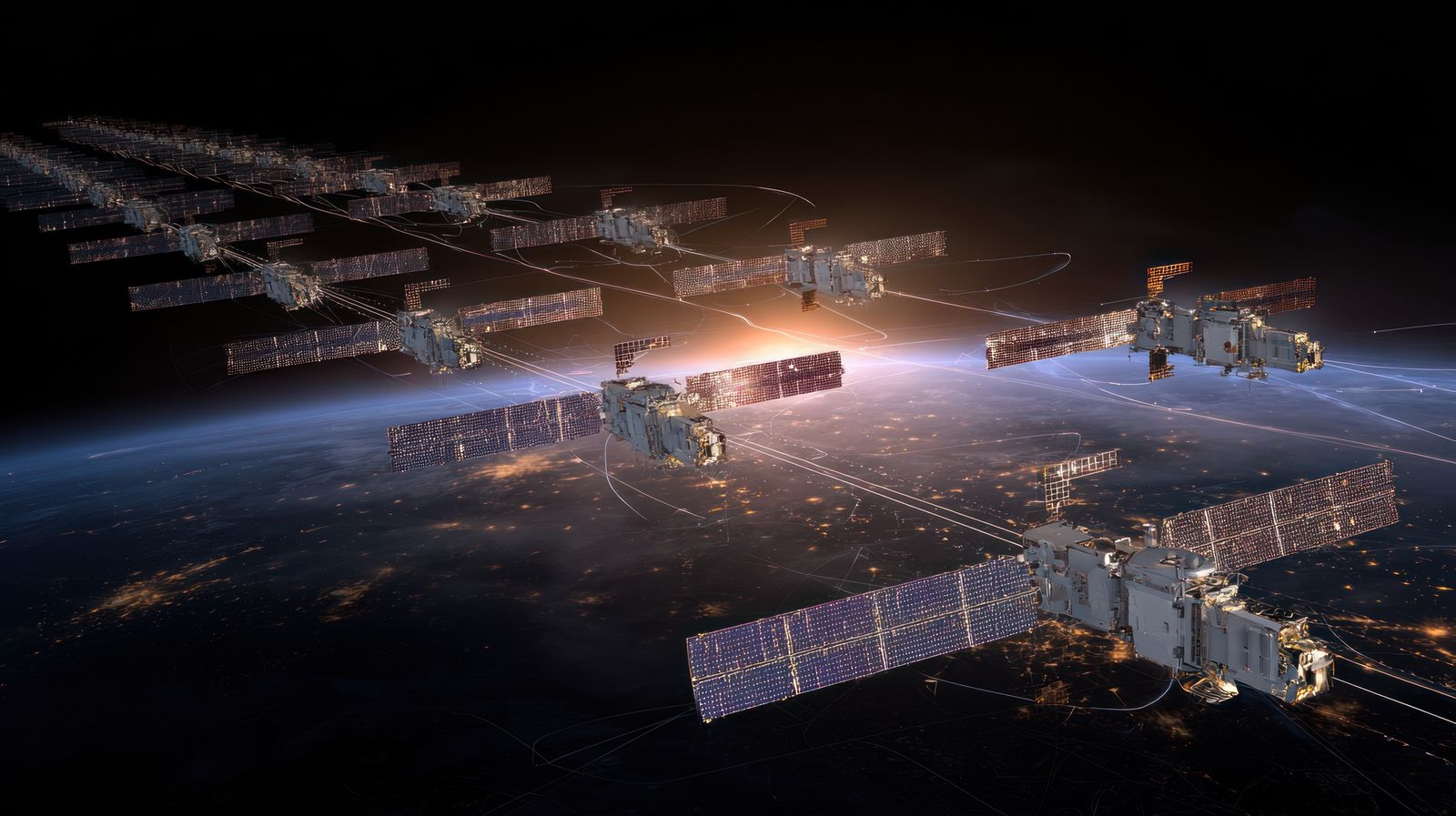

Satellite communication systems face escalating security threats, bandwidth constraints, and network complexity as global connectivity demands surge across commercial, military, and scientific applications.
Quantum technologies promise revolutionary improvements in communication security through unhackable encryption, enhanced signal processing capacity, and unprecedented network optimization capabilities.
The question isn't whether quantum techniques offer advantages but whether your development framework can integrate quantum cryptography, processing algorithms, and network protocols with existing satellite architectures that classical design methods address sequentially.
Steps to Optimize Quantum Satellite Communication
Quantum satellite communication optimization requires systematic integration of quantum key distribution protocols, secure channel establishment, quantum signal processing algorithms, bandwidth management strategies, quantum teleportation networks, enhanced positioning techniques, and simulation-driven validation.
The steps below represent the complete enhancement framework from quantum protocol selection through operational deployment that ensures communication systems deliver unbreakable security and maximum efficiency.
Step 1: Quantum Key Distribution: Establishing Tamper-Proof Security
Photon-based encryption and quantum mechanics foundations
QKD exploits fundamental quantum mechanics where measuring a quantum state inevitably disturbs it, making eavesdropping detectable. Satellites transmit individual photons encoding encryption keys in polarization or phase states, with any interception attempt introducing measurable errors that reveal security breaches. BB84 and E91 protocols achieve secure key distribution rates of 1-10 kbps over satellite-to-ground links.
Eavesdropping detection and key verification
Quantum protocols compare measurement statistics between sender and receiver to detect eavesdropping through increased bit error rates beyond quantum channel noise levels. When error rates exceed thresholds typically 11% for BB84, systems abort key generation and alert operators to security threats. Privacy amplification techniques extract perfectly secure shorter keys from partially compromised transmissions.
Satellite-to-ground QKD link establishment
Low Earth orbit satellites pass overhead for 5-15 minute visibility windows, requiring rapid link acquisition and key generation before the satellite sets below the horizon. Adaptive optics systems compensate for atmospheric turbulence that scatters photons and introduces errors, maintaining quantum channel fidelity despite 100+ km propagation through variable atmospheric conditions.
Step 2: Securing Communication Channels Between Satellites and Ground Stations
Resilience against code-breaking and quantum computing threats
Classical encryption algorithms including RSA and elliptic curve cryptography become vulnerable as quantum computers scale to thousands of logical qubits capable of running Shor's algorithm. QKD provides future-proof security independent of computational advances, protecting satellite communications against adversaries with arbitrary computing power.
Cyberattack mitigation and intrusion detection
Quantum random number generators create unpredictable encryption keys and authentication tokens immune to algorithmic attacks exploiting pseudorandom number generator weaknesses. Continuous monitoring of quantum channel characteristics detects sophisticated attacks including intercept-resend and photon number splitting that classical security systems cannot identify.
Data integrity verification and authenticated channels
Quantum digital signatures using entangled photon states enable message authentication that prevents spoofing and man-in-the-middle attacks. Recipients verify message origins through quantum correlations impossible to forge without detection. Integration with classical error correction maintains data integrity across noisy satellite channels.
Step 3: Enhancing Signal Processing with Quantum Algorithms
Quantum noise reduction and error mitigation
Quantum algorithms exploit superposition and entanglement to process signal data in parallel across multiple states simultaneously, identifying optimal noise filtering parameters 100× faster than classical optimization. Quantum machine learning models trained on satellite channel characteristics predict and compensate for atmospheric scintillation, ionospheric disturbances, and multipath interference.
Computational acceleration for real-time processing
Grover's algorithm provides quadratic speedup for database searches, accelerating routing table lookups, resource allocation decisions, and anomaly detection in satellite network management. Quantum annealing solves optimization problems underlying adaptive coding, modulation selection, and beam forming configurations in seconds compared to minutes for classical solvers.
Advanced data compression and encoding
Quantum-inspired compression algorithms identify statistical patterns in satellite imagery, telemetry, and scientific data more efficiently than classical techniques, reducing transmission bandwidth requirements by 30-50%. Quantum error correction codes protect data integrity with lower overhead than classical Reed-Solomon codes, maximizing effective throughput.
Step 4: Optimizing Bandwidth and Network Resource Allocation
Dynamic spectrum management across satellite constellations
Quantum optimization algorithms allocate frequency bands, time slots, and spatial beams across hundreds of satellites simultaneously, maximizing network throughput while avoiding interference. Real-time spectrum sensing identifies unused frequency resources and reallocates bandwidth to high-demand regions, increasing overall network efficiency by 25-35%.
Channel optimization and interference mitigation
Multi-objective optimization balances throughput, latency, power consumption, and quality-of-service requirements across diverse user types including video streaming, IoT sensors, and emergency communications. Quantum algorithms identify Pareto-optimal resource allocations in seconds compared to hours for exhaustive classical search.
Quality of service and priority traffic management
Network controllers implement priority queuing and bandwidth reservation ensuring critical communications maintain low latency and guaranteed throughput despite best-effort traffic surges. Quantum-enhanced predictive models forecast traffic patterns based on historical data, geographic events, and time-of-day trends, enabling proactive resource allocation before congestion develops.
Step 5: Quantum Teleportation and Long-Distance Quantum Networks
Quantum state transfer between satellites
Quantum teleportation transfers quantum states between satellites using shared entanglement and classical communication channels, enabling distributed quantum computing and ultra-secure communication networks. Entangled photon pairs generated onboard satellites or ground stations establish quantum channels spanning thousands of kilometers.
Relay nodes and entanglement distribution
Quantum repeaters extend network reach beyond direct satellite visibility by creating entanglement between relay nodes and performing entanglement swapping operations. Multi-hop networks connect ground stations on opposite sides of Earth through satellite relay chains, overcoming fundamental photon loss limits in fiber optic systems.
Overcoming fiber optic distance limitations
Terrestrial fiber optic quantum networks suffer photon loss limiting direct transmission to 100-200 km without repeaters, while satellite links span thousands of kilometers through low-loss vacuum propagation. Free-space channels between satellites avoid atmospheric absorption entirely, enabling global quantum key distribution at rates impossible with ground-based infrastructure.
Step 6: Quantum-Enhanced Positioning for Satellite Systems
Atomic clock timing and synchronization precision
Optical atomic clocks on satellites achieve timing stability of 1 part in 10^18, improving positioning accuracy by orders of magnitude compared to classical GNSS systems limited by 1 part in 10^14 satellite clocks. Quantum clock networks distribute time across constellations with picosecond synchronization, enabling coherent distributed aperture radar and precision orbit determination.
GNSS accuracy improvements and integrity monitoring
Quantum sensors detect gravitational field variations and atmospheric delays with unprecedented precision, correcting GNSS signal propagation errors that dominate positioning uncertainty. Quantum-enhanced integrity monitoring identifies satellite failures, signal anomalies, and spoofing attempts within seconds compared to minutes for classical detection.
Navigation and timing distribution applications
Quantum time transfer distributes UTC synchronization to remote facilities, communication networks, and financial systems requiring sub-microsecond timing accuracy. Positioning services exploit quantum clock stability and quantum sensing for indoor navigation, urban canyon environments, and GPS-denied operations where classical GNSS fails.
Step 7: Simulation and Modeling of Quantum Satellite Networks
Protocol validation and performance prediction
High-fidelity simulations model quantum channel characteristics including atmospheric turbulence, beam divergence, detector efficiencies, and quantum bit error rates across orbital geometries and ground station locations. Monte Carlo analysis evaluates network performance under varying weather conditions, hardware failures, and traffic patterns.
Hybrid classical-quantum network testing
Emulation facilities combine quantum hardware components with classical network simulation, validating QKD protocol implementations, key management systems, and application integration before orbital deployment. Hardware-in-loop testing reveals timing issues, synchronization challenges, and edge cases impossible to identify through analysis alone.
Pre-deployment optimization and risk reduction
Simulation-based trade studies quantify performance benefits of alternative satellite designs, quantum payload configurations, and ground station architectures supporting investment decisions. Sensitivity analysis identifies critical parameters driving network capability, focusing development efforts on high-impact improvements.
Why Choose BQP for Quantum-Assured Satellite Communication?
BQP delivers quantum-inspired optimization that accelerates quantum satellite communication development from laboratory demonstrations to operational deployments across commercial, government, and scientific networks.
It integrates directly into satellite communication system engineering workflows, enabling simultaneous evaluation of QKD protocols, network architectures, and resource allocation strategies that classical development methods cannot explore at program-relevant timescales.
What makes BQP different
- Quantum-inspired solvers for network optimization: QIEO algorithms evaluate thousands of satellite constellation configurations, ground station placements, and protocol parameters in parallel, converging on Pareto-optimal network designs up to 20× faster than sequential classical methods that cannot handle combinatorial complexity of resource allocation, routing, and security requirements simultaneously.
- Physics-Informed Neural Networks embedding quantum channel models: Governing equations for photon propagation, atmospheric turbulence, and quantum bit error rates are built directly into neural network architectures, ensuring performance predictions respect fundamental physics without requiring full Monte Carlo simulation for every design candidate, accelerating trade space exploration by orders of magnitude.
- Quantum-Assisted PINNs for sparse operational data: Accelerate training on limited datasets representing rare but mission-critical conditions like atmospheric scintillation events, hardware anomalies, and adversarial attacks where traditional models fail. QA-PINNs reduce model size by 10× while improving generalization to uncommanded scenarios that dominate operational risk.
- Mission-level trade-off analysis balancing security, throughput, and coverage: Quantify how QKD protocol choices affect key generation rates, network latency, and operational availability across global coverage requirements. Evaluate whether inter-satellite quantum links justify complexity or whether ground-relay architectures deliver better capability-to-cost ratios for specific applications.
- Real-time performance tracking for development and operational validation: Monitor QIEO solver convergence through live dashboards during preliminary design reviews, comparing quantum-enhanced communication against classical baseline performance. Plug hybrid quantum-classical algorithms into existing satellite network simulation tools without replacing validated test infrastructure.
- Satellite communication-specific workflows with validated quantum models: Pre-configured templates for QKD satellites, quantum repeaters, and ground station designs with accurate atmospheric models, detector characteristics, and orbital dynamics. Integration with industry-standard tools enables seamless adoption within established aerospace development processes.
Book a demo to see how BQP accelerates quantum satellite communication development on your exact constellation requirements from LEO broadband to GEO secure communications.
Frequently Asked Questions
What security advantages does quantum key distribution provide?
QKD provides provably secure encryption immune to computational attacks including future quantum computers running Shor's algorithm that breaks classical cryptography. Eavesdropping attempts are physically detectable through quantum measurement disturbances, alerting users to security breaches. Unlike classical encryption relying on computational hardness assumptions, QKD security derives from fundamental physics principles.
How does quantum teleportation enable long-distance satellite networks?
Quantum teleportation transfers quantum states between distant satellites using shared entanglement and classical communication, overcoming photon loss that limits direct transmission. Relay nodes perform entanglement swapping creating end-to-end quantum channels spanning thousands of kilometers, enabling global quantum networks connecting ground stations worldwide through satellite relay chains.
Why is bandwidth optimization essential for satellite constellations?
Satellite constellations serving millions of users face severe spectrum scarcity and interference challenges requiring sophisticated resource allocation. Quantum optimization algorithms dynamically assign frequency, time, and spatial resources maximizing network throughput while maintaining quality-of-service guarantees across varying traffic patterns and orbital geometry changes.
What challenges limit quantum satellite communication deployment?
Current QKD systems achieve key rates of 1-10 kbps insufficient for bulk data encryption requiring Gbps speeds. Atmospheric turbulence, cloud cover, and daylight background photons degrade quantum channel quality reducing availability to 20-40% depending on ground station location. Hardware costs exceeding $10M per satellite limit deployment to strategic applications.
Can quantum-enhanced positioning replace GPS?
Quantum sensors improve timing precision and atmospheric correction enabling centimeter-level positioning accuracy versus meter-level GPS performance. However, complete GPS replacement requires global quantum satellite constellations and widespread receiver deployment representing multi-decade transition. Near-term applications target high-value use cases like autonomous vehicles where performance justifies quantum receiver costs.
.png)
.png)
.svg)
.svg)
.svg)
.svg)