



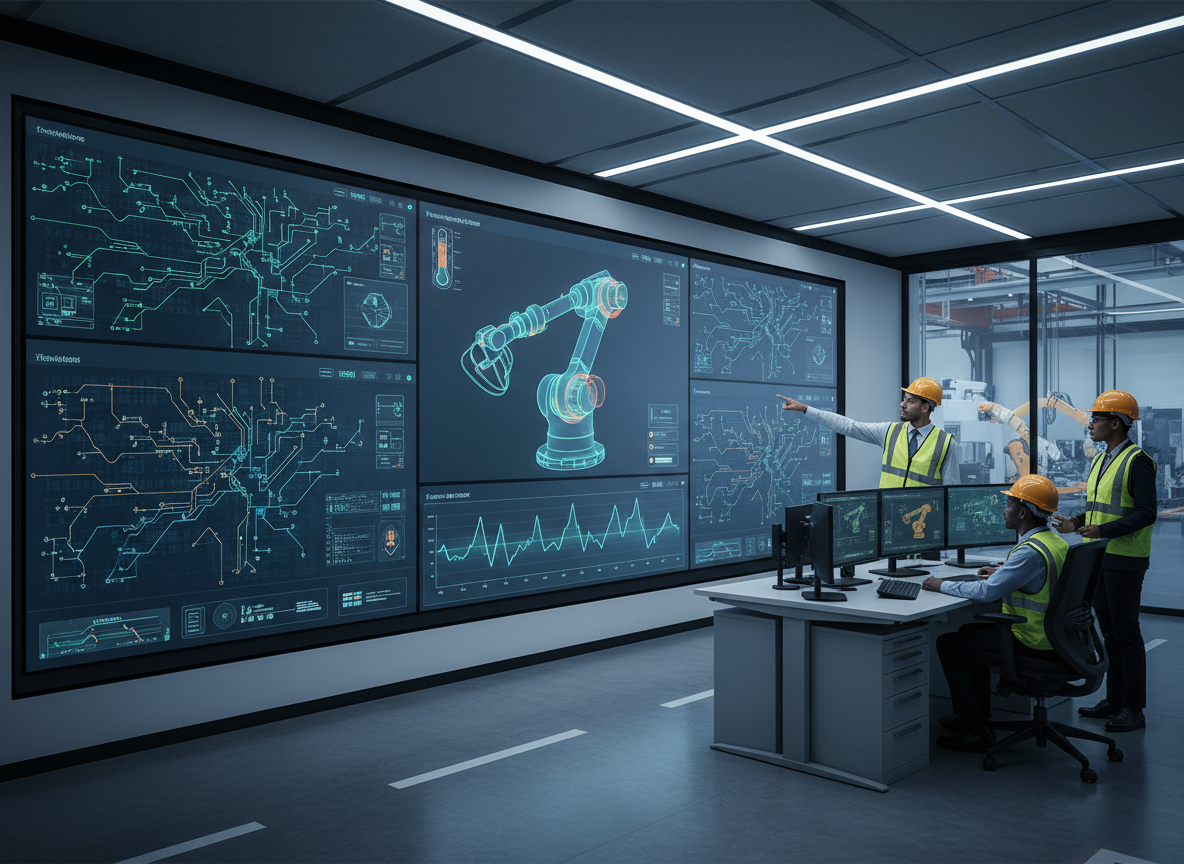

Move beyond reactive repairs and fixed schedules. Predictive maintenance software helps manufacturers prevent critical equipment failures, optimize maintenance timing, and integrate actionable insights directly into production workflows.
Manufacturing now accounts for 32.2% of global predictive maintenance spending, making it the largest end-use industry. Downtime isn’t just a maintenance issue it’s a business risk affecting production schedules, customer commitments, and profitability.
Plants that fully implement predictive maintenance can see:
- Up to 50% reduction in unplanned downtime
- Around 30% lower maintenance costs
Success depends on integrating predictions into workflows, focusing on the few critical failures that matter most, and building trust in the models.
This blog explores how predictive maintenance works in manufacturing, features that drive real results, leading platforms including BQP’s quantum-inspired approach, and how to turn predictive insights into operational advantage.
How Predictive Maintenance Software Works in Manufacturing
Step 1: Data Collection
Sensors watch machines in real time, measuring vibration, temperature, sound, and pressure.
- Vibration sensors detect early bearing wear
- Temperature sensors spot overheating motors
- Sound sensors catch unusual noises that point to mechanical issues
This steady flow of data builds a baseline for normal operation and highlights any unusual changes.
Step 2: Data Analysis
The software studies incoming data to learn what “normal” looks like for each machine. It then spots small shifts that suggest wear or damage before failure happens.
Step 3: Prediction and Alerts
When a developing issue is found, the system estimates when the failure might occur and how serious it could be.
Each alert includes:
- The machine or component affected
- The likely cause of failure
- The level of urgency and the suggested next step
Step 4: Proactive Scheduling
Maintenance tasks are planned based on how important the asset is and when downtime will have the least impact. Work orders are created automatically with all needed details for technicians.
Step 5: Integration with Operations
Predictive maintenance connects with existing plant systems:
- CMMS for work order management
- ERP for spare parts and purchasing
- MES for production scheduling
- Data historians for long-term tracking
This connection ensures that maintenance insights lead to real action on the shop floor.
Key Features of Predictive Maintenance Systems
- Condition monitoring: Tracks machine health in real time using sensors that measure vibration, temperature, pressure, and other parameters.
- Failure prediction: Detects early warning signs and estimates how long equipment can operate before failure.
- Work order automation: Automatically creates maintenance tasks with diagnostic details, recommended actions, and required parts.
- Dashboards and reports: Displays key information such as equipment health, uptime, maintenance costs, and prediction accuracy.
- Connectivity: Links with plant systems like CMMS, ERP, MES, and data historians to ensure smooth data flow across operations.
Benefits of Predictive Maintenance Systems for Manufacturing Operations
- Maximized uptime: Early fault detection helps prevent unplanned stoppages and production losses.
- Longer equipment life: Maintenance based on actual condition extends asset lifespan by replacing parts only when needed.
- Better safety and compliance: Predicting failures reduces the risk of accidents, injuries, and environmental issues.
- Higher operational efficiency: Maintenance is planned around production schedules, ensuring less disruption and better resource use.
- Lower maintenance costs: Fewer emergency repairs and rush orders reduce expenses while improving overall reliability.
Leading Predictive Maintenance Software for Manufacturing
1. BQP — Quantum-Inspired Predictive Maintenance for High-Fidelity Manufacturing
BQP is built for manufacturers facing complex reliability challenges such as limited failure data, critical equipment, and the constant need to balance uptime, safety, and cost.
BQP combines physics-based modeling with quantum-inspired optimization to predict rare, high-impact failures that traditional systems often miss. Instead of only detecting changes, BQP explains why they occur by modeling thermal stress, material fatigue, and vibration behavior.
By merging simulation insights with live sensor data, BQP delivers accurate, physics-validated predictions even in environments with little historical data.
It also helps teams plan maintenance across entire production lines, choosing the best time to act while reducing cost and downtime.
Key Features
- Quantum-assisted models that deliver accurate results with limited data
- Hybrid optimization that makes maintenance scheduling up to 20× faster
- Multi-objective planning that balances cost, uptime, and safety
- High-fidelity digital twins that connect live sensor data with physics models
- Ready-to-use templates for discrete, continuous, and hybrid manufacturing setups
Why Choose BQP
- Performs accurately even for rare or unseen failures
- Integrates easily with existing sensors, CMMS, and HPC systems
- Handles complex physical and operational conditions with confidence
- Provides simulation-validated predictions for better decision-making
- Reduces false alarms through physics-informed detection
Ready to transform your maintenance strategy?
See how BQP’s quantum-inspired predictive maintenance helps manufacturers cut downtime, optimize costs, and improve reliability.Book a demo or start your 30-day free trial today.
2. IBM Maximo — Enterprise-Grade Asset Management
IBM Maximo is a comprehensive asset management platform used across industries such as automotive, energy, and pharmaceuticals. It combines maintenance planning, inventory control, work order management, and predictive analytics in one integrated system.
Maximo’s main strength is its mature ecosystem. It connects easily with ERP systems, financial tools, and compliance modules, making it a strong choice for large enterprises managing multiple facilities and complex operations.
Key Features:
- Asset health scoring and failure probability modeling
- Mobile workforce management with offline access for field technicians
- Integration with ERP, procurement, and financial systems
- Compliance tracking and audit trail management
- Customizable workflows for specific industry requirements
Pros:
- Proven reliability with decades of deployment across industries
- Strong integration with systems like SAP and Oracle
- Robust compliance and reporting features
- Large implementation partner network and user community
Cons:
- Longer implementation timelines, often 6–12 months
- Higher overall cost due to licensing and setup requirements
- May feel heavy for mid-sized plants with simpler needs
- User interface is less modern than newer cloud platforms
3. Siemens MindSphere — IoT-Driven Equipment Optimization

Siemens MindSphere is an industrial IoT platform that connects factory equipment to the cloud for real-time data analysis and predictive insights. It helps manufacturers monitor machines, detect issues early, and improve equipment performance through connected analytics.
MindSphere works especially well for plants already using Siemens automation hardware. Its built-in connectivity allows fast setup and smooth data flow from sensors, controllers, and production systems to the cloud.
Key Features:
- Edge-to-cloud architecture for real-time equipment monitoring
- Digital twin capabilities for virtual replicas of assets
- Pre-built analytics applications for common equipment types
- Scalable time-series data storage for high-volume sensor data
- Industrial-grade security and data governance
Pros:
- Seamless integration with Siemens PLCs, drives, and hardware
- Scalable and flexible cloud infrastructure
- Strong visualization tools and easy-to-read dashboards
- Continuous product updates and active ecosystem support
Cons:
- Works best within the Siemens ecosystem, limiting hardware flexibility
- Requires specialized skills for custom analytics development
- Cloud-first architecture may not fit operations needing on-premise control
- Additional professional services may be needed for complex setup
How BQP Strengthens Predictive Maintenance in Manufacturing
BQP’s quantum-inspired platform helps manufacturers overcome the main challenges that limit traditional predictive maintenance systems.
Key Advantages
- Hybrid quantum algorithms
Improve anomaly detection accuracy and reduce false alerts by separating real equipment wear from normal variations. - Multi-physics modeling
Combine vibration, temperature, stress, and material fatigue data into one model for a clearer view of how failures develop. - Reduced training time
Learn from both simulations and real data to predict rare or new failure modes with limited historical information. - Industry-wide adaptability
Work across discrete, continuous, and hybrid manufacturing setups with ready-to-use templates and quick customization. - Actionable insights
Turn complex sensor data into clear, confident maintenance recommendations that fit directly into existing workflows.
See how BQP helps manufacturers improve reliability, reduce downtime, and make maintenance a proactive strength.Book a demo or start your 30-day free trial today.
Conclusion
Predictive maintenance is transforming manufacturing by reducing downtime, improving reliability, and optimizing costs. The advantage goes to operations that can predict critical failures accurately and integrate insights seamlessly into workflows.
Success comes from starting with imperfect data, validating predictions, and focusing on the few failures that matter most. Legacy equipment often offers the fastest returns because it concentrates risk and has operational knowledge to confirm predictions.
Platforms like BQP combine physics-informed models with quantum-inspired optimization, helping manufacturers predict rare failures, optimize complex trade-offs, and turn maintenance into a competitive strength.
FAQs
1.What is predictive maintenance in manufacturing?
It uses sensors and smart analysis to detect potential equipment failures before they happen, allowing maintenance to happen only when needed.
2.How does predictive maintenance reduce downtime?
By spotting problems early, teams can fix them during planned production windows instead of reacting to unexpected breakdowns.
3.Do we need perfect data to start predictive maintenance?
No. Effective programs start with limited data and improve over time using models that combine real and simulated information.
4.What is the ROI timeline for predictive maintenance in manufacturing?
Most manufacturers see initial benefits in 6–12 months, with full financial impact in 18–24 months.
5.Why does BQP work better for rare failures than traditional AI?
Traditional AI needs many past failures to learn patterns. BQP uses physics-based modeling to predict even rare or new failure modes reliably.
.png)
.png)



.svg)
.svg)
.svg)
.svg)