


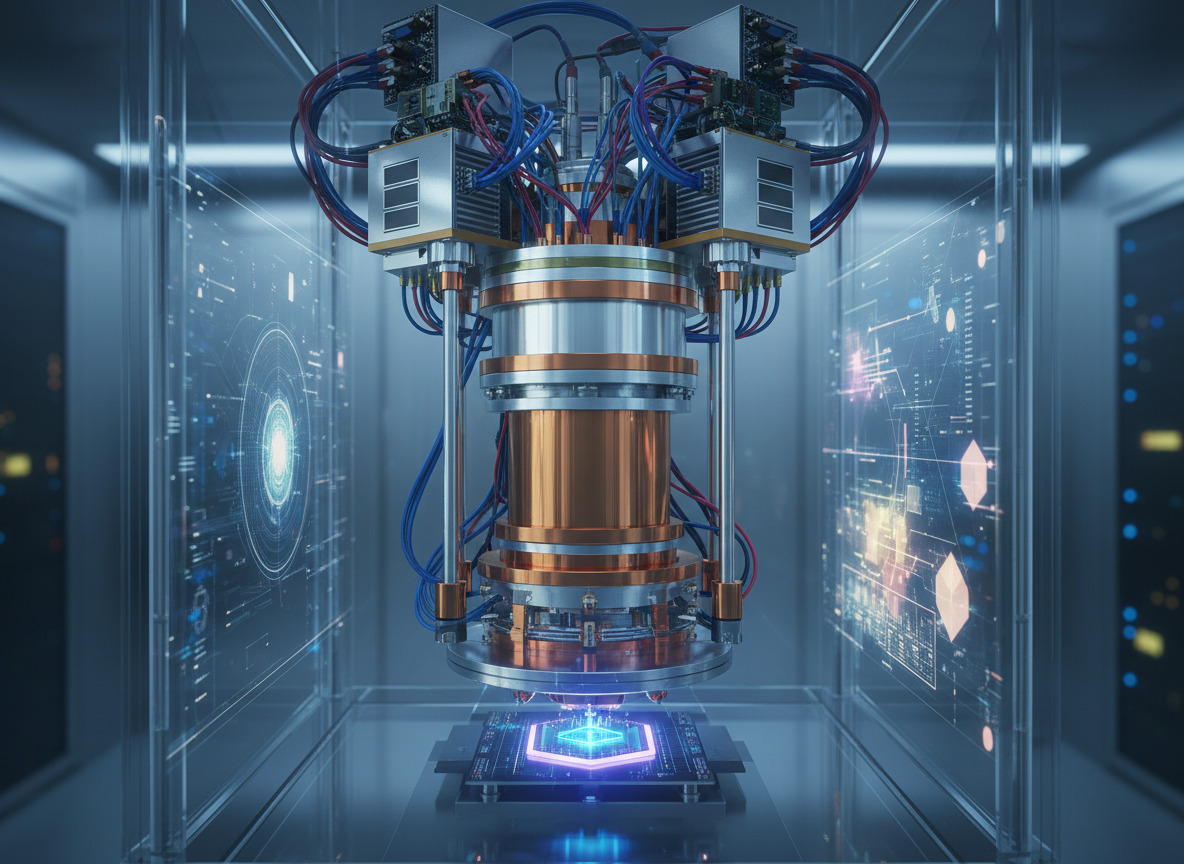

Classical bits are giving way to quantum bits faster than most anticipated.
The global quantum computing market reached USD 1.8 billion to USD 3.5 billion in 2025. Q1 2025 alone saw over USD 1.25 billion in investments, more than double the previous year.
Traditional binary systems excel at sequential processing but struggle with exponentially growing solution spaces. Mission planning across thousands of variables, molecular simulations with quantum-level accuracy, and real-time optimization of satellite constellations push classical architectures to their limits.
This article explains quantum computing technology from first principles to real-world relevance.
What Is Quantum Computing?
Quantum computing is a computational paradigm based on quantum mechanics rather than classical binary logic.
Classical computers process information as discrete bits (0 or 1). Quantum computers use quantum bits (qubits) that exist in superposition, representing both 0 and 1 simultaneously until measured.
Three quantum mechanical properties are:
- Superposition allows qubits to represent multiple states at once. A system with just 300 qubits can theoretically represent more states than there are atoms in the observable universe.
- Entanglement creates correlations between qubits where measuring one instantly affects others, regardless of distance. This interconnection allows quantum systems to process information in ways classical architectures cannot replicate.
- Interference amplifies correct solution pathways while canceling out incorrect ones, guiding the system toward optimal answers through wave interference.
This isn't an incremental improvement. Classical computing scaled through miniaturization and clock speed increases. Quantum computing scales through fundamentally different physics, enabling exponential performance gains for specific problem classes.
The key insight: quantum computing doesn't make classical computers obsolete. It solves problems classical computers struggle with while remaining inefficient for tasks classical systems handle well. That's why hybrid quantum-classical architectures represent the most practical near-term approach.
How Quantum Computers Work: Hardware and Software Basics?
A qubit is the quantum analog of a classical bit, but with crucial differences.
A classical bit stores either 0 or 1. A qubit exists in quantum superposition, a linear combination of both states simultaneously, until observation collapses it to a definite value.
Physical implementations vary:
- Superconducting circuits (IBM, Google)
- Trapped ions (IonQ)
- Neutral atoms (recently achieving 6,100-qubit arrays at Caltech)
- Photonic systems
- Topological approaches
Each has tradeoffs in coherence time, error rates, connectivity, and scalability.
Quantum operations manipulate qubits through quantum gates. Single-qubit gates create superposition. Two-qubit gates create entanglement. Sequences of these gates form quantum circuits that implement algorithms.
The process: initialize qubits, apply gate sequences, measure outcomes. Measurement collapses superposition, yielding classical output. Because of quantum noise and probabilistic nature, algorithms run multiple times with results aggregated statistically.
Current hardware faces significant challenges
We're in the NISQ era, Noisy Intermediate-Scale Quantum devices with 50-1000 qubits. In April 2025, Fujitsu and RIKEN announced a 256-qubit superconducting quantum computer, representing steady progress but still far from the millions of error-corrected qubits needed for fault-tolerant systems.
Noise, decoherence (qubits losing quantum properties), and error rates remain major obstacles. Qubits are extraordinarily fragile, requiring near-absolute-zero temperatures and electromagnetic isolation.
How Does Quantum Computing Expand Capabilities and Applications?
Quantum computing excels at specific problem classes where classical approaches scale poorly.
1. Optimization and Combinatorial Problems
Scheduling thousands of tasks with complex constraints, allocating resources across distributed systems, or planning optimal routes through high-dimensional spaces grow exponentially complex for classical algorithms.
Applications include:
- Defense mission planning
- Logistics networks
- Supply chain optimization
- Portfolio allocation
- Network design
The value proposition: solutions that are 10-20× faster or solutions that are simply impossible to compute classically within reasonable timeframes.
2. Simulation of Complex Systems
Simulating quantum mechanical systems on classical computers requires exponentially growing resources as system size increases. Quantum simulators naturally represent these quantum phenomena.
Aerospace applications include:
- Fluid dynamics simulations
- Thermal stress modeling
- Electromagnetic interference prediction
- Satellite trajectory optimization
Materials science uses quantum simulation for discovering new alloys, superconductors, and structural composites.
Learn more about complex simulations with quantum algorithms on high-performance computing.
3. Cryptography and Cybersecurity
Quantum computers running Shor's algorithm could theoretically break current public-key encryption systems. This drives the development of quantum-safe cryptography post-quantum encryption algorithms resistant to quantum attacks.
Quantum key distribution (QKD) enables theoretically unbreakable communication channels, critical for defense and secure government communications.
4. Data-Intensive Computing and Machine Learning
Quantum-enhanced optimization can improve neural network training, feature extraction, and pattern recognition in high-dimensional datasets. While general-purpose quantum machine learning remains largely experimental, hybrid approaches show promise.
Why early adoption matters strategically: Technologies that deliver exponential advantages create winner-takes-all dynamics. Organizations that understand quantum principles now will have years of advantage over competitors who wait.
Is Quantum Computing Ready for Real-World Use Today?
Honesty about current limitations is essential for strategic planning.
Current Hardware Constraints:
- Qubit counts remain in the hundreds to low thousands
- Error rates are high, 0.1-1% per gate operation
- Decoherence times are microseconds to milliseconds
- Connectivity is limited, not all qubits can interact directly
These constraints mean most quantum algorithms remain experimental. The term quantum advantage, where quantum systems outperform classical ones on specific tasks, has been demonstrated in narrow cases. But "quantum economic advantage" where quantum systems deliver cost-effective, scalable value, remains largely future-facing.
That said, dismissing quantum computing as purely theoretical ignores the acceleration happening now.
- Investment doubled year-over-year.
- Hardware capabilities grow monthly.
- Cloud access democratizes experimentation.
Hybrid and cloud-based approaches provide the practical bridge
Organizations don't need to buy quantum computers or hire quantum physicists. Cloud platforms offer pay-per-use quantum access. Quantum-inspired optimization solvers deliver near-quantum performance on classical GPUs and HPC clusters.
What enterprises need to prepare now:
- Strategy: Identify high-value use cases where quantum approaches could deliver 10× improvements
- Talent: Train engineers who understand quantum principles, even if they're not quantum physicists
- Infrastructure evaluation: Assess how quantum-inspired capabilities could integrate with current HPC pipelines
- Pilot projects: Run small-scale proofs-of-concept on representative problems
Organizations that start these preparations now will dominate the quantum-enabled future. Those who wait will face years of catch-up.
Why Quantum Computing Is Needed In Defense, Aerospace, and High-Performance Industries?
For defense contractors, aerospace firms, and national laboratories, quantum computing represents a strategic capability gap that's widening.
Competitive Advantage Through Problem-Solving
Classical computers can't efficiently simulate 100+ molecule quantum systems. They struggle with optimization problems involving thousands of interdependent variables. They require days or weeks to run high-fidelity aerospace simulations.
Quantum and quantum-inspired approaches collapse these timeframes dramatically:
- A simulation that took 72 hours might run in 3-4 hours
- An optimization problem with 10,000 configurations might converge 20× faster
These aren't marginal gains, they're capability step-changes.
Use Cases Demonstrating Immediate Relevance:
Materials Science and Drug Discovery: Simulating molecular interactions with quantum accuracy accelerates the discovery of new aerospace materials, propellants, protective coatings, and lightweight composites.
Aerospace Simulations: High-fidelity simulations of aerodynamics, thermal dynamics, structural stress, and electromagnetic effects benefit enormously from quantum-accelerated physics-based modeling. Explore quantum optimization for space applications.
Logistics Optimization: Military logistics involves tens of thousands of variables—supply routes, equipment availability, personnel allocation, fuel constraints, threat assessment. Quantum approaches navigate these high-dimensional spaces more efficiently.
Cryptography and Secure Communications: Defense organizations must transition to quantum-safe cryptography now. Adversaries are already harvesting encrypted communications to decrypt later. Learn about quantum technology in defense.
Large-Scale Simulations: Digital twins of complex systems require simulation fidelity that classical systems struggle to provide. Quantum-enhanced physics-informed neural networks improve accuracy while reducing computational cost.
Hybrid-ready adoption minimizes disruption. Platforms that integrate quantum-inspired solvers with existing HPC infrastructure let organizations gain quantum-like performance without rearchitecting entire workflows.
How BQP Platform Delivers Quantum-Powered Simulation Today?
BQP delivers quantum-powered simulation and optimization capabilities designed specifically for defense, aerospace, and high-performance industries.
Hybrid Quantum-Classical Integration
The platform embeds quantum-inspired optimization solvers directly into existing HPC and GPU workflows. Engineering teams continue using familiar simulation tools while BQP's solvers operate seamlessly in the background.
This means:
- No system overhaul
- No forcing engineers to learn quantum physics
- No replacing proven simulation pipelines
- Just measurably faster, more accurate results
Quantum-Inspired Solvers
BQP leverages QIO (Quantum-Inspired Optimization) to tackle complex design and scheduling problems up to 20× faster than classical methods. These solvers excel at multi-objective, high-dimensional optimization problems common in aerospace mission planning and defense system optimization.
Physics-Informed Neural Networks (PINNs)
BQP embeds governing physical laws directly into AI models, ensuring simulations respect fundamental physics. Quantum-Assisted PINNs (QA-PINNs) add quantum feature-extraction layers, accelerating training and improving generalization in sparse-data environments.
Use Cases:
- Mission-critical simulations with real-time constraints
- Multi-objective optimization (performance vs. cost vs. risk)
- Complex system modeling (thermal, structural, electromagnetic)
- Satellite trajectory optimization
- UAV path planning in contested environments
Scalability and Security
BQP runs in cloud environments for elastic compute or on-premise for data sovereignty critical for defense contractors handling classified workloads. Fine-grained access controls, audit logs, and encrypted data channels ensure security at every layer.
Benefits:
- 10-20× performance improvements on optimization and simulation workloads
- Improved simulation fidelity from physics-informed models
- Future-proofing infrastructure for true quantum hardware integration
- Competitive advantage through early adoption
BQP bridges the gap between quantum theory and enterprise reality. Organizations don't need to understand quantum mechanics to benefit from quantum-inspired performance.
Explore how BQP accelerates mission-critical simulations: BQP Quantum & Simulation Platform
Getting Started With Quantum-Powered Simulation
Quantum computing technology crossed the threshold from theoretical promise to commercial relevance.
With over USD 1.25 billion invested in Q1 2025, record-breaking qubit arrays demonstrated in research, and real quantum advantage achieved in practical simulations, the technology trajectory is clear.
The fundamental principles:
- Superposition
- Entanglement
- Quantum Interference
enable computational approaches that classical systems cannot replicate. Fault-tolerant quantum computers remain years away. For defense organizations, aerospace firms, and simulation-intensive industries, quantum computing represents a strategic capability that will separate leaders from laggards.
That's exactly why starting now matters. Organizations that build quantum literacy, experiment with hybrid workflows, and integrate quantum-inspired solvers into existing pipelines will be dep
Discover how hybrid quantum-classical workflows can accelerate your simulations: Simulation-Driven Optimization for Digital Mission Engineering
Frequently Asked Questions
1. What exactly is quantum computing and how is it different from classical computing?
Quantum computing uses qubits that can hold multiple states at once, unlike classical bits. This allows it to explore many solutions in parallel through superposition and entanglement.
2. What kind of problems can quantum computing solve today?
Today it helps with optimization, molecular simulations, and some machine learning tasks in hybrid setups. Quantum-inspired algorithms often provide the most practical near-term value.
3. When will quantum computing become widely usable in enterprise settings?
Broader usability is expected in the late 2020s, but hybrid approaches are already available. Cloud access and quantum-inspired solvers can deliver strong performance gains today.
4. Do we need specialized hardware to start using quantum computing?
No, most users access quantum systems through cloud platforms. Hybrid tools like BQP provide quantum-inspired performance on existing HPC setups without special hardware.
5. What industries will benefit first from quantum computing technology?
Early adopters include pharma, materials, aerospace, defense, finance, logistics, and cybersecurity. These sectors deal with complex optimization problems that quantum methods accelerate.
.png)
.png)



.svg)
.svg)
.svg)
.svg)