


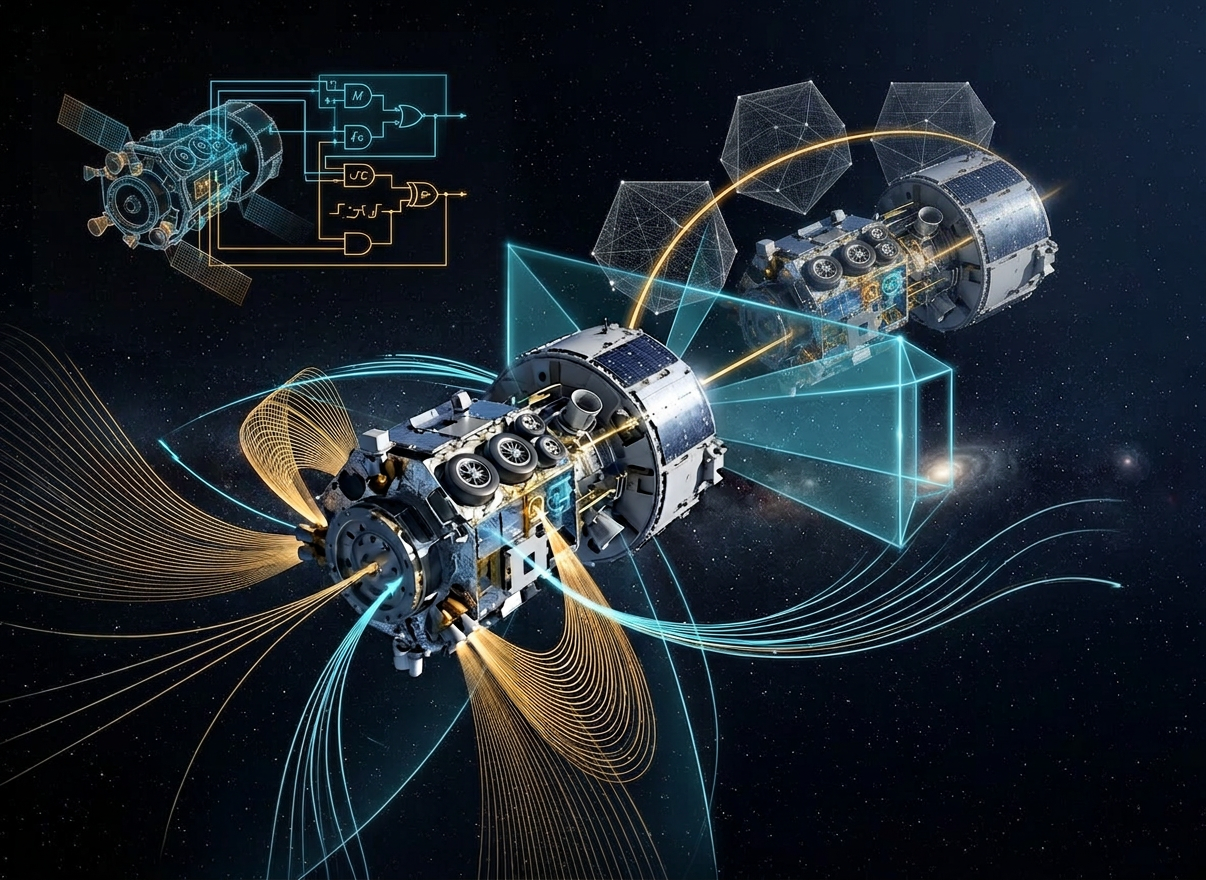

Spacecraft attitude control system optimization operates where actuator torque limits, sensor noise floors, and flexible structural dynamics interact within pointing accuracy requirements that leave no margin for conservative design compromises.
Reaction wheel sizing, control bandwidth, and momentum desaturation frequency interact across slew maneuver, fine pointing, and disturbance rejection operational modes simultaneously each mode imposing requirements that compete directly against mass, power, and propellant budgets. An ACS optimized purely for fine pointing stability will saturate its reaction wheels during rapid target acquisition slews; one sized for maximum slew rate will exceed the power budget during extended science observation periods.
Attitude control optimization is where every actuator gram and every control bandwidth decision compounds across the mission life.
This article covers:
- The dominant actuator sizing, sensor noise, and flexible dynamics constraints that define the spacecraft ACS feasible design boundary
- Three proven optimization methods including quantum inspired optimization via BQP, robust H-infinity control optimization, and reaction wheel momentum management optimization
- Step-by-step execution workflows derived from actual spacecraft ADCS engineering practice, not adapted from generic control system design procedures
Method selection at each ACS design phase determines whether the spacecraft meets pointing requirements across all operational modes without propellant-consuming desaturation events that shorten mission life.
What Limits Spacecraft Attitude Control System Performance?
Spacecraft ACS optimization begins by isolating the actuator, sensor, structural dynamics, and propellant constraints that define which control architectures and actuator configurations are simultaneously feasible for the mission pointing and maneuver requirements.
1. Reaction Wheel Torque and Momentum Storage Limits
Reaction wheel maximum torque and angular momentum storage capacity set the ceiling on achievable slew rate and the maximum angular impulse absorbable before desaturation is required, both of which are fixed properties of the selected wheel hardware.
Torque and momentum limits constrain the optimizer's ability to trade slew speed against desaturation frequency larger wheels enable faster slews but add mass and power draw that compete against the spacecraft's overall resource budgets.
2. Star Tracker and Gyroscope Noise Floor
Star tracker attitude measurement noise and gyroscope rate noise floor set the minimum achievable pointing knowledge error, which bounds how accurately the ACS can estimate and correct the spacecraft's attitude during fine pointing operational modes.
Sensor noise floors constrain achievable pointing accuracy independently of control bandwidth a perfectly designed controller cannot reduce pointing error below the sensor noise contribution, forcing the optimizer to account for sensor hardware selection as a primary performance driver.
3. Flexible Structural Mode Frequencies
Deployable solar arrays, antennas, and booms introduce flexible structural modes whose frequencies may overlap the ACS control bandwidth, creating the risk of control-structure interaction instability if the attitude controller excites rather than damps these modes.
Flexible mode frequencies set an upper bound on usable ACS control bandwidth controllers designed with bandwidth above the lowest flexible mode frequency require notch filtering that reduces disturbance rejection performance and complicates stability margin verification across the on-orbit mode frequency uncertainty range.
4. Magnetic Torquer and Thruster Desaturation Propellant Budget
Momentum desaturation requires either magnetic torquer rods operating against the geomagnetic field or thruster firing, both of which consume either electrical power or propellant at rates that scale with the accumulated disturbance torque environment.
Desaturation propellant budget constrains how frequently the optimizer can schedule desaturation events, forcing reaction wheel sizing to accommodate larger momentum accumulation between desaturation opportunities rather than relying on frequent small corrections.
These four constraints collectively define the feasible ACS design envelope. For how actuator sizing, sensor selection, and structural dynamics constraints interact across aerospace control systems, see aerospace optimization techniques.
What Are the Optimization Methods for Spacecraft Attitude Control System?
Three methods address distinct layers of spacecraft ACS optimization, from actuator configuration and mode selection through robust controller design and reaction wheel momentum management.
Method 1: Quantum Inspired Optimization Using BQP
BQP is a quantum inspired optimization framework that encodes combinatorial engineering problems as QUBO models and resolves them using quantum-inspired heuristics on classical hardware without requiring physical quantum processors.
For spacecraft ACS, BQP encodes the discrete actuator configuration selection problem choosing which combination of reaction wheels, magnetic torquer rods, and thrusters covers which operational modes as binary variables within simultaneous torque authority, power budget, pointing accuracy, and propellant consumption constraints across the full mission mode set.
BQP is best suited when ACS actuator configuration involves discrete hardware selection and operational mode assignment decisions across multiple interdependent subsystems where continuous sizing methods cannot resolve the combinatorial interactions between actuator types, control modes, and resource budgets.
Step-by-Step Execution for Spacecraft ACS Using BQP
Step 1: Enumerate Candidate Actuator Configurations per Mode
Define candidate actuator hardware combinations wheel count, wheel size, torquer rod dimensions, and thruster configuration for each spacecraft operational mode. Assign binary selection variables to each hardware-mode pairing as the primary decision set in the QUBO formulation.
Step 2: Encode Torque Authority Requirements as Mode-Level Constraints
Translate minimum required torque authority for each operational mode slew rate requirement, disturbance rejection torque, and desaturation torque margin into penalty terms that eliminate actuator configurations providing insufficient torque for their assigned mode from the feasible solution space.
Step 3: Apply Power Budget Constraints Across Simultaneous Active Modes
Encode the spacecraft power budget allocation for ACS hardware as a global constraint across all simultaneously active actuator binary variables. Penalize configurations where combined wheel spin-up power, torquer rod current, and thruster valve power exceeds the ACS power allocation.
Step 4: Encode Pointing Accuracy Compatibility per Hardware-Mode Pair
Add penalty terms for hardware-mode pairings where actuator minimum impulse bit or torquer rod resolution is too coarse to achieve the mode's required pointing accuracy. Eliminate configurations that cannot provide the fine control authority the pointing requirement demands.
Step 5: Encode Desaturation Frequency Against Propellant Budget
Translate the mission propellant budget for desaturation into a constraint on maximum allowable desaturation event frequency. Penalize actuator configurations that require desaturation more frequently than the propellant budget supports across the mission design life.
Step 6: Submit QUBO and Extract Actuator Configuration Map
Assemble and submit the Q matrix to BQP's solver. The lowest-energy configuration identifies the actuator hardware selection and mode assignment that satisfies torque authority, power budget, pointing accuracy, and desaturation propellant constraints simultaneously across all operational modes.
Step 7: Validate Configuration Against Disturbance Torque Environment
Cross-check the BQP-selected actuator configuration against the spacecraft disturbance torque environment model covering solar radiation pressure, gravity gradient, aerodynamic drag, and magnetic torques. Confirm momentum accumulation rates remain within the selected wheel storage capacity between scheduled desaturation events.
Practical Constraints and Failure Modes with BQP
QUBO matrix complexity grows with the number of candidate actuator hardware options and operational modes encoded simultaneously. Spacecraft with more than six operational modes and four actuator type options require mode clustering by pointing requirement tier to keep matrix dimensions tractable for BQP resolution.
BQP encodes disturbance torque environment estimates from pre-launch models that may differ from on-orbit reality due to solar array flexibility, residual magnetic dipole uncertainty, and atmospheric density variation at low altitudes. If actual disturbance torques exceed model predictions, the optimized actuator configuration may saturate reaction wheels faster than the encoded desaturation schedule accommodates.
Method 2: Robust H-Infinity Control Optimization
Robust H-infinity control optimization designs attitude controller gain matrices that minimize the worst-case pointing error response to disturbance inputs and plant uncertainty across the full range of spacecraft inertia variation, flexible mode frequency uncertainty, and sensor noise levels the spacecraft encounters on orbit.
Spacecraft inertia properties change as propellant is consumed, deployable appendages flex, and thermal deformation shifts mass distribution a controller optimized for the nominal inertia model will degrade in pointing performance and potentially lose stability margin as these variations accumulate during the mission.
H-infinity control optimization performs best for science missions with stringent pointing stability requirements where the spacecraft inertia uncertainty is large, flexible structural modes are close to the control bandwidth, and the controller must maintain guaranteed stability margins across the full uncertainty set without gain scheduling. For how robust control optimization fits within the broader design optimization in engineering framework, further context is available.
Step-by-Step Execution for Spacecraft ACS Using H-Infinity Control Optimization
Step 1: Build Nominal Plant Model with Uncertainty Bounds
Construct the spacecraft attitude dynamics model including rigid body inertia, flexible mode transfer functions, actuator dynamics, and sensor models. Define uncertainty bounds on inertia tensor elements, flexible mode frequencies, and damping ratios as structured perturbations to the nominal plant.
Step 2: Define Performance and Stability Weighting Functions
Select frequency-domain weighting functions specifying the desired disturbance rejection bandwidth, pointing error attenuation at low frequencies, and control effort limitation at high frequencies. Weight functions encode the performance-robustness tradeoff that the H-infinity synthesis will optimize.
Step 3: Formulate H-Infinity Synthesis Problem
Set up the generalized plant incorporating the nominal dynamics model, uncertainty descriptions, and weighting functions. The H-infinity norm of the closed-loop transfer matrix from disturbance inputs to weighted performance outputs is the objective being minimized by the controller synthesis.
Step 4: Solve H-Infinity Controller via Riccati or LMI Methods
Compute the H-infinity optimal controller using algebraic Riccati equation methods or linear matrix inequality formulations. Extract the full-order controller gain matrices and verify that the achieved H-infinity norm meets the performance specification across the full uncertainty set.
Step 5: Reduce Controller Order for Flight Implementation
Apply balanced truncation or Hankel norm approximation to reduce the full-order H-infinity controller to an implementable order compatible with the flight computer's available processing throughput and memory within the ACS software partition's WCET budget.
Step 6: Verify Stability Margins Across Inertia Uncertainty Set
Compute gain and phase margins for the reduced-order controller across a grid of inertia uncertainty realizations spanning the full mission propellant consumption range. Confirm stability margins remain above the mission requirement at all inertia states including end-of-life propellant-depleted configuration.
Practical Constraints and Failure Modes
H-infinity synthesis produces controllers that are optimal for the specified weighting functions but highly sensitive to weighting function selection. Poorly chosen weights that do not accurately reflect the mission's true performance-robustness priorities produce controllers that are mathematically optimal but operationally unacceptable in ways that only become apparent during hardware-in-the-loop testing.
Full-order H-infinity controllers have order equal to the plant model order plus weighting function orders, which can produce controllers with hundreds of states for high-fidelity flexible spacecraft models. Order reduction always introduces approximation error that must be verified to preserve stability margins across the full uncertainty set before flight implementation.
Method 3: Reaction Wheel Momentum Management Optimization
Reaction wheel momentum management optimization determines the wheel speed distribution, momentum envelope boundaries, and desaturation maneuver schedule that minimize propellant consumption while preventing wheel saturation across the full sequence of slew maneuvers, science observations, and disturbance accumulation events in the mission operations plan.
Reaction wheel momentum accumulates from external disturbance torques and attitude maneuvers without systematic momentum management, wheels saturate and the ACS loses attitude control authority at the worst possible times during science observations or critical mission events that cannot be interrupted for desaturation.
This method performs best during mission operations planning when the observation schedule is defined, the disturbance torque environment model is calibrated from early on-orbit data, and the momentum management optimizer can plan desaturation events across weeks to months of scheduled operations to minimize thruster firing frequency. This connects to the broader class of quantum optimization problems in spacecraft operational scheduling where discrete event planning under resource constraints drives mission efficiency.
Step-by-Step Execution for Spacecraft ACS Using Momentum Management Optimization
Step 1: Model Momentum Accumulation Across Observation Schedule
Propagate reaction wheel momentum accumulation across the planned observation schedule incorporating slew maneuver angular impulses, science observation disturbance torque accumulation rates, and eclipse-to-sunlit transition magnetic torque variations for each orbit in the planning window.
Step 2: Identify Saturation Risk Events in Momentum Trajectory
Flag time points in the propagated momentum trajectory where any wheel speed approaches its maximum rated speed within the saturation warning threshold. These events define the latest acceptable desaturation times that prevent wheel speed limit violations during subsequent scheduled maneuvers.
Step 3: Compute Desaturation Maneuver Options at Each Risk Point
For each identified saturation risk event, compute the available desaturation options magnetic torquer-only, thruster-only, or combined with their associated angular impulse, propellant cost, pointing interruption duration, and attitude error recovery time for each option.
Step 4: Optimize Desaturation Schedule to Minimize Propellant Use
Solve the desaturation scheduling problem: select the minimum number of desaturation events at the latest acceptable times using the least propellant-intensive method available, while ensuring no wheel saturation occurs between any two consecutive scheduled desaturation events.
Step 5: Distribute Wheel Speeds Across Four-Wheel Pyramid Configuration
For spacecraft with four-wheel pyramidal configurations, optimize the null-motion wheel speed distribution to keep all four wheels away from both zero crossing and saturation boundaries simultaneously, using the redundant degree of freedom to maximize saturation margin without consuming propellant.
Step 6: Reoptimize Schedule After Observation Plan Changes
Rerun the momentum propagation and desaturation scheduling whenever the observation plan changes new target insertions, observation cancellations, or emergency repointing events. Confirm the updated schedule maintains saturation margins before the revised operations plan is uplinked.
Practical Constraints and Failure Modes
Momentum management optimization accuracy degrades when the disturbance torque environment model does not reflect actual on-orbit conditions. Solar radiation pressure variations due to solar array articulation, residual magnetic dipole drift, and atmospheric density fluctuations at low altitudes all produce momentum accumulation rates that deviate from pre-launch models and require periodic model updates.
Four-wheel null-motion distribution optimization can produce wheel speed profiles that create bearing wear patterns by dwelling at specific speed ranges. Bearing wear constraints that limit time spent at particular wheel speeds must be included as inequality constraints in the distribution optimization to prevent premature wheel bearing degradation that reduces ACS operational life.
Key Metrics to Track During Spacecraft Attitude Control System Optimization
Three metric categories determine whether the optimized spacecraft ACS meets mission pointing requirements and sustains attitude control authority across the full operational life without propellant-depleting desaturation events or control instability under on-orbit plant uncertainty.
Pointing Error Residual in Fine Pointing Mode
Pointing error residual measures the RMS angular deviation between the spacecraft's actual pointing direction and the commanded target direction during fine science observation mode, decomposed into knowledge error and control error contributions.
Pointing error residual above the science instrument's field of view stability requirement degrades image quality, spectral resolution, or signal integration in ways that cannot be corrected in ground processing, directly reducing the science return from every observation the spacecraft executes during its operational life.
Reaction Wheel Momentum Saturation Margin
Reaction wheel momentum saturation margin measures the minimum separation between the highest-loaded wheel's angular momentum at any point in the mission operations plan and that wheel's rated maximum angular momentum storage capacity.
Saturation margin below the minimum threshold means the wheel will reach its speed limit during a scheduled observation, forcing an unplanned desaturation interruption that disrupts science data collection and consumes propellant outside the optimized desaturation schedule the mission operations team has planned.
ACS Propellant Consumption Rate for Desaturation
ACS propellant consumption rate for desaturation measures the thruster propellant mass consumed per unit time across all desaturation maneuvers executed against the total ACS propellant allocation for the mission design life.
Consumption rate above the allocation implies the mission will exhaust ACS propellant before the planned end of life, forcing either reduced desaturation frequency with increased saturation risk or mission life curtailment before primary science objectives are completed. For a broader treatment of resource consumption metrics in spacecraft design, see quantum inspired optimization for aerospace and defense.
These three metrics collectively determine whether the ACS design is viable for mission operations approval. All three must remain within bounds across the full mission operations plan before the ACS design is locked for hardware procurement.
Start Optimizing Spacecraft Attitude Control Systems with BQP
Spacecraft ACS optimization spans discrete actuator configuration selection, robust controller design under plant uncertainty, and reaction wheel momentum management scheduling each layer requiring a method matched to its problem structure and the operational timescale it governs.
BQP addresses the combinatorial actuator configuration and mode assignment problems that continuous control design methods cannot resolve: discrete hardware selection decisions across multiple actuator types under interdependent torque authority, power budget, pointing accuracy, and desaturation propellant constraints that interact nonlinearly across all operational modes simultaneously.
If your team is designing spacecraft attitude control architectures or momentum management strategies as part of a broader set of quantum optimization problems in space systems, BQP provides a practical platform without physical quantum hardware requirements.
Start your free trial and run your first ACS actuator configuration or desaturation schedule optimization on BQP today no hardware setup, no configuration overhead, engineering-relevant results from the first session.
Frequently Asked Questions About Spacecraft Attitude Control System Optimization
Why is spacecraft actuator configuration selection a combinatorial problem rather than a continuous sizing exercise?
Reaction wheel models come in discrete hardware variants with fixed torque and momentum specifications there is no continuous interpolation between a 0.4 Nms wheel and a 1.0 Nms wheel. Selecting the right combination of wheel sizes, torquer rod configurations, and thruster arrangements across operational modes requires evaluating discrete hardware pairings.
The combinatorial structure grows with the number of operational modes and candidate hardware options. Resolving all torque authority, power budget, and pointing accuracy constraints simultaneously across the full mode set requires discrete optimization methods that evaluate complete configuration sets rather than sizing each actuator independently.
How does flexible structural dynamics affect the ACS control bandwidth optimization?
Flexible modes impose an upper frequency limit on usable control bandwidth controllers designed with bandwidth above the lowest flexible mode frequency risk exciting rather than damping structural oscillations, potentially causing structural fatigue or pointing instability that gets worse as the controller gain increases.
The optimizer must establish control bandwidth below the lowest flexible mode while still achieving sufficient disturbance rejection bandwidth for the pointing stability requirement. This tradeoff becomes most constrained for spacecraft with large deployable appendages whose flexible mode frequencies are low and poorly characterized before on-orbit deployment.
What is the practical impact of inertia uncertainty on reaction wheel sizing optimization?
Spacecraft inertia changes as propellant depletes, thermal gradients shift mass distribution, and flexible appendages alter dynamic coupling. A reaction wheel sized for the beginning-of-life inertia configuration may produce different slew rates and different momentum accumulation responses at end of life.
Robust sizing accounts for the full inertia uncertainty range by ensuring torque authority and momentum capacity remain sufficient across all inertia states the spacecraft will experience. Ignoring inertia uncertainty produces nominally optimized designs that fail pointing requirements or saturate wheels at specific mission phases not anticipated during the optimization.
Can BQP optimize actuator selection and desaturation scheduling simultaneously in a single formulation?
BQP handles both actuator hardware selection and desaturation event scheduling within a single QUBO because both involve binary decisions with coupling constraints actuator hardware selection determines momentum accumulation rates, which directly drives desaturation scheduling requirements.
The practical limitation is matrix scale for missions with many operational modes and long scheduling horizons. Combining hardware selection variables with desaturation event timing variables across a 30-day operations plan requires hierarchical decomposition: optimize hardware configuration first, then optimize the desaturation schedule within the selected hardware architecture.
How does magnetic torquer desaturation interact with orbit altitude and inclination in the optimization?
Magnetic torquer effectiveness scales with local geomagnetic field strength, which varies with orbit altitude and inclination. High-inclination low Earth orbits provide stronger and more predictable geomagnetic fields that make torquer desaturation more efficient, while equatorial orbits produce weaker field vectors that reduce desaturation torque authority.
The momentum management optimizer must use orbit-specific geomagnetic field models to compute realistic torquer desaturation rates rather than assuming constant torquer effectiveness. Missions transitioning between orbit altitudes during propulsive maneuvers experience changing desaturation efficiency that the scheduler must account for across the full mission operations timeline.
.png)
.png)


.svg)
.svg)
.svg)
.svg)