



Aerospace systems today require virtual validation across aerodynamics, structures, propulsion, and mission performance before a single physical prototype exists. Certification authorities demand traceable, high-fidelity analysis. Program timelines compress as aircraft and spacecraft grow more complex. Late-stage design changes can derail entire development efforts.
Simulation software evolved from a specialist tool for stress analysis into the backbone of modern aerospace digital engineering. Engineers now rely on interconnected platforms to model everything from wing flutter and thermal loads to satellite constellation behavior and urban air mobility traffic patterns.
The aerospace simulation software market is expected to grow from $5.6 billion in 2025 to $10.2 billion in 2035. Tool selection decisions made today will shape workflows for the next decade or longer.
This guide explains the leading aerospace simulation tools, what engineering domains they excel in, where they encounter limitations, and how forward-thinking organizations are building simulation stacks that balance immediate certification needs with long-term scalability.
What Is Aerospace Simulation Software?
Aerospace simulation software comprises computational platforms that model the physical behavior, system interactions, and operational performance of aircraft, spacecraft, UAVs, satellites, and related components without requiring physical prototypes or test flights.
These tools encode the governing equations of:
- Aerodynamics
- Structural mechanics
- Thermodynamics
- System dynamics
Engineers input design geometry, boundary conditions, and material properties. The software numerically solves these equations across millions of mesh elements or system nodes. The output predicts lift, drag, structural strain, thermal loads, fuel consumption, mission feasibility, or failure modes.
Simulation plays critical roles across the lifecycle:
- Concept design trades for airframe configurations
- Detailed analysis for FAA or EASA certification packages
- Failure scenario modeling for safety cases
- Operational digital twins that mirror in-service vehicle health
A modern commercial transport can involve 10 million+ hours of simulation before first flight. Defense programs routinely run thousands of mission scenarios to validate tactics and reliability. Aerospace simulation software translates design intent into quantitative predictions of how a vehicle or system will perform under real-world physics and operational constraints.
What Are the Problems Aerospace Simulation Software Solves?
Aerodynamic prediction without wind tunnel dependency
- Engineers use CFD to calculate lift, drag, pressure distribution, and shock wave behavior across flight envelopes, from subsonic commercial cruise to hypersonic reentry.
- This eliminates the need for dozens of wind tunnel test campaigns, which can cost millions of dollars and require months of facility scheduling.
- Simulation allows exploration of hundreds of design variants in parallel.
Structural validation for stress, vibration, and fatigue
- FEA tools predict where components will experience peak stress during maneuvers, how structures respond to acoustic loads during launch, and if fatigue cracks will develop over 20-year service lives.
- Certification authorities require demonstrated safety margins for ultimate load cases.
- Simulation provides the quantitative evidence needed for regulatory approval.
System interaction modeling for integrated aerospace platforms
- Modern aerospace systems are tightly coupled: flight control algorithms interact with aerodynamic forces, which respond to structural deformation, which affects sensor readings fed back into control loops.
- MBSE and system-level simulation platforms model these interdependencies, catching integration failures that component-level testing would miss.
Cost, risk, and time compression
- Physical prototypes are expensive and inflexible. Once built, geometry changes require fabrication lead times.
- Simulation shifts discovery earlier: engineers find design flaws, optimize performance, and validate concepts digitally before cutting metal.
- Programs that invest in early simulation typically see 30-50% reductions in physical test iterations.
What Are the Types of Aerospace Simulation Tools?
Aerospace engineering relies on a portfolio of specialized simulation platforms, each optimized for distinct physics domains or lifecycle phases.
CFD tools for aerodynamics and thermal flows
Computational Fluid Dynamics solvers discretize airflow around vehicles into millions of cells, then numerically solve the Navier-Stokes equations to predict pressure, velocity, temperature, and turbulence. Aerospace CFD handles subsonic through hypersonic regimes, compressible flows with shock waves, and multiphase phenomena like fuel spray or ice accretion.
FEA tools for structures and fatigue
Finite Element Analysis platforms mesh solid components into interconnected elements, applying loads and solving for displacement, stress, and strain.
Aerospace FEA goes beyond static analysis:
- Modal analysis for vibration frequencies
- Transient dynamic analysis for gust loads or hard landings
- Nonlinear analysis for material plasticity
- Fatigue life prediction for cyclic loading over decades
System-level and MBSE simulation tools
Model-Based Systems Engineering platforms model the behavior of interconnected subsystems (flight control logic, hydraulic actuators, electrical power distribution, thermal management) without requiring component-level physics fidelity. These tools excel at early-stage architecture trades and integration validation.
Manufacturing simulation and digital twin platforms
As designs mature, simulation extends into production and operations. Manufacturing process simulation predicts composite layup defects or assembly tolerance stack-ups. Digital twin platforms mirror in-service vehicle health using sensor data, physics models, and predictive analytics.
Why does no single tool cover everything?
The physics, mathematical methods, and computational architectures differ fundamentally across these domains.
- CFD requires high-resolution spatial meshes and turbulence models.
- FEA demands accurate material constitutive laws and contact algorithms.
- Systems modeling prioritizes fast time-domain solvers over spatial fidelity.
Vendors build deep expertise in one area, but no platform masters all. Aerospace organizations, therefore, assemble simulation ecosystems, orchestrating data flow between tools.
Top 7 Aerospace Simulation Software Used By Engineers
The aerospace simulation landscape is defined by established multiphysics platforms, emerging system-level tools, and next-generation optimization-driven solutions.
1. BQP
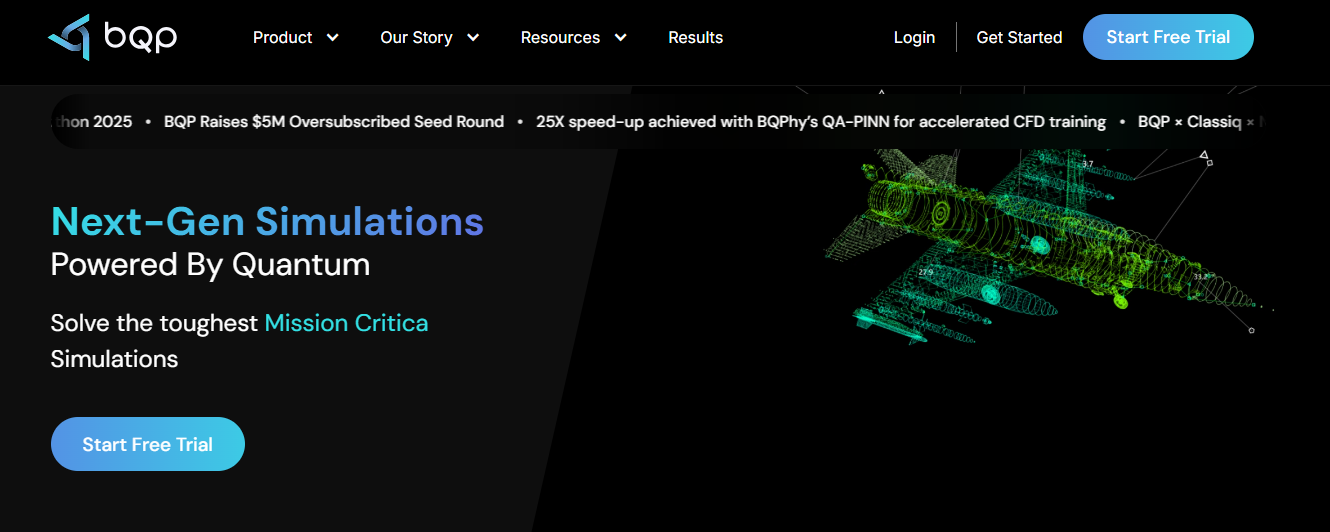
BQP positions itself as a next-generation aerospace simulation and optimization platform designed to augment (not replace) existing CFD, FEA, and system simulators. Traditional tools excel at high-fidelity physics within single domains. BQP addresses the scaling challenges that arise in system-of-systems contexts: mission planning across multi-satellite constellations, trajectory optimization under uncertainty, and design space exploration with tens of thousands of variables.
The platform is architected for aerospace and defense programs confronting optimization-heavy, mission-critical simulations that exceed the practical limits of brute-force parameter sweeps or gradient-based methods.
Key Features
- Quantum-inspired and hybrid optimization solvers: BQP's QIO-powered solvers tackle large, combinatorial aerospace problems, delivering near-optimal solutions up to 20× faster than classical heuristics
- Physics-aware simulation intelligence: The platform embeds Physics-Informed Neural Networks (PINNs) and Quantum-Assisted PINNs (QA-PINNs) to accelerate predictive modeling, particularly valuable in sparse-data environments like rare failure scenarios
- Integration layer for existing workflows: BQP's hybrid quantum-classical architecture allows teams to "plug in" quantum-inspired algorithms alongside established HPC/GPU simulation workflows
- Real-time performance tracking: Live dashboards let engineers monitor solver convergence, compare quantum-inspired vs. classical runs, and adjust parameters on the fly
Best For
Aerospace and defense programs are facing scaling limits in classical simulation, optimization-driven use cases (mission planning, trajectory optimization, system trade studies), and organizations building future-proof simulation stacks.
2. Ansys

Ansys is a comprehensive multi-physics simulation platform with deep penetration in aerospace for CFD (Fluent, CFX), FEA (Mechanical), and electromagnetic analysis. Its solvers are benchmarked against decades of validation data and certification test cases, making Ansys a default choice for detailed physics validation required by FAA, EASA, and military authorities.
Key Features
- High-fidelity aerodynamics (compressible flow, turbulence modeling, conjugate heat transfer)
- Structural analysis (linear/nonlinear FEA, fatigue, fracture mechanics)
- Enterprise-grade solver maturity with extensive material libraries
Best For
Detailed physics validation and certification-driven analysis where regulatory traceability and solver pedigree are paramount.
3. SIMULIA (Dassault Systèmes)
SIMULIA is Dassault's simulation brand, tightly integrated with the 3DEXPERIENCE platform and CATIA CAD tools. It emphasizes early-stage concept validation and system-level modeling within a unified digital thread.
Key Features
- Structural (Abaqus for nonlinear FEA), aerodynamic (PowerFLOW lattice-Boltzmann CFD), and electromagnetic modeling
- Native 3DEXPERIENCE integration linking simulation results directly to design requirements
- Digital twin capabilities leveraging operational data fed back into simulation models
Best For
System engineering teams and concept-phase optimization where tight CAD-simulation-PLM integration reduces iteration cycles.
4. Siemens Simcenter
Simcenter provides integrated multiphysics simulation across the product lifecycle, connecting design, simulation, test, and manufacturing data within the Siemens Xcelerator ecosystem.
Key Features
- Multiphysics solvers (CFD, FEA, thermal, acoustics) within a unified environment
- System simulation (Simcenter Amesim for 1D system modeling)
- Lifecycle integration where simulation results feed manufacturing process planning
Best For
Lifecycle-integrated aerospace workflows where simulation must align with PLM, supply chain, and manufacturing execution systems.
5. Modelon
Modelon specializes in system-level modeling using the Modelica language, focusing on multidisciplinary subsystem interaction (flight control, propulsion, environmental control, electrical power).
Key Features
- Modelica libraries tailored for aircraft and spacecraft subsystems
- FMI-based co-simulation support enabling integration with CFD/FEA tools
- Rapid model iteration during early architecture definition
Best For
Systems engineering and control-focused simulations where understanding coupled subsystem behavior outweighs the need for high-fidelity spatial resolution.
6. Altair FlightStream

FlightStream is a specialized aerodynamic simulation platform emphasizing rapid design exploration and airflow analysis. It trades some CFD fidelity for faster turnaround.
Key Features
- Geometry-to-analysis automation reduces manual meshing time
- Scripting interfaces and design space exploration tools
- Lighter computational footprint than full Navier-Stokes solvers
Best For
Aerodynamic trade studies and early-stage design iteration where speed and ease-of-use outweigh shock-capturing fidelity.
7. MATLAB/Simulink and CAD Platforms
MATLAB and Simulink are foundational tools for control system design, algorithm prototyping, and system dynamics modeling. CAD platforms (CATIA, NX, SolidWorks) define geometry that feeds downstream simulation tools.
Key Features
- Control system simulation (Simulink for flight control laws, autopilot logic)
- High-fidelity CAD modeling establishing the master geometry
- Extensive third-party toolboxes connecting MATLAB/CAD to CFD, FEA, and test systems
Best For
Control development, algorithm validation, geometry definition, and serving as the data backbone tying together disparate simulation domains.
How Engineers Apply Simulation Throughout the Aerospace Lifecycle
Aerospace simulation spans the entire lifecycle from initial concept trades through operational sustainment.
Concept design and trade studies:
Early in a program, engineers evaluate architectural alternatives using low-fidelity, fast-running simulations. The goal is to filter the design space to viable candidates before significant resources are committed.
Detailed virtual testing and validation:
Once a baseline design is selected, high-fidelity CFD and FEA take over. Engineers simulate every load case the certification authority will demand. This phase generates the analysis reports that accompany certification applications.
Certification support and failure analysis:
Regulatory bodies accept simulation as primary evidence for many certification criteria, provided the models are validated and uncertainty is quantified. When test anomalies occur, engineers return to simulation to diagnose root causes.
Digital twins for operations and sustainment:
After entry into service, simulation models transition into digital twins: software replicas of individual vehicles fed by real-time sensor data. Airlines use digital twins to predict component fatigue and schedule maintenance before failures occur.
What Are the Limitations Of Aerospace Simulation Software?
Despite decades of maturation, current aerospace simulation platforms encounter structural constraints that affect program timelines, costs, and the scope of problems engineers can practically address.
High computing and infrastructure cost
High-fidelity CFD or FEA simulations demand substantial HPC resources:
- Thousands of cores
- Terabytes of RAM
- Petabyte-scale storage for transient results
Organizations either invest in on-premise clusters (requiring data center facilities, cooling, and IT staff) or lease cloud compute, where per-hour costs add up quickly for long-running jobs.
Long runtimes for high-fidelity models
- A full-vehicle CFD simulation capturing shock waves and turbulent boundary layers can take 48-72 hours on a 1,000-core cluster.
- If the design changes (a common occurrence during development), that entire simulation must be rerun.
- Serial execution becomes prohibitive when engineers need to explore 50 design variants or 100 mission scenarios.
Integration friction across tools
- Aerospace workflows typically involve 5-10 distinct software packages.
- Data translation between tools introduces manual steps, version control challenges, and opportunities for human error.
- Each tool speaks a different file format.
Scaling challenges for system-of-systems simulations
- As aerospace platforms grow more interconnected (satellite constellations with hundreds of nodes, autonomous UAV swarms, urban air mobility traffic management), traditional simulation approaches struggle.
- Modeling every vehicle and interaction at high fidelity becomes computationally intractable.
- The combinatorial explosion of mission scenarios exceeds what classical optimization can explore within program timelines.
What are the Key Benefits of Modern Aerospace Simulation Strategies?
Aerospace simulation is undergoing an architectural transition from domain-specific tools operating in isolation toward unified platforms and hybrid computational approaches.
Multiphysics and system-level simulation integration
- Modern aerospace systems rarely fail from a single-physics mode.
- Instead, failures emerge from coupled interactions between structures, aerodynamics, controls, and thermal systems.
- Engineers increasingly demand multiphysics platforms that natively model these couplings rather than requiring manual data exchange.
Simulation embedded in the digital thread
Leading aerospace programs now treat simulation as a continuous process embedded in the digital thread (the connected flow of data from requirements through design, analysis, manufacturing, and operations). Engineers query simulation results alongside CAD models, test data, and supplier information within unified platforms.
Optimization-driven and AI-assisted simulation
Traditional simulation workflows are analysis-centric: define a design, simulate it, evaluate the results, and manually iterate.
Emerging platforms flip this to optimization-centric:
- Define objectives and constraints
- Let solvers explore the design space autonomously
- Return Pareto-optimal solutions
AI-assisted approaches (surrogate models, physics-informed neural networks, generative design) accelerate this exploration.
Classical approaches are hitting scaling limits
Classical CFD and FEA solvers are near-asymptotic in single-physics accuracy improvements.
The bottleneck has shifted:
- From "Can we solve this problem accurately?" to "Can we solve enough problem variants to find the optimal design?" and "Can we simulate system-of-systems complexity in practical time?"
How BQP Supports the Future of Aerospace Simulation?
BQP approaches aerospace simulation from a complementary angle: rather than replacing high-fidelity CFD or FEA solvers, it provides an advanced physics and optimization layer that augments existing tools where classical methods encounter scaling or combinatorial barriers.
BQP as an optimization-first platform
Traditional simulation excels at predicting "what happens if I design X?" BQP addresses "what is the best X given these objectives and constraints?" Its quantum-inspired optimization solvers handle large, discrete design spaces:
- Routing satellite constellations for maximum coverage
- Scheduling maintenance activities across a fleet
- Optimizing multi-stage rocket trajectories under fuel and thermal constraints
The platform delivers near-optimal solutions 20× faster than classical methods.
Complementing existing simulation tools
BQP integrates with established aerospace simulation workflows via a hybrid architecture. Teams continue running high-fidelity Ansys CFD or SIMULIA FEA for certification-critical analyses but invoke BQP's optimization solvers when exploring thousands of design variants or mission scenarios. Engineers retain the validated fidelity they need while gaining the exploration efficiency they lack.
Quantum-inspired optimization and advanced solvers
BQP's Quantum-Inspired Optimization (QIO) algorithms mimic quantum computational advantages on classical hardware, delivering quantum-like speedups today. Physics-Informed Neural Networks (PINNs) and Quantum-Assisted PINNs (QA-PINNs) embed governing equations into AI models, ensuring predictions respect physical laws even in data-sparse regimes.
Faster exploration, better scalability, future-ready architecture
Organizations adopting BQP report dramatic reductions in design cycle time. What previously took 500 serial CFD runs and weeks of calendar time now completes in days with intelligent sampling and surrogate-assisted optimization. The platform's roadmap toward quantum hardware acceleration future-proofs simulation investments. As NISQ and fault-tolerant quantum systems mature, BQP users gain access to next-generation computing without rearchitecting their workflows.
Conclusion
Choosing the best aerospace simulation software depends on where your program sits in the development lifecycle and what computational bottleneck you're trying to solve.
For certification-critical CFD and FEA, Ansys, SIMULIA, and Siemens Simcenter remain the validated standards that regulatory authorities accept. For system-level and control-focused modeling, Modelon and MATLAB/Simulink handle subsystem interaction and algorithm validation that physics solvers aren't designed for. For rapid aerodynamic trade studies, Altair FlightStream reduces turnaround time without the overhead of full Navier-Stokes solvers.
The gap most aerospace programs encounter is not fidelity, it's scalability. When design spaces grow to thousands of variables, mission scenarios multiply, or system-of-systems complexity exceeds what classical optimization can explore within program timelines, established tools hit their limits. That's the problem BQP is built to solve: augmenting existing simulation stacks with quantum-inspired optimization that explores more design variants faster, on the infrastructure teams already operate.
The best aerospace simulation strategy in 2026 is not a single tool. It's the right combination: high-fidelity solvers for validation, optimization-first platforms for exploration.
Frequently Asked Questions
What is aerospace simulation software?
Aerospace simulation software is a set of computational tools that model the aerodynamics, structures, controls, and mission performance of aircraft, spacecraft, and UAVs before physical testing, helping teams validate designs and reduce development risk.
Which aerospace simulation software is best for CFD and FEA?
Ansys, Siemens Simcenter, and SIMULIA are widely used for aerospace CFD and FEA because they offer validated solvers, extensive material libraries, and workflows aligned with FAA and EASA certification requirements.
How do aerospace engineers choose the right simulation software?
Aerospace engineers choose simulation software based on physics coverage (CFD, FEA, systems), certification pedigree, integration with CAD and PLM tools, compute requirements, and how well the platform scales to large design spaces and system-of-systems problems.
Can aerospace simulation software replace wind tunnel and flight testing?
Aerospace simulation software greatly reduces the number of wind tunnel and flight tests by screening designs virtually, but final certification still requires physical testing for critical load cases and safety scenarios.
What is the role of digital twins in aerospace simulation?
Digital twins use aerospace simulation models combined with real-time sensor data to mirror the health and performance of individual aircraft or spacecraft, enabling predictive maintenance and more efficient operations.
How is AI used in aerospace simulation software?
AI techniques such as surrogate models, physics-informed neural networks, and generative design accelerate aerospace simulation by approximating expensive runs, exploring design spaces faster, and suggesting high-performing design candidates.
.png)
.png)


.svg)
.svg)
.svg)
.svg)