


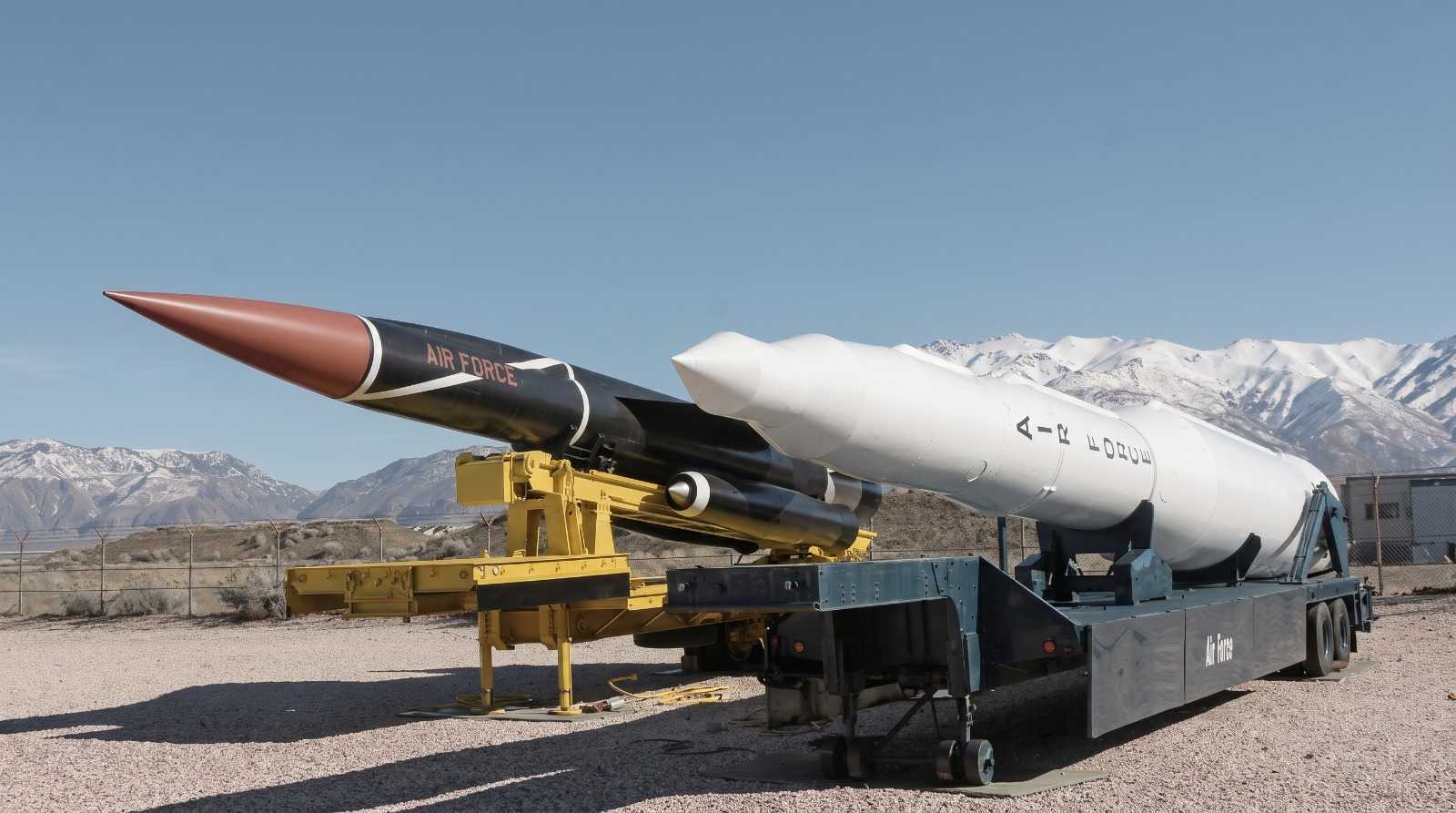

Detecting a ballistic missile launch is relatively simple. The real challenge is tracking it across flight phases, fusing multi-sensor data, predicting impact points accurately, and making intercept decisions within tight time windows.
Ballistic missile detection underpins modern integrated air and missile defense (IAMD) systems. While missile trajectories are largely predictable in midcourse flight, reliable detection and interception remain technically demanding.Detection performance directly impacts deterrence. Multi-layer IAMD systems achieve 85–95% success rates, while single-layer systems drop to around 56%, with effectiveness declining further against hypersonic and maneuvering threats.
As a result, the focus has shifted from investing in detection to validating system-level performance, especially as the global anti-ballistic missile market grows from USD 12.39 billion in 2024 to USD 19.29 billion by 2030.
What Are The Types of Ballistic Missiles and Their Trajectories?
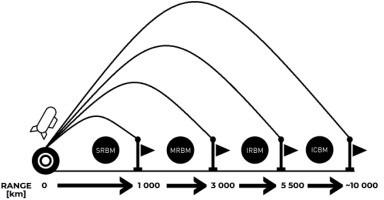
Ballistic missiles are classified by range and payload, with each category presenting distinct detection and interception challenges:
- Short-Range Ballistic Missiles (SRBMs) travel under 1,000 km with flight times of 3-10 minutes. Israel's Iron Dome demonstrates over 85% intercept rates in real combat by integrating radar tracking with rapid-fire interceptors.
- Medium-Range Ballistic Missiles (MRBMs) cover 1,000-3,500 km with apogees reaching 300-500 km altitude. Their midcourse phase lasts longer, allowing space-based infrared sensors to track thermal signatures before re-entry.
- Intermediate-Range Ballistic Missiles (IRBMs) span 3,500-5,500 km, reaching altitudes above 1,000 km. Longer flight times enable multi-sensor fusion but also permit decoy deployment and mid-flight maneuvering.
- Intercontinental Ballistic Missiles (ICBMs) exceed 5,500 km range with apogees above 1,200 km. Detection relies on early-warning satellites and over-the-horizon radars. Interception requires boost-phase or midcourse engagement before re-entry vehicles separate.
Trajectory shape varies by mission profile. Depressed trajectories sacrifice range for reduced apogee, complicating radar horizon geometry. Lofted trajectories increase apogee to test re-entry systems or evade lower-altitude interceptors.
What Are The Three Phases Of Ballistic Missile Trajectory?
A ballistic missile's flight divides into three distinct phases, each with unique detection signatures:
1. Boost Phase (60-300 seconds)
- Rocket motors produce intense infrared plumes visible to space-based sensors.
- Detection is straightforward. Interception windows are extremely narrow, typically under two minutes for mobile ICBMs.
- Launch point determination must account for Earth's rotation, atmospheric refraction, and sensor platform motion.
2. Midcourse Phase (up to 20 minutes for ICBMs)
- The missile coast in a ballistic arc above the atmosphere.
- With engines off, infrared signatures fade, requiring radar or optical tracking.
- This phase offers the longest interception window but also enables deployment of decoys, chaff, and penetration aids that mimic warhead radar cross-sections.
3. Terminal Phase (30-60 seconds)
- Re-entry vehicles descend at hypersonic speeds, often exceeding Mach 20 for ICBMs, while experiencing extreme heating and plasma formation that disrupts radar tracking.
- Modern maneuverable re-entry vehicles (MaRVs) execute pull-up maneuvers or lateral jinks to evade terminal interceptors, compressing engagement timelines to single-digit seconds.
As threats evolve toward hypersonic glide vehicles that skip between atmospheric layers or maneuver unpredictably during descent, the traditional three-phase model breaks down. Detection systems must adapt to continuous trajectory updates rather than ballistic arc prediction. For a deeper exploration of how trajectory phases influence intercept strategies, see our analysis of evolving threats and smarter defenses.
How Defense Systems Detect and Track Ballistic Threats?
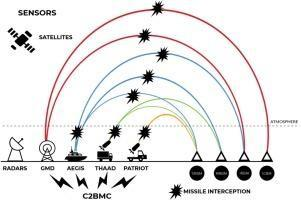
Modern BMD systems function as layered architectures, with each tier optimized for specific trajectory phases:
- Space-Based Infrared Sensors: Satellites in geosynchronous and highly elliptical orbits detect boost-phase plumes within seconds of ignition. The early warning radar market alone is projected to grow from $12.5 billion in 2024 to $21.8 billion by 2032, reflecting investment in persistent overhead surveillance.
- Ground-Based Radars: X-band and S-band arrays track midcourse objects with meter-level resolution. Phased-array systems like AN/TPY-2 provide 360-degree coverage and can discriminate between warheads and decoys based on radar cross-section dynamics.
- Sea-Based Aegis Systems: Destroyers equipped with SPY-1 or SPY-6 radars extend coverage over contested maritime regions, providing mobile sensor nodes that complicate adversary targeting while enabling flexible intercept geometries.
- Terminal Interceptors: Systems like THAAD and Patriot PAC-3 engage descending re-entry vehicles in the final seconds before impact, using hit-to-kill kinetic warheads that must achieve direct collisions at closing speeds exceeding Mach 25.
The challenge isn't individual sensor performance. It's fusing data across heterogeneous platforms with different latencies, coordinate systems, and error characteristics. A space-based sensor might detect a launch with 50-kilometer positional uncertainty; ground radar refines this to 10 meters; fire control algorithms must reconcile these inputs within milliseconds.
What Are The Challenges in Ballistic Missile Trajectory Prediction?
Predicting where a ballistic missile will land involves solving a deceptively complex inverse problem: given noisy, incomplete observations of an object's state, reconstruct its future path through a dynamic environment.
Key challenges include:
- Atmospheric Uncertainty: Drag coefficients vary with altitude, velocity, and re-entry vehicle shape. Temperature and density fluctuations in the upper atmosphere introduce prediction errors that compound over multi-thousand-kilometer trajectories.
- Sparse Observation Windows: Ground radars can't track missiles during boost phase or when targets fly below the radar horizon. Space-based sensors experience coverage gaps during satellite handoffs, forcing prediction algorithms to extrapolate using incomplete state vectors.
- Adversarial Countermeasures: Decoys, chaff, and radar-absorbing materials degrade tracking quality. Maneuverable re-entry vehicles execute evasive maneuvers designed to invalidate ballistic trajectory models. According to Arms Control Association analysis, ground-based midcourse defense interceptors achieve only 56% single-hit effectiveness in scripted tests.
- Computational Latency: High-fidelity physics simulations that model atmospheric turbulence, aerodynamic heating, and multi-body separation dynamics require minutes to hours on conventional HPC clusters. Operational engagement timelines are measured in seconds.
The fundamental tension: prediction accuracy improves with observation density and model fidelity, but decision windows shrink as threats accelerate. You can't afford to wait for better data when intercept geometry closes in under 30 seconds.
Hybrid Approaches to Ballistic Missile Detection
Hybrid detection architectures combine multiple sensor modalities, AI-driven data fusion, and quantum-inspired optimization to address the limitations of single-platform systems.
1. Multi-Spectral Sensor Fusion
- Overlays infrared satellite tracks with X-band radar returns and optical telescope observations, creating redundant measurement streams.
- When one sensor saturates or loses lock, others maintain tracking continuity.
- Bayesian fusion algorithms weight each input by estimated error covariance, producing composite state estimates more accurate than any single source.
2. Physics-Informed Machine Learning:
- Traditional tracking filters like extended Kalman filters assume Gaussian noise and smooth trajectories, assumptions violated by maneuvering targets and non-linear atmospheric drag.
- Physics-informed neural networks (PINNs) embed conservation laws directly into network loss functions, ensuring predictions respect physical constraints even when training data is sparse.
- A PINN trained on historical ICBM test flights learns to predict re-entry heating effects without requiring exhaustive computational fluid dynamics simulations, reducing prediction uncertainty by 30-40% compared to purely data-driven models.
3. Quantum-Inspired Trajectory Optimization:
- When multiple interceptor batteries can engage a single target, selecting the optimal firing solution becomes a combinatorial optimization problem.
- Quantum-inspired optimization solvers, leveraging techniques like simulated annealing and quantum tunneling, identify near-optimal intercept solutions up to 20× faster than conventional methods.
- This speed advantage translates directly into extended decision windows for human operators or autonomous engagement systems.
Quantum-Assisted Detection: Accelerating Prediction Under Uncertainty
Quantum-assisted simulation platforms address three critical bottlenecks in ballistic missile defense:
1. Accelerated Monte Carlo Sampling
- Predicting impact probability distributions requires running thousands of trajectory simulations with perturbed initial conditions.
- Quantum-assisted PINNs (QA-PINNs) layer quantum feature-extraction circuits before classical neural network layers, compressing high-dimensional parameter spaces into lower-dimensional representations that train 10-15× faster than classical architectures.
- This acceleration is especially valuable for rare-event modeling like multi-stage separation anomalies or unexpected maneuvering.
2. Sensor Placement Optimization
- Deploying a fixed budget of ground radars, satellite sensors, and mobile platforms to maximize coverage of adversary launch corridors is an NP-hard optimization problem.
- Quantum-inspired solvers evaluate millions of candidate configurations, accounting for terrain masking, electromagnetic interference, and adversary targeting priorities.
3. Real-Time Performance Tracking
During live engagements, operators need immediate feedback on prediction confidence and resource allocation.
BQP's live dashboards
- Surface convergence metrics
- Solution quality indicators
- Bottleneck diagnostics in real time
allowing analysts to pivot between quantum-inspired and classical solver modes based on time-to-decision requirements.
For mission planners validating new defense architectures, the ability to simulate system-of-systems behavior (testing how space-based sensors, ground radars, and fire control networks interact under contested conditions) determines whether multi-billion-dollar investments deliver promised capabilities or create integrated points of failure.
The Future of Ballistic Missile Detection Systems
Three technology vectors will define next-generation detection architectures:
Autonomous AI-Driven Fusion
Human operators cannot manually correlate data from 50+ sensors updating at 10 Hz while evaluating intercept options in seconds. Autonomous fusion engines ingest multi-spectral inputs, resolve track ambiguities, and prioritize engagements without human bottlenecks.
Persistent Space-Based Surveillance
Large LEO constellations with hundreds of satellites deliver continuous coverage and sub-second revisit rates. Distributed sensor meshes reduce single points of failure and complicate adversary counter-space strategies.
Quantum–Classical Hybrid Workflows
Defense organizations will not replace legacy HPC systems overnight. Instead, hybrid architectures integrate quantum-inspired solvers for high-impact subtasks such as
- Trajectory optimization
- Uncertainty quantification
- Resource allocation
while classical HPC continues to handle large-scale simulation and visualization.
This is where BQP fits decisively. BQP enables defense teams to operationalize quantum–classical hybrid workflows today without waiting for fault-tolerant quantum hardware. Its platforms allow engineers to integrate quantum-inspired optimization directly into existing missile detection and tracking pipelines, accelerating convergence on hard problems while preserving validated classical models.
The primary vulnerability going forward is not sensing or computing. It is integration.
Ensuring these technologies operate as a cohesive system of systems is critical. BQP supports end-to-end mission simulation, allowing defense organizations to validate detection, tracking, and interception performance across full timelines before committing resources to operational deployment.
Frequently Asked Questions
What is ballistic missile detection in modern defense systems?
Ballistic missile detection is the process of identifying, tracking, and predicting the path of a missile from launch to impact using space-based sensors, ground and sea radars, and AI-driven fusion engines. It must distinguish real warheads from decoys while keeping a continuous, high-confidence track to enable timely interception decisions.
How do space-based sensors improve ballistic missile detection?
Space-based infrared sensors detect the intense heat plumes from missile launches within seconds, providing early warning before the missile leaves the atmosphere. These satellites extend coverage beyond radar horizons and feed trajectory data into ground-based systems for refined tracking and intercept planning.
Why are hypersonic and maneuverable threats difficult to detect and track?
Hypersonic and maneuverable missiles fly at very high speeds, often changing altitude and direction to evade radar and interceptor coverage. Their unpredictable paths and short warning times compress decision windows from minutes to seconds, making traditional ballistic trajectory models less reliable.
How does AI-driven sensor fusion help ballistic missile detection?
AI-driven fusion engines combine inputs from multiple sensors satellites, ground radars, sea-based systems, and optical sensors into a single, coherent track. By weighting each signal based on its accuracy and latency, these engines reduce noise, resolve ambiguities, and improve prediction confidence for intercept solutions.
What role does quantum-assisted optimization play in missile detection and interception?
Quantum-assisted optimization accelerates complex calculations such as trajectory prediction, sensor placement, and interceptor assignment. By exploring large solution spaces faster than classical methods, it helps defense teams find near-optimal intercept strategies within tight time constraints, especially under high uncertainty.
How do modern systems validate ballistic missile detection performance before deployment?
Modern defense organizations use high-fidelity simulations and digital twins to test full system-of-systems behavior across realistic threat scenarios. They evaluate detection coverage, tracking accuracy, and intercept success rates before committing to real-world deployment, reducing costly integration failures.
.png)
.png)


.svg)
.svg)
.svg)
.svg)