




Training a modern language model burns through weeks of GPU time and millions in compute costs. Optimizing global supply chains across thousands of constraints pushes classical algorithms past their breaking point.
Simulating molecular interactions for drug discovery? That's where traditional computing starts sweating.
Quantum computing is changing the equation.
- In October 2025, Google demonstrated a 13,000× speedup over the Frontier supercomputer using just 65 qubits for physics simulations.
- IBM is racing toward quantum advantage by 2026.
- McKinsey's 2025 report confirms that quantum computing addresses AI's core constraints: algorithmic efficiency, memory walls, and compute bottlenecks.
This guide breaks down how quantum computing enhances AI, from fundamental concepts to production workflows, helping engineering teams and business leaders prepare for the next wave of intelligent systems.
What Is Quantum Computing?
Quantum computing is a new computing model that uses the principles of quantum mechanics to process information in ways classical computers cannot. Instead of bits that store data as 0 or 1, quantum computers use qubits, which can exist in multiple states at once and interact in uniquely powerful ways.
Classical computers process bits as binary switches: 0 or 1.
Quantum computers use qubits that can exist in multiple states simultaneously through superposition. A qubit can represent both 0 and 1 until measured. For context, ten qubits can represent 1,024 combinations at once, while ten classical bits represent only one.
Quantum systems also use entanglement, which links qubits so that changing one instantly affects the others. This creates highly parallel information pathways that classical systems cannot replicate.
The result is a machine capable of exploring massive solution spaces simultaneously. Tasks that grow exponentially harder for classical computers, such as evaluating billions of optimization paths or simulating complex molecules, become computationally feasible.
Quantum computing will not replace classical computing. Instead, it is emerging as a specialized co-processor for problems where classical algorithms reach their limits, especially in optimization, simulation, and cryptography.
What Is Quantum AI?
Artificial intelligence trains machines to recognize patterns, make predictions, and solve problems by learning from data. Quantum AI applies quantum computing to accelerate or fundamentally improve how AI systems learn.
Three layers define the quantum-AI intersection:
- Quantum-assisted classical AI: Quantum algorithms preprocess data, optimize parameters, or accelerate subroutines while classical neural networks handle core learning
- Quantum machine learning: Quantum circuits perform learning tasks directly: classification, clustering, feature extraction using quantum states
- Fully quantum AI: End-to-end models running entirely on quantum hardware (still largely theoretical)
Today's practical quantum AI is hybrid. Quantum processors tackle computationally expensive optimization or feature extraction. Classical GPUs handle final training and inference.
Think of it this way: Classical AI explores a maze one corridor at a time. Quantum AI evaluates multiple paths simultaneously through superposition, collapsing to the optimal route faster. The advantage scales dramatically when the "maze" has billions of corridors, as in large-scale optimization or high-dimensional data analysis.
How Does Quantum Computing Improve AI Performance?
The Process Behind Quantum-Enhanced AI
Encode classical data into quantum states
Images, sensor readings, financial transactions get transformed into qubit configurations. This encoding maps high-dimensional datasets into quantum feature spaces where hidden patterns emerge.
Extract features through quantum circuits
Quantum gates process encoded data, leveraging superposition and entanglement to identify relationships classical methods miss. Aerospace telemetry with thousands of interdependent variables? Quantum feature extraction thrives here.
Optimize model parameters using quantum algorithms
Training AI demands finding optimal weights across millions of parameters.
Algorithms like QAOA (Quantum Approximate Optimization Algorithm) and quantum annealing explore solution spaces more efficiently than gradient descent, especially for combinatorial problems.
Hand off to classical systems for final training
The quantum processor completes the heavy lifting optimization, feature extraction, then passes results to classical GPUs for final iterations, inference, and deployment.
Validate and interpret outputs
Results decode from quantum states back to classical format, get validated against ground truth, and feed into business decisions.
Cloud platforms enable experimentation
IBM Quantum, AWS Braket, and quantum simulators let teams test quantum-enhanced AI without owning quantum hardware. Skill-building accelerates. Adoption barriers drop.
Performance Gains That Matter to Business
Faster optimization for large-scale models
Google's 13,000× speedup in simulations hints at similar potential for AI training tasks involving massive parameter spaces. Months of model development compress into days.
Business impact: Faster product iteration. Competitive first-mover advantage.
Better feature selection in complex datasets
Quantum feature extraction identifies patterns classical methods overlook. Critical in aerospace sensor fusion, materials science, genomics anywhere variables interact non-linearly.
Business impact: More accurate predictions. Fewer false positives. Better decision support in mission-critical systems.
Speedup in probabilistic modeling
Quantum sampling accelerates Bayesian inference, uncertainty quantification, generative modeling. Tasks central to risk analysis, forecasting, synthetic data generation.
Business impact: Real-time insights from streaming data. Improved scenario planning. Faster Monte Carlo simulations for defense and finance.
Simplified Workflow:
- Encode data → quantum states
- Extract features via quantum circuits
- Optimize parameters using quantum algorithms
- Transfer to classical GPUs for final training
- Validate, deploy, interpret
This hybrid approach delivers quantum advantages today without waiting for fault-tolerant systems.
Business Applications of Quantum AI
Finance
- Quantum AI can optimize large portfolios, model risk in real time, and detect fraud faster than traditional systems.
- The result is quicker decisions, better capital allocation, and significant cost savings.
Healthcare
- It speeds up drug discovery by simulating complex molecules and supports diagnostics using genomic and imaging data.
- This leads to faster treatment development and more personalized care.
Manufacturing
- Quantum AI improves predictive maintenance and streamlines supply chain decisions across thousands of variables.
- Companies benefit from reduced downtime, lower inventory costs, and smoother production.
Logistics
- It enhances route planning for global fleets and strengthens demand forecasting using diverse data signals.
- The impact includes lower fuel usage, quicker deliveries, and reduced emissions.
Cybersecurity
- Quantum-enhanced models detect anomalies earlier and help design encryption that can withstand future quantum attacks.
- This enables stronger protection and more proactive threat response.
Energy
- Quantum AI supports smart grid balancing and improves maintenance planning for turbines and other critical assets.
- This drives grid stability, operational savings, and faster adoption of clean energy.
Across all sectors, the value comes from one core advantage: quantum AI can handle complex optimization and high-dimensional data problems far faster and more effectively than classical methods alone.
Quantum AI vs Classical AI: Key Differences
Why hybrid models dominate: Classical AI handles bulk learning and inference with proven reliability. Quantum tackles the hardest optimization and feature extraction where quantum advantages show up. This split delivers practical value now while hardware matures.
Classical AI isn't disappearing. Quantum enhances it where it counts most.
Key Limitations of Quantum AI Today
Hardware instability and error rates
Qubits are fragile. Environmental noise causes decoherence, introducing calculation errors. Current systems need error correction overhead that limits effective qubit counts.
Limited qubit counts
State-of-the-art machines have hundreds of qubits. Enterprise-scale AI problems would benefit from thousands or millions for full quantum advantage.
High infrastructure costs
Quantum computing requires extreme cooling (near absolute zero), specialized hardware, expert operation. Cloud access mitigates capital costs but per-job pricing stays premium.
Algorithm development complexity
Designing quantum algorithms demands expertise in quantum mechanics, linear algebra, optimization theory. Translating classical AI models to quantum circuits isn't trivial.
Talent and skill gap
Few engineers understand both quantum computing and machine learning deeply. Building quantum AI capabilities means cross-training teams or competing for rare specialists.
These limitations are real but temporary. Google's verifiable quantum advantage in October 2025 proves feasibility. Cloud platforms lower access barriers. Educational resources multiply. Early adopters who start learning now will lead when quantum AI matures.
What Is The Future of Quantum Computing in AI?
Hardware improvements on the horizon: IBM's 2026 quantum advantage target and Google's breakthroughs signal that error-corrected, scalable systems are coming. Analysts project tens of billions in market value by the mid-2030s as fault-tolerant quantum computers reach commercial viability.
Hybrid AI models will dominate: The future isn't purely quantum. Classical deep learning frameworks will integrate quantum subroutines as modular components. Engineers will "drop in" quantum optimization layers without redesigning entire AI stacks.
Enterprise adoption timeline: Quantum AI pilots are live now in finance, pharma, aerospace. Mainstream adoption will accelerate between 2026 and 2030 as hardware stabilizes and cloud platforms mature. Organizations experimenting today gain a 3-5 year head start in talent, infrastructure, algorithm development.
Impact on AI infrastructure: Quantum co-processors will join GPUs and TPUs in AI data centers, handling specialized workloads (optimization, sampling, cryptography) while classical hardware manages general-purpose learning and inference.
Why early preparation matters: McKinsey emphasizes the mutually reinforcing quantum-AI relationship: quantum accelerates AI while AI optimizes quantum hardware and algorithms. Companies building quantum AI literacy now through pilots, partnerships, skill development will shape the next decade of intelligent systems.
Waiting for "perfect" quantum hardware means starting from zero when competitors deploy hybrid solutions.
How BQP Supports Quantum AI Workflows?
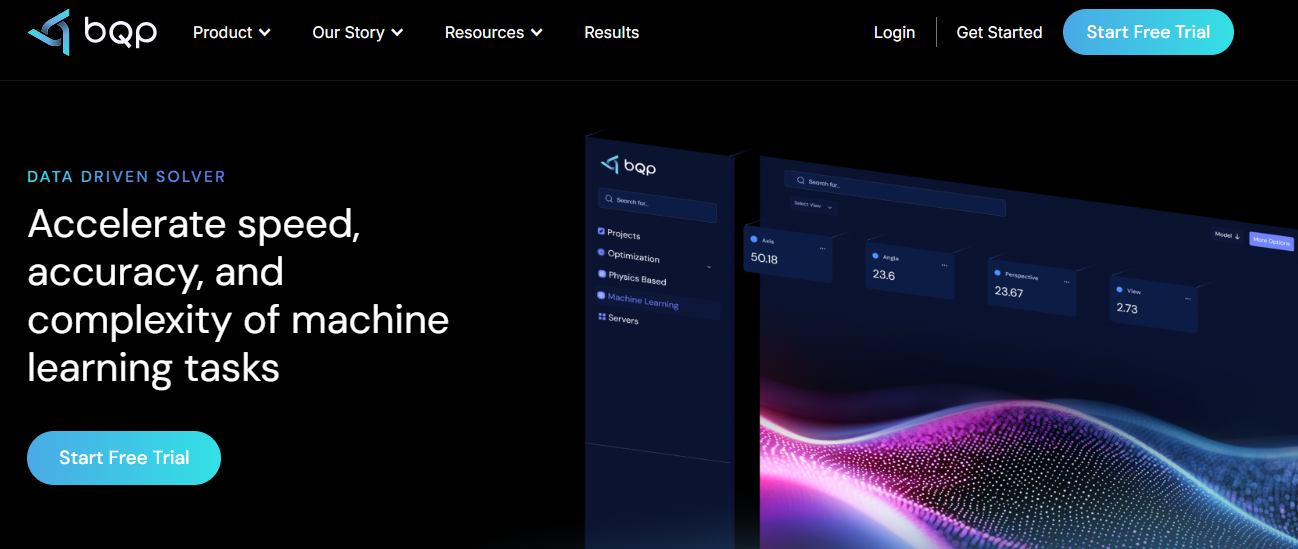
BQP delivers quantum-enhanced AI and simulation through a hybrid quantum-classical architecture built for aerospace, defense, and mission-critical engineering.
Quantum optimization software accelerates AI model training and hyperparameter tuning using QIO algorithms (up to 20× faster than classical methods) without requiring native quantum hardware. Hybrid quantum-classical integration plugs quantum-inspired algorithms into existing HPC and GPU workflows. No system overhaul needed. Engineers keep using PyTorch, TensorFlow, MATLAB while gaining quantum-like performance on optimization-heavy tasks.
Physics-Informed Neural Networks (PINNs) and Quantum-Assisted PINNs embed physical laws directly into AI models. Accuracy and stability improve for aerospace simulation, thermal stress prediction, and fluid dynamics. Quantum-assisted PINNs add quantum feature-extraction layers, accelerating training and improving generalization in sparse-data environments like rare failure scenarios.
Real-time performance tracking through live dashboards shows solver convergence, compares quantum-inspired vs classical runs, and adjusts parameters on the fly. Essential for iterative AI development.
Key benefits:
- Faster AI experimentation (months compressed to weeks)
- Scalable hybrid compute (cloud or on-premise, elastic scaling)
- Lower long-term infrastructure cost (solve harder problems with less brute-force compute)
- Future-ready AI stack (build quantum AI skills on production infrastructure today)
BQP bridges classical AI and quantum-enhanced workflows, letting organizations gain advantages now while preparing for fully quantum systems. Explore quantum machine learning applications and AI with quantum computing to see how hybrid platforms reshape mission-critical AI.
Quantum AI Is No Longer Optional
Quantum computing has moved from physics labs to competitive AI infrastructure. Google's 13,000× speedup, IBM's 2026 quantum advantage roadmap, McKinsey's identification of quantum-AI synergy point to the same conclusion: organizations exploring quantum-enhanced AI today will lead tomorrow's markets.
The convergence of artificial intelligence, high-performance computing, and quantum algorithms creates a new category of intelligent systems capable of solving problems that classical AI cannot. Early exploration isn't about replacing your AI stack. It's about augmenting it with quantum advantages where they matter most.
Start with hybrid platforms. Build quantum literacy in your teams. Run pilots on real problems.
Frequently Asked Questions
What is quantum AI?
Quantum AI is the use of quantum computing to accelerate and enhance artificial intelligence workflows, from optimization and feature extraction to simulation and probabilistic modeling. It combines quantum processors with classical GPUs in hybrid pipelines so teams can solve high-dimensional, optimization-heavy problems faster than with classical AI alone.
How do quantum computing and AI work together in practice?
Quantum computing and AI work together through hybrid architectures where quantum algorithms handle the hardest subproblems such as optimization, sampling, or feature extraction while classical AI models manage large-scale training and inference. Data is encoded into quantum states, processed by quantum circuits, and then passed back to classical systems for model training and deployment.
What are the main benefits of using quantum computing for AI?
The main benefits of using quantum computing for AI include faster optimization for large models, better feature selection in complex datasets, and speedups in probabilistic modeling and simulation. These advantages translate into shorter training cycles, more accurate predictions, and improved decision-making in industries like finance, aerospace, logistics, and energy.
Is quantum AI ready for real-world business use cases today?
Yes, quantum AI is already being used in real-world business pilots through cloud-based and quantum-inspired solutions. Organizations can tap into quantum hardware and quantum-inspired algorithms via providers like IBM Quantum, AWS Braket, and platforms such as BQP to accelerate optimization and simulation without owning quantum hardware.
Which industries benefit most from quantum AI right now?
Industries with complex optimization and simulation challenges benefit most from quantum AI today, including finance, pharma, aerospace, defense, logistics, and energy. These sectors use quantum-enhanced models for portfolio optimization, molecular simulation, route planning, predictive maintenance, and grid optimization.
What are the limitations of quantum AI today?
Current limitations of quantum AI include fragile qubits, limited qubit counts, high infrastructure and cloud costs, and a steep learning curve for quantum algorithms. There is also a talent gap, as few engineers have deep expertise in both quantum computing and machine learning, so many organizations partner with specialized vendors to get started.
.png)
.png)


.svg)
.svg)
.svg)
.svg)