





Quantum-Assisted Physics-Informed Neural Networks (QA-PINNs) represent a measurable advance in ballistic missile detection and trajectory prediction, combining physics-based constraints with quantum-inspired optimization to converge faster, require less data, and maintain accuracy under adversarial conditions that break classical models. Independent research validates a 21% accuracy improvement over classical PINNs on ballistic trajectory benchmarks, with trainable parameters reduced by 40% and prediction accuracy above 90% on datasets 60% smaller than those required by classical ML approaches.
This blog covers how QA-PINNs work, where classical models fail, the architecture and methodology behind BQP's implementation, and where this technology is being applied in active missile defense programs.
Disclosure: BQP is referenced throughout this article. BQP develops quantum-inspired simulation and optimization software that runs on existing HPC and GPU infrastructure.
Why Missile Trajectory Prediction Is an Optimization Problem, Not a Data Problem
Missile defense is not won by models that perform well in controlled simulation environments. It is won by systems that converge under pressure: when sensor data is incomplete, when adversaries maneuver unpredictably, and when interception windows compress from minutes to seconds.
Classical Physics-Informed Neural Networks encode the correct governing equations but fail to train at scale. Pure machine learning models achieve fast inference but violate conservation laws the moment conditions deviate from training distributions. Kalman-based estimators and Monte Carlo propagation hit fundamental performance ceilings when adversaries introduce deception or when launch parameters remain deliberately obscured.
The core problem is not modeling fidelity. It is the optimization bottleneck that prevents classical methods from converging reliably on sparse, adversarial, real-world trajectory datasets. QA-PINNs address this bottleneck directly.
What Are Physics-Informed Neural Networks (PINNs)?
Physics-Informed Neural Networks are neural networks that embed governing physical laws directly into their loss function during training. Rather than treating trajectory prediction as pure pattern recognition, PINNs constrain the model to satisfy differential equations including Newton's laws, aerodynamic drag models, and conservation principles across the entire training domain.
The Core Advantage of PINNs
PINNs generalize beyond their training data because the model cannot learn trajectories that violate physics. A pure ML model trained on subsonic trajectories will produce unreliable predictions when asked to model hypersonic profiles. A PINN, by contrast, respects momentum conservation and thermodynamic constraints regardless of the velocity regime, making it structurally more reliable for ballistic missile defense applications where threat profiles vary widely.
Where Classical PINNs Break Down
Training classical PINNs at scale is computationally expensive. The loss function must simultaneously satisfy data alignment and physics compliance across the entire spatiotemporal domain. Gradient descent stalls in local minima frequently. Convergence can take days or fail entirely when initial conditions are poorly constrained, which is precisely the scenario missile defense teams face when tracking evasive or newly launched threats with incomplete radar coverage.
This is where optimization, not modeling fidelity, becomes the true bottleneck for operational deployment.
Limitations of Classical Missile Trajectory Prediction Models
Defense engineering teams work with a toolkit built for a different threat environment. Each classical approach has a well-defined breaking point under modern adversarial conditions.
The tactical reality is straightforward. Adversaries do not publish launch parameters. Sensor networks are degraded by jamming, weather, and countermeasures. Missile defense is fundamentally an optimization under adversarial uncertainty, not a data collection challenge. Waiting for more complete datasets is not a viable operational strategy.
What Is a Quantum-Assisted PINN (QA-PINN)?
A Quantum-Assisted Physics-Informed Neural Network (QA-PINN) is a hybrid quantum-classical architecture that layers quantum feature-extraction gates before classical neural network layers to accelerate convergence, reduce model complexity, and improve generalization in sparse-data regimes. It combines the physics-compliance of classical PINNs with the optimization efficiency of quantum-inspired computation, without requiring quantum hardware to deploy.
QA-PINNs do not replace classical physics or machine learning. They resolve the optimization bottleneck that prevents classical PINNs from scaling to operational defense timelines, making physics-informed trajectory prediction practical under real-world constraints.
How QA-PINNs Work
Input variables including time, position, and velocity are encoded into quantum states using parameterized rotation gates. These quantum layers perform high-dimensional feature mapping that would require exponentially more classical neurons to replicate. The quantum-processed features then feed into classical hidden layers, which apply physics-based loss functions during training.
Key Architectural Innovation
BQP's QA-PINN framework uses 8 layers of RX rotational gates with alternating full entanglement blocks, creating a hybrid quantum-classical optimization landscape that escapes local minima more efficiently than purely classical gradient descent. The result is fewer trainable parameters without sacrificing accuracy and faster convergence on the same computational budget.
Critical Clarification on Hardware Requirements
QA-PINNs run today on classical hardware using quantum inspired algorithms. This is not contingent on fault-tolerant quantum computers or any specialized quantum infrastructure. Measurable performance gains are available now on existing HPC and GPU infrastructure through BQP's hybrid solvers.
QA-PINN vs Classical PINN vs Pure ML: Head-to-Head Comparison
Methodology of QA-PINN in Ballistic Missile Prediction Modeling
Six-Degree-of-Freedom (6-DOF) Ballistic Model
Missile trajectory prediction requires modeling motion across six independent degrees of freedom: three translational (range, altitude, lateral deflection) and three rotational (pitch, yaw, roll). BQP's QA-PINN framework encodes this complexity using a 6-DOF ballistic model with 15 variables spanning spatial coordinates, angular velocities, and aerodynamic angles including angle of attack and sideslip.
Classical approaches solve these differential equations numerically, requiring precise knowledge of thrust profiles, drag coefficients, and atmospheric density models. QA-PINN learns these dynamics from a combination of observed radar data and physics-based simulations, reducing dependence on complete a priori knowledge of launch parameters.
Data Sources Driving the Model
- Observed trajectory data: Real-time sensor inputs including range, altitude, and deviation collected during flight
- Simulated physical data: Derived from known physics models, used to construct physics loss functions that enforce conservation laws and boundary conditions
This dual-data strategy allows the network to generalize across missile types and environmental conditions, including scenarios where launch parameters are partially unknown or deliberately obscured by adversarial action.
BQP's Quantum Architecture
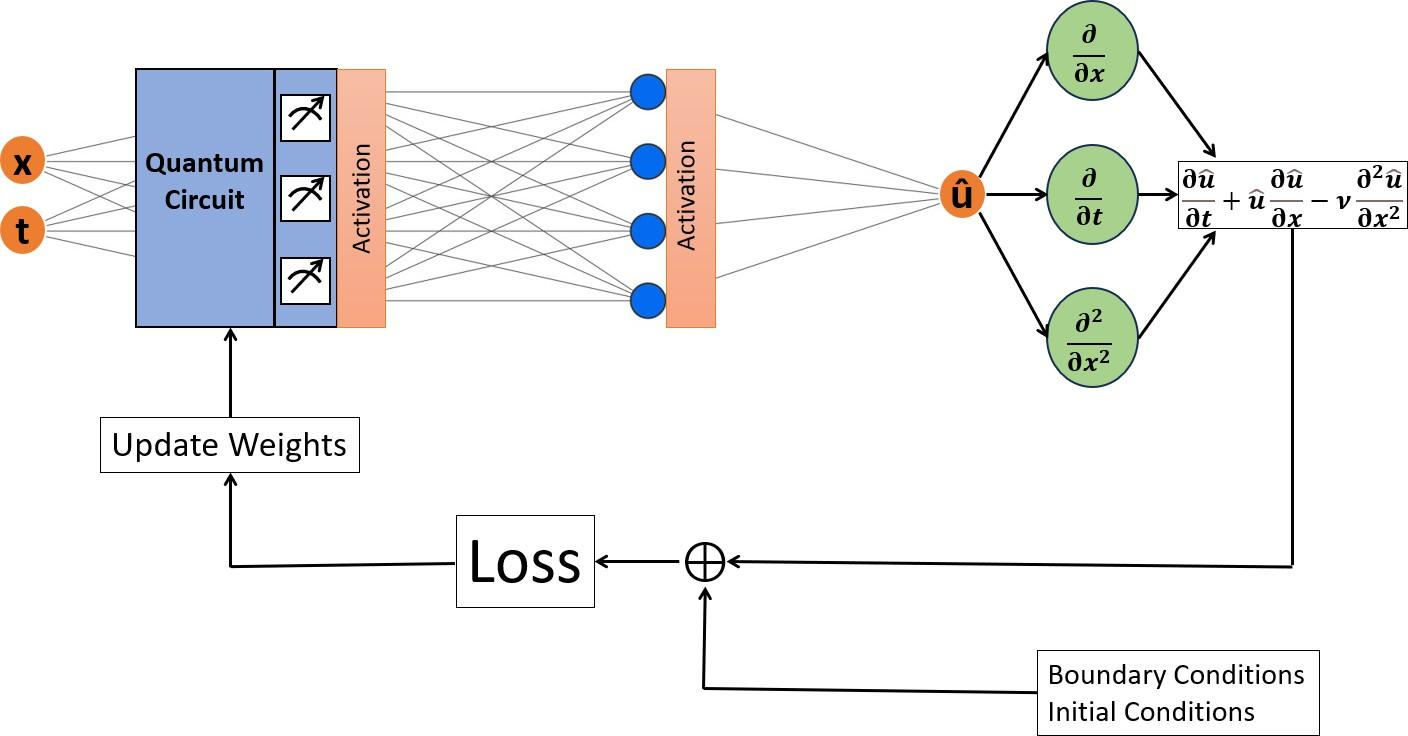
Architectural Components
- Input Layer: Receives initial conditions including time, spatial position, and velocity vectors
- Quantum Hidden Layer: Encodes inputs into quantum states using 8 layers of RX rotation gates with full entanglement between qubits, generating a high-dimensional probability state vector
- Classical Hidden Layers: Process quantum output alongside physics-informed loss gradients
- Output Layer: Predicts trajectory parameters at future time steps
Why This Hybrid Structure Matters
The quantum layer performs feature extraction in a compressed representational space, enabling the model to capture nonlinear trajectory dynamics with fewer trainable parameters than an equivalent classical PINN. This directly addresses the parameter overhead that makes classical PINNs computationally expensive to train within operational time constraints.
Physics-Informed Loss Function Design
Training QA-PINN involves minimizing a composite loss function with two critical components.
Boundary Loss (Lb): Measures deviation from known initial and boundary conditions and observed sensor data.
Physical Loss (Lp): Ensures the predicted trajectory satisfies governing differential equations including Newton's laws, drag models, and conservation of momentum.
For ballistic modeling, the total loss decomposes into three spatial sub-losses:
- Range loss (Lx): Predicts downrange distance
- Elevation loss (Ly): Predicts altitude profile
- Lateral deflection loss (Lu): Predicts cross-range deviation
Quantum optimization solvers navigate this multi-objective loss landscape more efficiently, finding near-optimal parameter configurations up to 20× faster than classical gradient descent on equivalent hardware.
How QA-PINN Improves Prediction Accuracy with Limited Data
The adversarial reality of missile defense is that complete, high-fidelity trajectory datasets are rarely available. Launch parameters are concealed. Flight paths include mid-course maneuvers designed to deceive tracking systems. Sensor coverage is intermittent due to jamming and environmental interference.
QA-PINN Advantages in Sparse-Data Scenarios
- Physics constraints reduce overfitting: Even with small datasets, the model cannot learn trajectories that violate momentum conservation or thermodynamic principles, preventing the hallucination failures common in pure ML approaches.
- Quantum feature extraction improves generalization: High-dimensional quantum state encoding captures trajectory patterns from limited samples more effectively than classical feature engineering methods.
- Hybrid data strategy: Combining real sensor observations with physics-based simulations enables training even when operational data is scarce, without sacrificing prediction reliability.
- Validated sparse-data performance: In testing environments simulating adversarial sensor degradation, QA-PINNs maintained prediction accuracy above 90% using datasets 60% smaller than those required by classical ML models.
The performance gap between QA-PINNs and classical approaches widens precisely under the conditions that matter most operationally: incomplete data, adversarial maneuvering, and sensor degradation.
Applications of QA-PINN in Missile Defense Systems
Interceptor Guidance Optimization
QA-PINNs enable earlier, higher-confidence intercept calculations by predicting threat trajectories with tighter error bounds. Faster convergence means missile guidance systems can evaluate more interception geometries within the decision window, directly increasing probability of kill. For time-critical intercept scenarios, the difference between a 15-second and 30-second convergence window is operationally significant.
Hypersonic and Evasive Threat Modeling
Advanced hypersonic missiles and maneuvering re-entry vehicles execute unpredictable flight profiles to evade interception. QA-PINNs trained on physics-informed loss functions extrapolate beyond observed maneuver patterns while respecting kinematic and aerodynamic constraints, reducing the risk of model failure when threats deviate from historical profiles. This is a direct answer to the hypersonic missile tracking challenge that classical Kalman-based estimators cannot address reliably.
Multi-Threat Prioritization in Saturation Attacks
In saturation attack scenarios, defense systems must allocate limited interceptors across multiple simultaneous inbound threats. QA-PINN's reduced inference time and improved accuracy enable real-time threat ranking based on predicted impact zones and interception feasibility, supporting faster and more defensible engagement decisions under time pressure.
Sensor Fusion Under Degraded Conditions
Radar, infrared, and optical sensors provide conflicting or incomplete data during degraded operations caused by jamming, weather, or countermeasures. QA-PINN's physics-informed framework weights sensor inputs based on consistency with known flight dynamics, acting as an intelligent arbiter and producing unified trajectory estimates even when individual sensor streams are unreliable.
Digital Twin Integration for Ballistic Modeling
QA-PINNs can serve as the prediction core within digital twin environments that simulate entire engagement scenarios. Defense programs using model-based systems engineering can embed QA-PINN solvers into their simulation pipelines to run virtual engagement scenarios before operational deployment, reducing both development cost and mission risk.
Future of Quantum-Assisted AI in Defense Trajectory Modeling
The convergence of quantum AI, physics-informed machine learning, and real-time sensor fusion is operational today. Near-term and mid-term developments will extend and deepen this capability.
Near-Term (2026 to 2028)
- Hybrid quantum-classical frameworks become standard components in mission planning and engagement control tools
- QA-PINNs extend beyond ballistic threats to hypersonic glide vehicles, maneuvering re-entry vehicles, and orbital re-entry prediction
- Automated pilot programs validate performance against classified threat profiles in controlled defense environments
Mid-Term (2028 to 2030)
- Full integration with adaptive interceptor guidance systems, enabling closed-loop learning during live engagements
- Quantum-assisted multi-physics models combine trajectory prediction with electromagnetic warfare environment modeling and cyber threat assessment
- Sovereign defense organizations deploy on-premise QA-PINN solvers to maintain full data sovereignty over classified engagement data
Defense organizations that treat quantum technology in defense as a tactical advantage today, rather than a research investment for future consideration, will define the next generation of intercept capabilities. The performance gap between early adopters and late movers will compound over the deployment cycle.
Why BQP's QA-PINN Is Built for Next-Generation Defense Systems
Operational Now, Not Years From Now
BQP's QA-PINN framework runs on existing HPC and GPU infrastructure through quantum optimization software and quantum-inspired solvers. No hardware overhaul, no quantum mechanics retraining for engineering teams, and no dependency on fault-tolerant quantum computers. Hybrid quantum-classical integration connects directly into current defense simulation workflows.
Validated Performance Gains
Independent research validates 21% accuracy improvement over classical PINNs on ballistic trajectory benchmarks. BQP's architecture achieves this with 40% fewer trainable parameters and faster training cycles, directly addressing the optimization bottleneck that prevents classical methods from scaling to operational defense timelines.
Built for Adversarial Data Environments
Sparse sensor data. Incomplete launch parameters. Mid-course deceptive maneuvers. QA-PINN converges under uncertainty by embedding physics constraints that prevent the model from learning physically impossible trajectories, producing reliable predictions in the exact conditions where classical models fail.
Start with Proof, Not Promises
BQP offers no-obligation pilot programs to validate QA-PINN performance against your existing models. Run head-to-head benchmarks on your own data. Measure convergence time, prediction accuracy, and computational efficiency before committing to full deployment.
Scalable, Secure, and Sovereign
Deploy BQPhy® in the cloud for elastic compute scaling or on-premise for full data sovereignty. Fine-grained access controls, audit logs, and encrypted channels ensure mission-critical simulations remain under your operational authority and meet defense-grade security requirements.
Frequently Asked Questions About Quantum-Assisted PINNs
What are Quantum-Assisted Physics-Informed Neural Networks (QA-PINNs)?
Quantum-Assisted Physics-Informed Neural Networks combine physics-based governing equations, classical neural network layers, and quantum-inspired optimization to predict missile trajectories with higher accuracy and faster convergence than purely classical models. The quantum layer performs high-dimensional feature extraction that reduces trainable parameters while improving generalization on sparse, adversarial datasets. The architecture runs on standard HPC and GPU infrastructure without requiring quantum hardware.
How do QA-PINNs improve missile trajectory prediction accuracy?
QA-PINNs enforce physical laws during training through a composite loss function that penalizes trajectories violating Newton's laws, drag models, and conservation of momentum. This physics compliance prevents the overfitting and hallucination failures common in pure ML models under adversarial conditions. Combined with quantum-inspired optimization that escapes local minima more efficiently, the result is 21% higher accuracy than classical PINNs on ballistic trajectory benchmarks.
Why do traditional missile trajectory prediction models fail under adversarial conditions?
Classical models including Kalman filters, Monte Carlo propagation, and pure physics simulations rely on complete, accurate launch parameters and well-behaved sensor data. Adversaries deliberately obscure launch parameters, execute mid-course maneuvers to defeat tracking assumptions, and degrade sensor coverage through jamming. These conditions cause classical methods to diverge, stall, or produce unreliable predictions precisely when interception accuracy matters most.
Can QA-PINNs operate effectively with limited or noisy missile tracking data?
Yes. In testing environments simulating adversarial sensor degradation, QA-PINNs maintained prediction accuracy above 90% on datasets 60% smaller than those required by classical ML models. Physics constraints prevent the model from learning impossible trajectories even with sparse data, while quantum feature extraction captures trajectory patterns from limited samples more effectively than classical feature engineering.
How do QA-PINNs support faster missile interception decisions?
Quantum optimization algorithms navigate the multi-objective physics-informed loss landscape up to 20x faster than classical gradient descent on equivalent hardware. Faster convergence means guidance computers can evaluate more interception geometries within the same decision window, calculate intercept solutions earlier in the threat timeline, and support higher-confidence engagement decisions under time-critical operational conditions.
Does deploying QA-PINNs require quantum computers or new infrastructure?
No. BQP's QA-PINN framework runs on existing HPC and GPU infrastructure through quantum-inspired solvers. There is no quantum hardware dependency, no cryogenic cooling requirement, and no need to retrain engineering teams on quantum mechanics. BQPhy® integrates into current defense simulation workflows and can be deployed on-premise for full data sovereignty.
.png)
.png)



.svg)
.svg)
.svg)
.svg)