





Modern quantum optimization problems are pushing classical algorithms to their limits. Consider challenges like routing vehicles across thousands of delivery locations, optimizing investment portfolios across millions of scenarios, or planning satellite missions where constraints change continuously.
Now consider this question: what if you could use quantum computing ideas without needing a quantum computer?
Quantum-inspired algorithms do exactly that. They apply principles drawn from quantum computing such as superposition and entanglement using mathematical models that run on standard CPUs and GPUs. This creates a practical bridge between classical and quantum computing, allowing organizations to experiment with quantum-style optimization today, without waiting for quantum hardware to mature.
The distinction is important:
- Quantum-inspired algorithms run entirely on classical hardware and simulate quantum concepts mathematically.
- True quantum algorithms require physical qubits and quantum hardware to exploit quantum mechanics directly.
Because of this, quantum-inspired approaches let businesses access “quantum-like” benefits immediately, using existing infrastructure and familiar deployment models.
In this article, you will learn:
- What quantum-inspired algorithms are and how they work
- How do they run efficiently on classical hardware
- Where they deliver real, practical value for enterprises today
What Are Quantum-Inspired Algorithms?

Quantum-inspired algorithms are classical computer programs that borrow concepts from quantum mechanics to solve complex problems on traditional hardware. They use "quantum thinking" through mathematical models running efficiently on CPUs and GPUs.
The mechanism involves mimicking quantum principles through classical computation. Where a quantum computer maintains multiple states simultaneously through superposition, quantum-inspired algorithms achieve similar exploration using probabilistic sampling and parallel processing.
The critical distinction: quantum-inspired algorithms execute on standard processors without needing quantum phenomena, while quantum algorithms require specialized quantum processors with actual qubits.
Primary use cases:
- Optimization problems (scheduling, routing, resource allocation)
- Machine learning enhancement (parameter optimization, architecture search)
- AI-driven data analysis (pattern recognition, recommendation systems)
Industries already benefiting:
- Finance: portfolio optimization, risk analysis
- Logistics: supply chain and vehicle routing
- Pharmaceuticals: molecular screening and drug discovery
- Aerospace and defense: aerospace optimization techniques including mission planning optimization and trajectory optimization
The Quantum AI market reached USD 473.54 million in 2025 and is projected to grow at 34.80% CAGR through 2034, validating the practical business value these algorithms deliver on classical hardware today.
How Do Quantum-Inspired Algorithms Work on Classical Hardware?
Core Principles & Techniques
Quantum-inspired algorithms translate quantum mechanical concepts into classical mathematical operations that standard processors can execute.
- Mathematical models simulate quantum concepts through classical representations.
- Where quantum superposition allows multiple states to exist simultaneously
- Quantum-inspired algorithms use probability distributions and ensemble methods to explore multiple solution paths in parallel
Key techniques include:
- Amplitude encoding: Represents information in quantum-like probability distributions rather than discrete classical bits, allowing algorithms to weight different solution candidates probabilistically.
- Tensor networks: Efficiently represent high-dimensional data structures that would otherwise require exponential classical memory, compressing information while preserving relationships needed for optimization.
- Probabilistic sampling: Explores solution spaces using quantum-inspired probability methods rather than deterministic classical search, enabling faster convergence on near-optimal solutions.
- GPU parallel processing: Graphics processors handle large tensor operations and parallel computation naturally. The matrix operations underlying quantum-inspired techniques map efficiently to GPU architectures. Research shows quantum-inspired algorithms can solve hard optimization problems up to 80 times faster than traditional solvers when properly optimized for GPU execution.
Classical vs Quantum Execution
Quantum-inspired algorithms run on existing hardware infrastructure (standard CPUs, GPUs, and HPC clusters that organizations already own). They scale horizontally by adding more classical processors and vertically through GPU acceleration.
True quantum algorithms require specialized quantum processors with qubits maintained at near-absolute-zero temperatures, precise electromagnetic control, and sophisticated error correction. Access remains limited and expensive.
Performance trade-offs:
- Quantum-inspired approaches deliver practical speedups (often 10-80× for specific problems) available immediately.
- True quantum computing promises theoretical exponential advantages that remain mostly unrealized due to current hardware limitations.
The key is matching problem characteristics to algorithm strengths rather than expecting universal improvements.
What Are the Key Quantum-Inspired Algorithms & Techniques?
Comparison Table
5 Common Misconceptions About Quantum-Inspired Algorithms
Quantum-inspired algorithms sit at the intersection of quantum computing and classical software, which makes them easy to mischaracterize. These five misconceptions come up repeatedly in enterprise evaluations and are worth addressing directly before organizations make deployment decisions.
Misconception 1
Quantum-inspired algorithms require quantum hardware. They run entirely on standard CPUs and GPUs. No qubits, no cryogenic cooling, and no cloud QPU access required. The "quantum" refers to the mathematical principles borrowed, not the hardware used to execute them.
Misconception 2
They deliver the same speedups as true quantum computers. Quantum-inspired approaches deliver polynomial speedups, typically 10-80x for specific problem types. True fault-tolerant quantum computers promise exponential speedups for certain problems. These are meaningfully different, and conflating them leads to misaligned expectations.
Misconception 3
They will outperform classical solvers on any optimization problem. Performance depends entirely on problem structure. For well-structured problems with known mathematical properties, classical optimization solvers remain competitive. Quantum-inspired methods show the clearest advantage on combinatorial problems, rugged solution landscapes, and low-rank matrix structures.
Misconception 4
Implementing quantum-inspired algorithms requires quantum computing expertise. Classical programming teams can implement and operate these algorithms without quantum physics backgrounds. The mathematical frameworks map to standard software engineering practices, and platforms like BQPhy abstract the complexity further through pre-built solver templates.
Misconception 5
Quantum-inspired is a temporary workaround until real quantum computers arrive. It is a production-grade approach in its own right. For the majority of enterprise optimization problems, quantum-inspired methods on classical infrastructure will remain the practical deployment path even after fault-tolerant quantum hardware matures, because most workloads do not require true quantum advantage to benefit.
What Are Real-World Applications of Quantum-Inspired Algorithms?
Optimization Problems
Logistics operations see immediate impact via:
- Vehicle routing for delivery fleets with time windows, capacity constraints, and driver schedules.
- Supply chain optimization balancing inventory costs against service levels.
- Warehouse management determining optimal picking routes and storage allocation.
Organizations report 20-40% efficiency improvements when quantum-inspired algorithms match problem structure well.
Finance applications leverage these algorithms for:
- Portfolio optimization across thousands of assets with correlation constraints
- Risk analysis modeling extreme market scenarios
- Trading strategies that optimize execution across multiple venues and time periods
Manufacturing environments apply quantum-inspired optimization to:
- production scheduling with setup time minimization
- Resource allocation balancing machine utilization against changeover costs
- Batch sizing optimization for multi-product facilities
Machine Learning & AI
Quantum-inspired techniques enhance deep learning training through:
- better parameter initialization
- Improved optimization of loss landscapes with many local minima
- more efficient exploration of hyperparameter spaces.
Business impact: Faster model training (cutting days to hours for complex models) and improved accuracy through better optimization. Companies building AI products gain competitive advantage through faster iteration cycles.
Drug Discovery & Materials Science
Pharmaceutical research applications:
- Molecular structure optimization
- Screening millions of drug candidates against target proteins
- Predicting molecular properties before synthesis
Materials science applications:
- Predicting material properties from atomic structure
- Designing alloys with specific characteristics
- Optimizing composite materials for aerospace applications
Business impact: Compounds that took months to evaluate now get screened in weeks. Materials candidates get prioritized more effectively before expensive physical testing.Aerospace & Defense
- Mission planning optimization handles complex scheduling for satellite constellations with observation targets, power constraints, and communication windows.
- Trajectory optimization determines fuel-efficient paths for spacecraft, UAVs, and missiles considering dynamic constraints.
Business impact: Improved mission success rates through better planning, cost reduction via optimized resource use, and faster response times when operational conditions change.
How Do Quantum-Inspired and True Quantum Algorithms Differ?
Quantum-Inspired vs. True Quantum: Full Comparison
When Should You Choose Quantum-Inspired Approaches?
Select quantum-inspired algorithms when you need:
- Solutions deployable today for projects with near-term deadlines
- Large-scale optimization or ML capabilities with thousands of variables
- To leverage existing GPU/HPC infrastructure without quantum hardware procurement
- To build quantum-thinking capabilities that transfer when quantum computing matures
- Problems with exploitable structure like combinatorial optimization or low-rank matrices
When Should You Explore True Quantum Computing?
Consider true quantum algorithms when you have:
- Problems with proven quantum advantage such as factoring or molecular simulation
- Long-term R&D investment horizon of 5-10 year timelines
- Specific chemistry or cryptography applications
- Access to quantum resources through partnerships
The practical decision for most organizations in 2026: start with quantum-inspired algorithms for immediate value while monitoring quantum computing development.
What Are the Benefits & Limitations of Quantum-Inspired Algorithms?
Key Benefits:
- Practical solutions available today: Deploy on existing hardware without waiting for quantum computers to mature
- Significant speedups: Demonstrated 10-80× improvements for optimization and ML tasks. The Quantum AI market, projected to grow to USD 638.33 million in 2026, reflects real business adoption
- Bridge to future quantum computing: Build quantum-thinking skills that transfer directly when quantum hardware becomes viable
- Excellent for large datasets: Handle optimization problems with thousands of variables and ML tasks on massive datasets
- GPU acceleration provides cost-effectiveness: Leverage commodity GPU hardware already in data centers
- No specialized quantum expertise required: Classical programming teams can implement and optimize these algorithms
Limitations:
- Not a replacement for true quantum computers: Won't deliver exponential speedups that future fault-tolerant quantum computers promise
- Improvements are polynomial: 10-80× rather than exponential. For problems where quantum computers would provide 10^6× speedup, quantum-inspired approaches might deliver 50×
- Performance depends on problem structure: Work exceptionally well for certain problem types but may not outperform classical methods universally
- Require careful problem formulation: Expressing your optimization challenge in the right mathematical framework determines success
- May not beat highly optimized classical algorithms: Domain-specific classical solvers remain competitive baselines
- Need parameter tuning and benchmarking: Organizations must rigorously benchmark against current solutions to validate improvements
Success requires realistic expectations, careful problem selection, and rigorous performance validation.
Why Enterprises Need Quantum-Inspired Algorithms Today?
- An immediate competitive advantage emerges from solving optimization and ML problems better than competitors using only classical approaches. Organizations gain measurable efficiency improvements (faster delivery routes, better portfolio returns, optimized production schedules) while competitors wait for quantum computers.
- No quantum hardware barrier means deployment happens on existing GPU and HPC infrastructure. IT teams leverage current investments rather than procuring specialized quantum processors with uncertain ROI timelines.
- Skills development builds organizational quantum-thinking capabilities essential when quantum computing matures. Teams learn to formulate problems for quantum-like algorithms and develop intuition for when quantum concepts provide advantage.
- Proven ROI shows demonstrated improvements. Logistics companies reduce delivery costs 20-30%. Pharmaceutical firms accelerate drug screening timelines by months. Financial institutions improve portfolio performance. Asia Pacific markets are leading quantum-inspired adoption with a 35.1% CAGR, validating this business value.
Industries seeing immediate impact:
- Finance (portfolio and risk optimization)
- Logistics (routing and supply chain)
- Pharmaceuticals (drug discovery acceleration)
- Aerospace (mission planning and trajectory optimization)
- Defense (resource allocation and operational planning)
The market momentum is clear: businesses aren't waiting for quantum computers. They're deploying quantum-inspired solutions today for measurable competitive advantage.
How Does BQP Platform Implement Quantum-Inspired Algorithms?
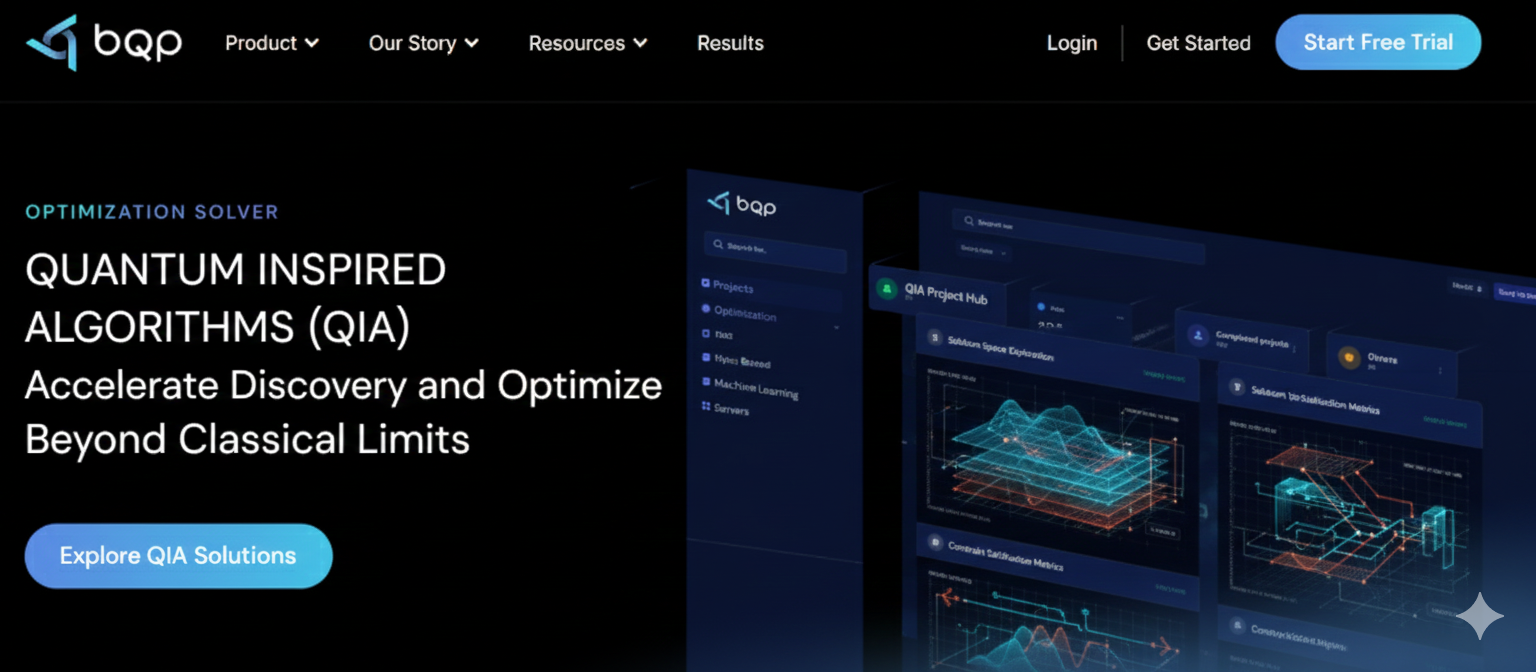
BQP delivers quantum-inspired optimization through its BQPhy® platform, specifically designed for aerospace and defense applications requiring high-performance optimization on classical hardware.
Core capabilities:
- Quantum-Inspired Optimization (QIO): GPU-optimized algorithms that deliver up to 20× faster solutions than classical methods for complex design and scheduling problems
- GPU optimization: Leverages modern graphics processors to accelerate tensor operations, probabilistic sampling, and population evolution
- Integration with existing workflows: Seamlessly plugs quantum-inspired algorithms alongside existing HPC and GPU workflows (no system overhaul required)
Proven applications:
- Satellite constellation optimization: Mission planning for multi-satellite systems with observation targets, power constraints, and collision avoidance
- UAV mission planning: Route optimization considering fuel constraints, no-fly zones, and dynamic threats
- Defense logistics optimization: Resource allocation across personnel, equipment, and supplies
- Design optimization in engineering: Component design balancing weight, strength, and thermal properties
Business benefits:
- Faster optimization cycles (reduce iteration time from days to hours)
- Standard GPU infrastructure (eliminates quantum hardware procurement)
- Scalable deployment (grows from prototype to production-scale)
- Security and data sovereignty for defense applications
- Accessible to teams without quantum computing expertise
The platform includes real-time performance tracking, monitoring solver progress and convergence metrics through live dashboards. Engineers identify bottlenecks, compare quantum-inspired versus classical runs, and adjust simulation parameters during execution.
FAQs
What are quantum-inspired algorithms in simple terms?
Quantum-inspired algorithms are classical computer programs that borrow mathematical principles from quantum mechanics to solve complex optimization problems faster. They run entirely on standard CPUs and GPUs, with no quantum hardware, cryogenic cooling, or specialized infrastructure required.
How do quantum-inspired algorithms differ from true quantum algorithms?
Quantum-inspired algorithms run on classical hardware and simulate quantum concepts through mathematical models, delivering 10-80x speedups for specific problem types today. True quantum algorithms require physical qubits and quantum processors, promising exponential speedups that remain largely theoretical due to current hardware limitations and high error rates.
What problems are best suited for quantum-inspired algorithms?
Quantum-inspired algorithms show the clearest advantage on combinatorial optimization problems with large discrete search spaces, rugged solution landscapes with many local minima, and parameter optimization for machine learning. They are less suited for well-structured problems where classical solvers are already highly optimized.
Are quantum-inspired algorithms a temporary solution until quantum computers mature?
No. For the majority of enterprise optimization problems, quantum-inspired methods on classical infrastructure will remain a production-grade approach even after fault-tolerant quantum hardware becomes commercially viable. Most workloads do not require true quantum advantage to benefit from quantum-inspired performance gains.
How does BQP's platform make quantum-inspired algorithms accessible to engineering teams?
BQPhy® delivers pre-configured quantum-inspired optimization solvers designed specifically for aerospace, defense, and advanced manufacturing workflows. Teams gain up to 20x faster solutions on complex design and scheduling problems, with full integration into existing HPC and GPU environments and no quantum computing expertise required.
.png)
.png)



.svg)
.svg)
.svg)
.svg)