Results
Physics-Based Solver

Quantum CFD Achieves 100× Circuit Compression

Contact Us
Thank you! Your PDF will get downloaded automatically.
Oops! Something went wrong while submitting the form.
Challenges

Scaling VQLS-based PDE solvers is fundamentally limited by circuit depth:

  • Block encodings for PDE operators often grow exponentially with system size.
  • Hand-crafted circuits (e.g., Qiskit) introduce unnecessary gates and deep control paths.
  • Deep circuits break hybrid workflows:
    • Increased simulation cost
    • Slower variational optimization
    • Higher noise accumulation
  • For structured PDE systems (like 2D Poisson), inefficient encoding made large-grid experiments impractical.

Core bottleneck: circuit depth, not algorithm design.
Results

Using Classiq’s compiler-driven synthesis and NVIDIA CUDA-Q GPU-accelerated simulation, the framework achieved major scalability gains:
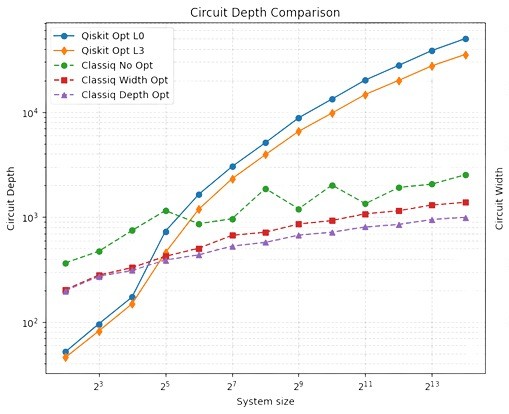
  • Circuit depth reduction: up to 100× lower than Qiskit-based circuits
  • Block encoding efficiency: logarithmic scaling with grid size via structured sparsity exploitation
  • GPU-accelerated hybrid execution: large-scale VQLS experiments became feasible
  • Experimentation throughput: significantly more VQLS iterations and parametric sweeps
  • Impact: Hybrid quantum-classical PDE solvers now scale to practical engineering problem sizes (e.g., 2D Poisson).

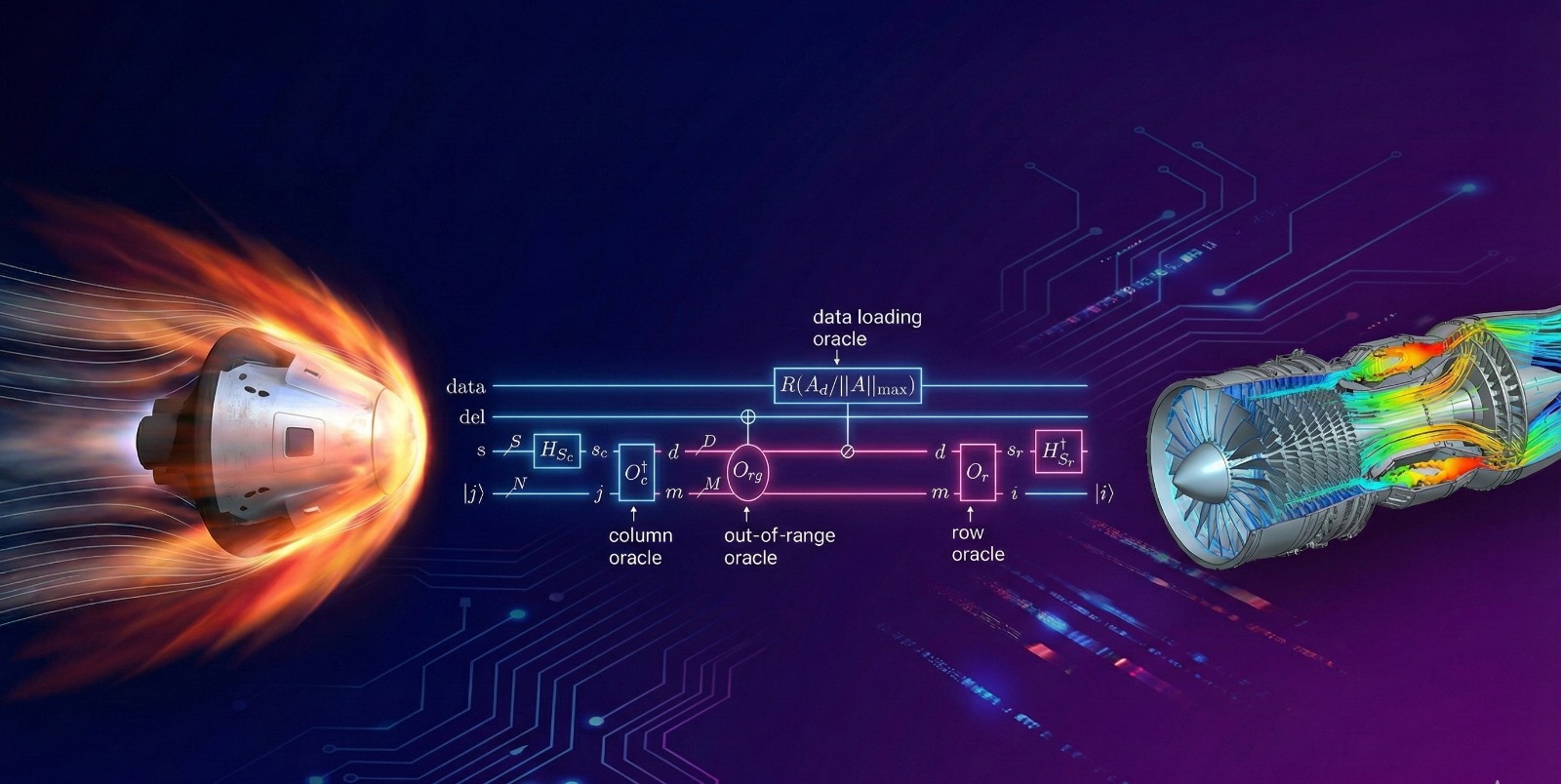
BQPhy hybrid quantum-classical PDE solver improves circuit compression for scalable CFD

100× Circuit Compression

Classiq’s compiler-generated circuits achieved up to 100× lower depth, enabling larger PDE grids.

GPU-Accelerated Hybrid Execution
CUDA-Q simulation dramatically increased runtime performance—allowing wide parametric studies.
Scalable Block Encoding
Structured sparsity enabled efficient encodings, making VQLS viable for real scientific and engineering PDEs.
Go Beyond Classical Limits.
Explore with a commitment-free Proof of Concept.
Schedule Call
Get in touch for a no obligation proof-of concept
Schedule a Call
More to Explore
SEE ALL
Optimization Solver
Airfoil Shape Optimization Using Surrogate model & QIO
Achieved high-accuracy drag prediction with R² = 0.996 and improved design convergence|| Faster exploration • Reduced evaluation cost • Stable optimization
Check Out
Optimization Solver
Optimized Gate Allocation: Operational Resilience for Airline Gate Scheduling
BQPhy’s QIO solver delivers up to 3X faster convergence than Classical Algorithms for dynamic airport gate assignments, while consistently producing conflict-free schedules.
Check Out
Physics-Based Solver
Quantum CFD Achieves 100× Circuit Compression
BQPhy's QCFD algorithm, Classiq’s compiler and NVIDIA GPU simulators enabled 100× circuit-depth reduction and successful scaling to the 2D Poisson equation for quantum-accelerated PDE solving.
Check Out