




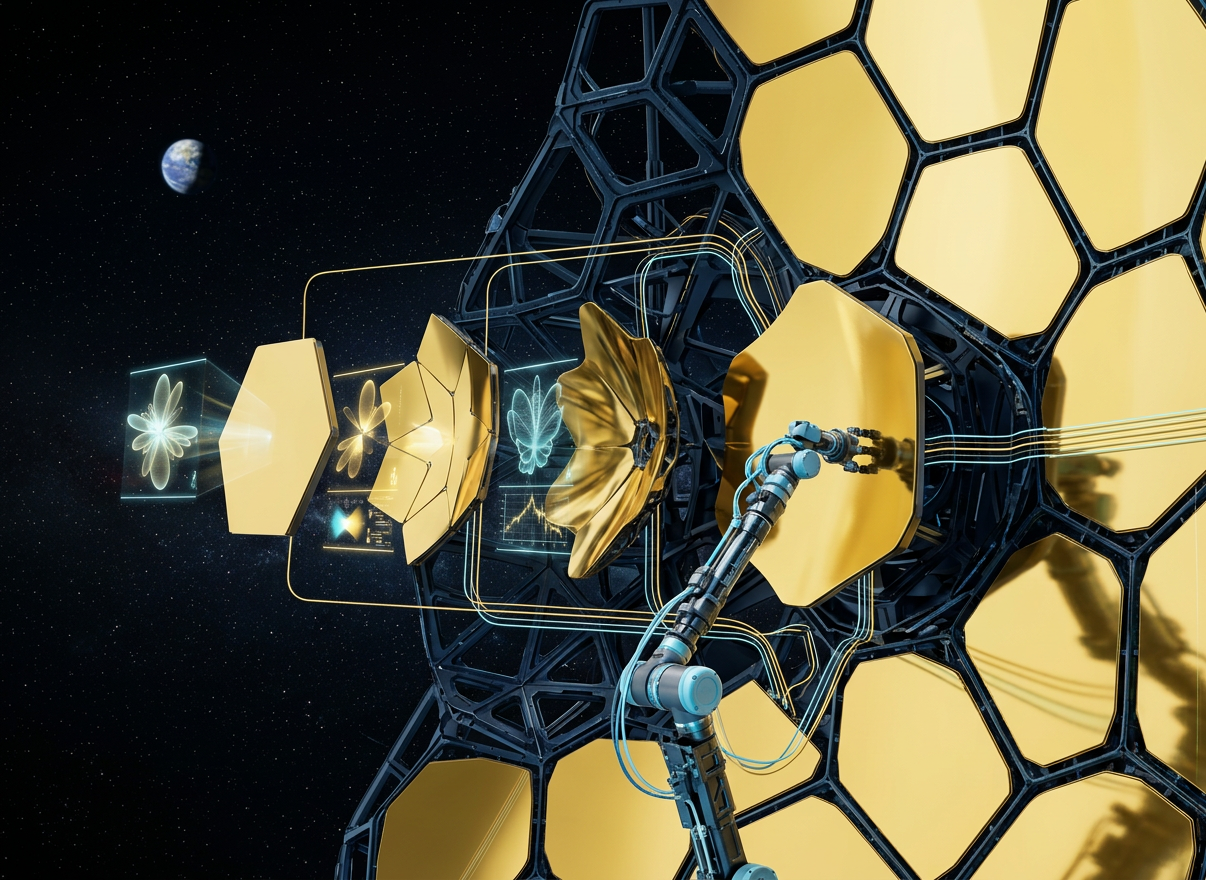
Deep space probe optimization operates where radioisotope power decay, one-way light-time communication delays, and interplanetary trajectory mechanics impose constraints with no real-time correction capability.
Instrument power budgets, downlink data volume limits, and gravity assist timing windows interact across mission arcs spanning decades each constraint tightening as the RTG degrades and Earth-probe distance grows. A probe optimized for early-mission science return without accounting for end-of-life power margins will go silent years before reaching its primary science target.
Deep space probe optimization is a decades-long commitment where every decision compounds.
This article covers:
- The dominant power, communication, and trajectory constraints that define the deep space probe's feasible mission design boundary
- Three proven optimization methods including quantum inspired optimization via BQP, multi-flyby gravity assist trajectory optimization, and multi-objective science operations scheduling
- Step-by-step execution workflows specific to deep space probe mission design, not adapted from Earth-orbit spacecraft operations procedures
Getting method selection right at each mission design phase determines whether the probe delivers science return across its full interplanetary trajectory.
What Limits Deep Space Probe Performance?
Deep space probe optimization begins by identifying the power, communication, and trajectory constraints that define which science operations schedules and mission profiles are physically achievable across the full mission arc.
1. RTG Power Output Degradation
Radioisotope thermoelectric generators decay in output power at approximately 1.6 percent per year as the plutonium-238 fuel undergoes radioactive decay and thermoelectric couple efficiency degrades with accumulated thermal cycling.
RTG degradation sets a shrinking power budget ceiling that the optimizer must plan against across the full mission life, forcing instrument scheduling to adapt to progressively tighter power allocations as the mission advances toward its primary science targets.
2. Deep Space Network Contact Window Availability
DSN contact windows for deep space probes are shared across multiple active missions, creating scheduled allocation constraints that limit downlink duration, uplink command frequency, and real-time anomaly response capability at interplanetary distances.
DSN allocation limits set hard ceilings on achievable downlink data volume per week, directly constraining how much science data the probe can return and forcing the optimizer to prioritize instrument operations against available downlink capacity.
3. Gravity Assist Timing and Planetary Alignment
Gravity assist maneuvers require precise planetary alignment that only occurs within narrow launch windows recurring on multi-year cycles missing a flyby opportunity by days can eliminate an entire trajectory option for the mission.
Gravity assist timing constraints create discrete, inflexible waypoints in the trajectory design space that the optimizer must build the entire mission arc around, eliminating trajectory options that do not thread through available alignment windows.
4. Onboard Fault Protection and Safe Mode Recovery Time
Deep space probes carry autonomous fault protection systems that transition the spacecraft to safe mode when anomalies are detected, suspending science operations for recovery periods that can extend days to weeks at interplanetary distances.
Safe mode recovery time constraints force the mission planner to build scheduling margins that account for potential science operations interruptions, preventing the optimizer from packing the schedule so tightly that a single safe mode event causes unrecoverable data loss.
These four constraints collectively define the feasible deep space probe mission design envelope. For how power-limited and communication-constrained systems architecture drives mission design tradeoffs, see aerospace optimization techniques.
What Are the Optimization Methods for Deep Space Probe?
Three methods address distinct layers of deep space probe optimization, from instrument scheduling and power management through gravity assist trajectory design and multi-objective science return planning.
Method 1: Quantum Inspired Optimization Using BQP
BQP is a quantum inspired optimization framework that encodes combinatorial engineering problems as QUBO models and resolves them using quantum-inspired heuristics on classical hardware without requiring physical quantum processors.
For deep space probes, BQP encodes the discrete instrument operation scheduling problem selecting which instruments operate during which mission phases, which data products are prioritized for downlink, and how power modes are sequenced across RTG-limited orbital periods as binary variables within power budget and DSN contact constraints.
BQP is best suited when instrument scheduling involves discrete on/off activation decisions across many instruments with interdependent power draws, thermal constraints, and downlink priority rankings that change across mission phases as RTG output declines.
Step-by-Step Execution for Deep Space Probe Using BQP
Step 1: Catalog Instrument Power Profiles Across Operating Modes
Document the power draw for each instrument operating mode full science, standby, calibration, and off across all probe instruments. These profiles form the power cost coefficients for each binary activation variable in the QUBO formulation.
Step 2: Encode RTG Power Budget as Per-Phase Ceiling Constraints
Translate the RTG power output forecast for each mission phase into hard ceiling constraints. Encode combinations of simultaneously active instruments that exceed the phase power budget as large quadratic penalty terms in the Q matrix.
Step 3: Assign Downlink Priority Weights to Science Data Products
Rank science data products by mission priority and assign priority weights to binary downlink selection variables. Higher-priority data products receive lower penalty costs for scheduling, biasing the solver toward protecting high-value observations when DSN capacity is constrained.
Step 4: Encode DSN Contact Window Capacity as Downlink Rate Constraints
Translate available DSN contact hours per mission phase into downlink volume capacity limits. Penalize scheduling configurations where total queued science data volume exceeds the downlink capacity available in the phase's allocated DSN contact windows.
Step 5: Add Instrument Thermal Compatibility Constraints
Encode mutual exclusion constraints between instrument pairs that cannot operate simultaneously due to thermal interference adjacent instruments whose combined heat dissipation exceeds local thermal control system limits within the probe's thermal design envelope.
Step 6: Submit QUBO and Extract Mission Phase Science Schedule
Assemble and submit the complete Q matrix to BQP's solver. The lowest-energy configuration identifies which instruments operate in which modes during each mission phase, respecting all power, downlink, and thermal constraints simultaneously.
Step 7: Reoptimize Schedule for Each Mission Phase Power Update
Rerun the QUBO at each major mission phase boundary using updated RTG power output measurements. Adjust instrument activation variables to reflect actual degraded power availability rather than pre-launch forecast values.
Practical Constraints and Failure Modes with BQP
QUBO matrix size scales with the number of instruments, operating modes, and mission phase time blocks encoded simultaneously. Deep space probes with 10 or more science instruments across decade-long missions require phase-by-phase decomposition to keep matrix dimensions tractable for BQP resolution.
BQP encodes DSN contact availability from pre-planned allocation schedules. If DSN contacts are cancelled or shortened due to competing mission priorities or ground system maintenance, the optimized schedule becomes infeasible and requires replanning against revised contact availability data.
Method 2: Multi-Flyby Gravity Assist Trajectory Optimization
Multi-flyby gravity assist trajectory optimization identifies optimal planetary encounter sequences, flyby altitudes, and interplanetary transfer arc parameters that deliver the probe to its science target with minimum propellant expenditure while threading through available planetary alignment windows.
Deep space probe trajectories to the outer planets and beyond require gravity assists from multiple planets to achieve the required heliocentric velocity the sequence, timing, and geometry of these flybys determines both the propellant budget and the arrival date at the primary science destination.
This method performs best during the mission concept and trajectory design phase when the planetary sequence has not been committed and the optimizer has freedom to explore unconventional multi-planet routes that deliver better science target arrival conditions than the baseline direct or single-flyby options. For how gravity assist trajectory optimization fits within the broader landscape of quantum optimization problems in mission design, further context is available.
Step-by-Step Execution for Deep Space Probe Using Gravity Assist Trajectory Optimization
Step 1: Define Science Target Arrival Requirements
Specify the required arrival conditions at the primary science target: arrival date range, hyperbolic excess velocity limit, and approach geometry constraints driven by science observation requirements and orbit insertion delta-v budget.
Step 2: Enumerate Candidate Planetary Flyby Sequences
Generate candidate multi-planet gravity assist sequences connecting the launch date to the target arrival window. Use pruned tree search or patched conic pre-screening to eliminate sequences that cannot geometrically achieve the required heliocentric velocity increment within the delta-v budget.
Step 3: Optimize Each Candidate Sequence via Patched Conic Methods
For each viable planetary sequence, solve the multi-leg Lambert problem to compute transfer arc delta-v requirements between successive flybys. Identify the launch date, flyby dates, and flyby altitudes that minimize total mission delta-v for each sequence.
Step 4: Refine Promising Sequences with High-Fidelity Numerical Integration
Take the top-ranked patched conic solutions and propagate them using full-force numerical integration incorporating planetary gravity, solar radiation pressure, and relativistic corrections. Identify delta-v penalties and arrival condition changes relative to patched conic estimates.
Step 5: Optimize Trajectory Correction Maneuver Placement
Within each refined trajectory, optimize the placement and magnitude of trajectory correction maneuvers (TCMs) to minimize total TCM delta-v while maintaining arrival condition accuracy within navigation delivery error tolerances across Monte Carlo dispersion cases.
Step 6: Select Final Sequence Based on Science and Risk Criteria
Rank refined trajectory options against science arrival quality, total delta-v margin, launch window width, and risk criteria including single-point failure sensitivity to TCM execution errors. Present the Pareto front to mission planners for final sequence selection.
Practical Constraints and Failure Modes
Patched conic trajectory screening produces optimistic delta-v estimates that consistently underpredict actual mission costs when refined with full-force numerical propagation, particularly for trajectories with close planetary flybys where non-spherical gravity and atmospheric drag become significant.
Gravity assist trajectory solutions are highly sensitive to launch date precision. A launch delay of even a few days can require a completely different planetary sequence, and the backup trajectory may have substantially higher delta-v requirements or worse science target arrival conditions than the primary option.
Method 3: Multi-Objective Science Operations Scheduling
Multi-objective science operations scheduling simultaneously optimizes instrument observation time allocation, data volume return, and power consumption across competing science objectives without reducing the problem to a single weighted cost function that obscures real mission design tradeoffs.
Deep space probe science teams represent multiple principal investigators with competing observation priorities atmospheric science, magnetospheric measurements, surface imaging, and particle detection instruments cannot all operate simultaneously and must share a shrinking RTG power budget across a mission lasting years to decades.
This method performs best when the probe is in the science operations phase near its primary target, DSN contact allocation is fixed for the observation campaign period, and the mission team needs to resolve instrument priority conflicts across multiple science objectives with explicit tradeoff visibility. For how multi-objective scheduling methods apply across complex aerospace systems, see quantum inspired optimization for aerospace and defense.
Step-by-Step Execution for Deep Space Probe Using Multi-Objective Science Scheduling
Step 1: Define Science Objectives and Observation Requirements per Instrument
Document each science objective's minimum required observation time, preferred observation geometry, data volume output per hour, and acceptable power mode combinations. These parameters define the objective function components for each instrument's scheduling allocation.
Step 2: Build Conflict Matrix for Simultaneous Instrument Operations
Construct a conflict matrix identifying pairs of instruments that cannot operate simultaneously due to power, thermal, pointing, or electromagnetic interference constraints. This matrix defines the mutual exclusion constraints in the scheduling optimization.
Step 3: Specify DSN Downlink Volume Budget per Observation Window
Translate available DSN contact time into downlink volume budgets for each observation window. Set these as hard upper bounds on total science data volume generated during each window, preventing the schedule from producing more data than can be returned to Earth.
Step 4: Run NSGA-II to Generate Science Return Pareto Front
Execute NSGA-II with instrument scheduling chromosomes encoded as time-allocation vectors per observation window. Simultaneously maximize science return across all principal investigator objectives while respecting power, thermal, and downlink budget constraints.
Step 5: Extract Pareto Front and Present Tradeoff Options to Science Team
Extract the Pareto front showing achievable combinations of science return across competing objectives. Present tradeoff curves to the science team, quantifying exactly how much one objective's observation time must decrease to increase another's allocation within the fixed power and downlink budget.
Step 6: Lock Selected Schedule and Generate Uplink Command Sequence
Convert the science team's selected Pareto point into a concrete instrument activation timeline. Generate the uplink command sequence specifying instrument on/off times, data compression settings, and downlink prioritization flags for transmission to the probe.
Practical Constraints and Failure Modes
NSGA-II convergence quality depends on chromosome encoding resolution. Coarse time allocation granularity misses short observation windows created by instrument conflict resolution, while overly fine granularity produces scheduling chromosomes too large for evolutionary search to converge within operational planning timelines.
Science operations schedules must account for probe attitude constraints not all instruments can point at their targets simultaneously given fixed high-gain antenna pointing requirements for DSN contact. Attitude conflict detection must be embedded directly in the fitness evaluation, not applied as post-processing after schedule generation.
Key Metrics to Track During Deep Space Probe Optimization
Three metric categories determine whether the optimized deep space probe mission design sustains science return and operational viability across its full multi-decade mission arc.
Downlink Data Volume Margin per Mission Phase
Downlink data volume margin measures the difference between science data generated by the scheduled instrument operations and the downlink capacity available through allocated DSN contacts during each mission phase.
Negative margin in any mission phase means science data accumulates faster than it can be returned to Earth, forcing either instrument deactivation or data compression that degrades science product quality both outcomes that reduce the mission's science return against its objectives.
RTG Power Margin at End-of-Mission Science Phase
RTG power margin at the end-of-mission science phase measures the residual power available above the minimum required to sustain science instrument operations and critical spacecraft housekeeping functions simultaneously.
Insufficient end-of-mission power margin means the probe reaches its primary science target with insufficient power to operate the instruments it traveled decades to deploy, rendering the mission's highest-value science phase unexecutable despite a successful interplanetary transit.
Trajectory Correction Delta-V Budget Consumption
TCM delta-v consumption tracks the propellant mass equivalent of all trajectory correction maneuvers executed against the total onboard delta-v budget allocated for navigation corrections across the full interplanetary arc.
Excessive early-mission TCM consumption compresses the delta-v reserve available for late-mission critical corrections near science targets, where navigation accuracy requirements are tightest and the cost of trajectory errors in terms of science impact is highest.
These three metrics collectively determine whether the deep space probe mission architecture delivers on its science objectives. For foundational context on budget-constrained metric-driven design processes, see design optimization in engineering.
Start Optimizing Deep Space Probe Missions with BQP
Deep space probe optimization spans discrete instrument scheduling under RTG power constraints, multi-flyby gravity assist trajectory design, and multi-objective science operations planning each layer requiring a method matched to its problem structure across mission timescales measured in decades.
BQP addresses the combinatorial instrument scheduling and downlink priority problems that continuous solvers cannot resolve: discrete activation decisions across many instruments under simultaneously shrinking power budgets, fixed DSN allocations, and competing science priority rankings that shift with every mission phase.
If your team is designing deep space mission operations or science scheduling architectures as part of a broader set of quantum optimization problems in planetary science, BQP provides a practical platform without physical quantum hardware requirements.
Start your free trial and run your first deep space probe instrument schedule or power mode optimization on BQP today no hardware setup, no configuration overhead, results from the first session.
Frequently Asked Questions About Deep Space Probe Optimization
Why does RTG power degradation make deep space probe scheduling fundamentally different from solar-powered spacecraft?
Solar-powered spacecraft adjust power availability by reorienting panels, but RTG output follows an irreversible decay curve independent of spacecraft attitude or operational choices. The scheduler cannot recover lost power capacity through operational adjustments.
This means every instrument activation decision permanently consumes a fraction of the non-renewable power budget. The optimizer must plan across the full mission life, not just the current phase, to ensure sufficient power remains for end-of-mission science objectives.
How far in advance are deep space probe science operations schedules typically planned?
Science operations sequences for deep space probes are typically planned 4 to 8 weeks in advance to allow time for command sequence generation, review, uplink, and onboard load validation before execution. Longer horizons are used for major mission phase transitions.
The planning horizon is constrained by DSN contact allocation schedules, which are negotiated months in advance across all active missions. Changes to instrument scheduling within the committed planning window require priority escalation and may displace allocations from other active missions.
Can gravity assist trajectories be re-optimized mid-mission if the probe falls behind the planned schedule?
Gravity assist opportunities are fixed by planetary alignment and cannot be rescheduled if the probe misses its flyby window. A missed flyby due to launch delay or early-mission propulsion anomaly typically eliminates that planetary encounter entirely from the mission trajectory.
Recovery options depend on whether an alternative planetary sequence exists that is reachable from the probe's actual trajectory with available delta-v. In practice, trajectory recovery from a missed gravity assist requires accepting either a significantly higher delta-v cost or a degraded science target arrival condition.
What is the practical limit on how many instruments a QUBO formulation can schedule simultaneously for a deep space mission?
QUBO matrix size grows quadratically with the number of binary decision variables. For a probe with 10 instruments, each with 4 operating modes, scheduled across 20 mission phase blocks, the variable count approaches 800, producing a matrix of manageable size for BQP resolution without decomposition.
Missions requiring finer temporal scheduling granularity or more instruments need hierarchical decomposition: optimize instrument mode selection at the mission phase level first, then refine activation timing within each phase as a separate lower-dimensional QUBO problem.
How does one-way light-time delay affect the optimization of deep space probe anomaly response procedures?
One-way light times to deep space probes range from minutes for inner solar system targets to hours for outer planet missions. This eliminates real-time ground intervention as an anomaly response option, requiring all critical fault responses to execute autonomously onboard.
The mission scheduler must build in operational margins that allow autonomous fault protection to execute and recover without ground intervention before the next scheduled DSN contact window, preventing anomaly recovery from consuming science operations time that cannot be reclaimed later in the mission arc.
.png)
.png)


.svg)
.svg)
.svg)
.svg)