


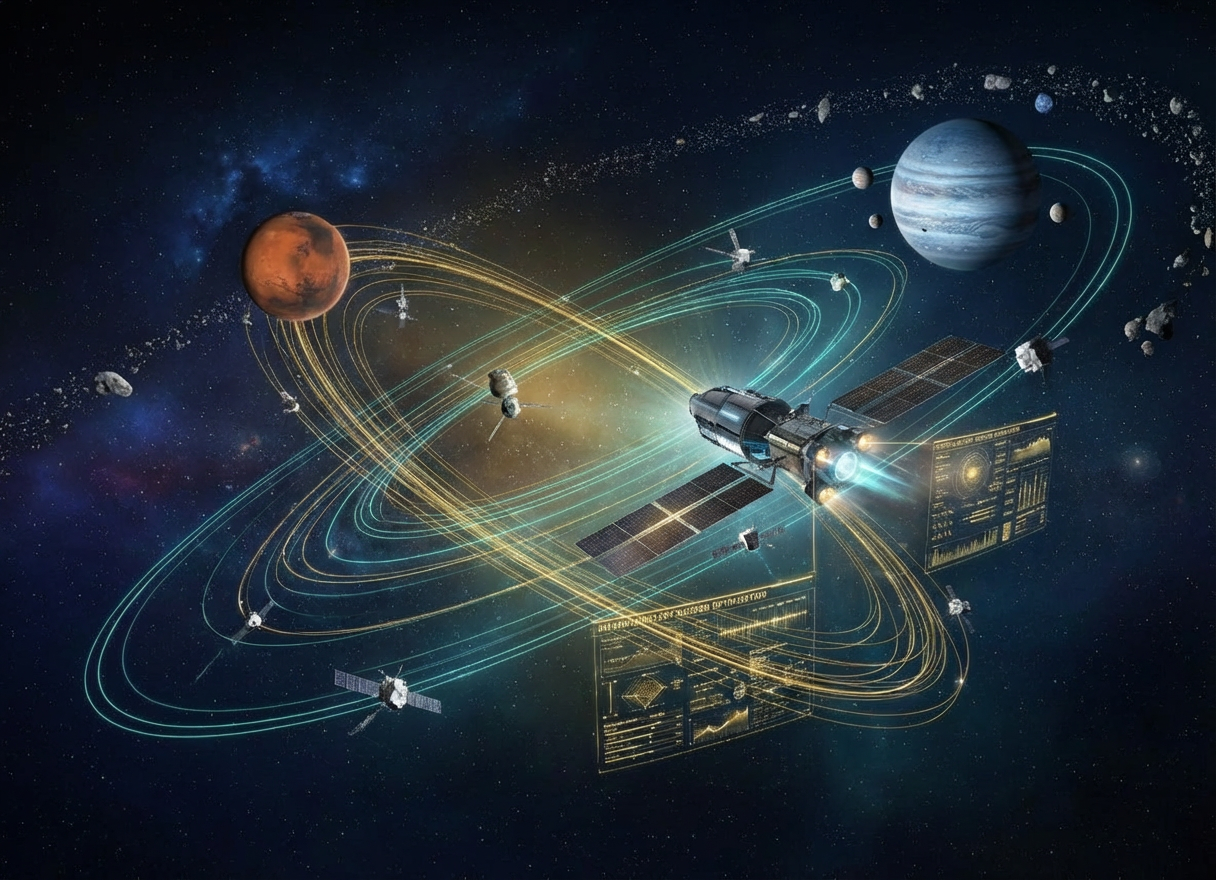

Interplanetary trajectory optimization is a high-dimensional, multi-phase control problem with no closed-form solution and no tolerance for suboptimal early decisions.
Every gram of propellant, every departure window, and every gravity assist sequence is a constrained decision variable that compounds across mission phases spanning months to years small delta-v inefficiencies early in the mission translate directly into payload mass reductions or mission objective shortfalls that cannot be recovered without a trajectory redesign. Getting the feasible design envelope right before selecting a method is non-negotiable.
Interplanetary optimization is where trajectory combinatorics, planetary geometry, and propellant economics converge into a single irreversible commitment.
This article covers:
- The four dominant physical and operational constraints that define interplanetary mission feasibility before any solver is selected
- Three optimization methods including quantum inspired optimization via BQP, direct collocation, and pseudospectral optimal control with component-specific execution workflows for each
- Practical failure modes and key performance metrics for mission-phase validation against design review requirements
The goal is actionable execution assume you are already inside a mission design cycle.
What Limits Interplanetary Mission Performance?
Optimization starts by identifying the dominant constraints that define every tradeoff before a solver is selected or a trajectory family is committed to for refinement.
1. Delta-V Budget and Propellant Mass Fraction
Delta-v is the total velocity change a spacecraft must execute across all mission phases: departure burn, mid-course corrections, orbital insertion, and disposal. Propellant consumption scales exponentially with delta-v through the Tsiolkovsky rocket equation, meaning small inefficiencies compound dramatically over interplanetary distances.
Delta-v budget constraints set the primary feasibility gate for every trajectory candidate solutions that minimize transfer time at excessive propellant cost and eliminate payload capacity in ways that cannot be recovered through subsystem mass reduction alone.
2. Launch Window Constraints and Planetary Geometry
Departure windows for interplanetary missions open based on synodic periods between origin and target bodies. Mars windows open approximately every 26 months; Jupiter and outer planet windows are less frequent and admit fewer low-energy trajectory options per cycle.
Window constraints make trajectory solutions non-transferable between departure dates; a delta-v-optimal path for one departure date is not valid for any other, forcing the optimizer to search across the full porkchop plot solution space for each candidate launch window independently.
3. Multi-Body Gravitational Dynamics
For most of an interplanetary cruise, solar gravity dominates. Near planetary encounters, local gravitational fields take over. Gravity assists introduce hybrid dynamics requiring patched-conic approximations or full N-body numerical integration at sphere-of-influence boundaries.
Multi-body dynamics constraints require the optimizer to handle discrete regime transitions at each flyby encounter adding flybys multiplies design space dimensionality and requires mixed-integer formulations to handle discrete encounter ordering across candidate sequences.
4. Propulsion Architecture and Thrust Mode Constraints
Low-thrust electric propulsion delivers high specific impulse but requires continuous thrust arcs lasting weeks to months. Eclipse periods interrupt solar-powered thrusting, creating discontinuous thrust arcs that must be encoded as path constraints rather than post-processing corrections.
Thrust mode constraints interact across the entire mission arc eclipse duty cycles, power availability profiles, and engine throttle limits all couple trajectory shapes to propulsion hardware performance in ways that cannot be resolved by trajectory optimization alone without propulsion model integration.
These four constraints collectively define the feasible interplanetary mission design envelope. For how multi-body dynamics and propulsion constraints drive trajectory architecture decisions across aerospace systems, see aerospace optimization techniques.
What Are the Optimization Methods for Interplanetary Mission Planning?
Method 1: Quantum Inspired Optimization Using BQP
BQP is a quantum inspired optimization platform that runs on classical hardware and applies quantum-inspired parallel search to explore high-dimensional solution spaces simultaneously rather than following single gradient descent paths from fixed initial conditions.
For interplanetary missions, BQP maps the full trajectory parameter space departure date, flyby sequence, thrust profiles, insertion burns into a unified optimization problem, evaluating candidate solutions across the coupled constraint set simultaneously and identifying feasible trajectories that gradient-based methods cannot find from poor initial guesses.
BQP is best suited for early-phase mission design, gravity assist sequence selection, multi-objective delta-v and transfer time tradeoffs, and trajectory families that must remain robust under propulsion uncertainty across a range of departure window candidates.
Step-by-Step Execution for Interplanetary Mission Planning Using BQP
Step 1: Mission Parameter Space Definition
Define departure date ranges, target body arrival windows, candidate flyby bodies, propulsion type, and power availability constraints. These form the outer bounds of the BQP search domain and determine the combinatorial scope of the flyby sequence optimization.
Step 2: Patched-Conic Seed Population Generation
Generate a population of patched-conic trajectory candidates covering the porkchop plot solution space. These approximate solutions initialize the BQP population without requiring converged high-fidelity solutions, seeding the search with physically plausible departure-arrival combinations.
Step 3: Multi-Body Constraint Encoding
Encode planetary ephemerides, sphere-of-influence transition conditions, thrust magnitude limits, and eclipse period constraints directly into the BQP objective evaluation pipeline. Physics violations eliminate candidate trajectories at evaluation without requiring post-processing filter steps.
Step 4: Multi-Objective Trade Function Formulation
Define simultaneous objectives: minimize delta-v, maximize payload mass fraction, satisfy arrival window constraints, and bound total transfer time. BQP generates a Pareto frontier across these competing objectives rather than collapsing them into a single weighted scalar cost.
Step 5: Quantum-Inspired Global Search Across Flyby Sequences
Execute BQP's parallel population search across all candidate flyby sequences and departure dates simultaneously. This step addresses the combinatorial challenge that defeats classical sequential methods BQP explores flyby ordering spaces that sequential solvers cannot evaluate within mission design schedule constraints.
Step 6: Pareto Solution Set Review and Down-Selection
Review the Pareto front for trajectory families that balance delta-v margin, transfer time, and arrival accuracy. Select candidates for high-fidelity refinement based on mission priority weighting before committing direct collocation or pseudospectral solver time to any single trajectory.
Step 7: Refined Trajectory Handoff to Full N-Body Propagator
Pass selected trajectories from BQP into a full N-body integration tool such as GMAT or STK for verification. BQP integrates natively with these platforms, preserving the solution as an initial guess for final high-fidelity refinement without requiring manual trajectory reconstruction.
Practical Constraints and Failure Modes with BQP
Population diversity degrades if the departure date search range is too narrow. Artificially constrained input windows produce converged but globally suboptimal trajectory families that miss lower-delta-v solutions available outside the specified input bounds.
Gravity assist sequence combinatorics grow rapidly beyond three flyby bodies. For missions with four or more flybys, BQP execution time scales with sequence permutations problem scoping and sequence pre-filtering against minimum flyby delta-v contribution thresholds are required before full optimization runs begin.
Method 2: Direct Collocation
Direct collocation discretizes the continuous trajectory optimization problem into a nonlinear program by representing spacecraft state and control as polynomial splines at a set of mesh points, converting the optimal control problem into a large sparse NLP solvable by standard solvers such as IPOPT or SNOPT.
For interplanetary low-thrust trajectories, direct collocation handles continuous thrust arcs with variable thrust direction across hundreds of revolutions, including eclipse-driven thrust interruptions encoded as path constraints within the same NLP formulation a capability that indirect methods and analytical shaping approaches cannot match in fidelity.
Direct collocation performs best when a reasonable initial guess already exists from a BQP global search or analytical shaping method, and high-accuracy solutions are required for mission-critical delivery phases where trajectory error tolerance is tightest. This method addresses a distinct layer of the broader quantum optimization problems landscape where high-fidelity continuous refinement complements global discrete search.
Step-by-Step Execution for Interplanetary Low-Thrust Trajectory Using Direct Collocation
Step 1: Trajectory Phase Segmentation
Divide the mission arc into distinct phases: Earth departure spiral, heliocentric cruise, gravity assist flyby, and planetary orbit insertion. Each phase carries independent dynamics and boundary conditions at phase junctions that must be matched as interior point constraints in the NLP.
Step 2: Spacecraft Dynamics and Ephemeris Model Setup
Build state equations incorporating heliocentric two-body dynamics plus third-body perturbations near flyby bodies. Integrate planetary ephemeris data to define body positions at each collocation node across the full mission arc duration.
Step 3: Mesh Initialization and Polynomial Order Selection
Initialize a coarse collocation mesh across the full mission arc. Select polynomial order per phase based on trajectory smoothness low-thrust cruise arcs benefit from higher-order Hermite-Simpson or Legendre-Gauss-Lobatto collocation to maintain accuracy without excessive mesh density.
Step 4: Constraint Encoding for Eclipse and Thrust Limits
Encode eclipse period intervals as path constraints that zero thrust magnitude during solar occultation windows. Enforce thrust magnitude bounds, specific impulse limits, and power availability profiles as inequality constraints on the NLP at every collocation node.
Step 5: NLP Solution via Sparse Solver
Execute the sparse NLP using sequential quadratic programming. For interplanetary low-thrust problems, the NLP is large long mission arcs with fine mesh density produce hundreds of thousands of variables and constraints requiring solvers that exploit sparsity structure designed for orbital mechanics problem classes.
Step 6: Mesh Refinement for Accuracy Convergence
Refine the collocation mesh iteratively in regions where trajectory accuracy is insufficient. Focus refinement near planetary flybys and orbit insertion burns where dynamics are most nonlinear and collocation approximation error is highest relative to mission navigation accuracy requirements.
Practical Constraints and Failure Modes
Direct collocation is highly sensitive to initial guess quality. Poor initialization in multi-revolution low-thrust arcs causes NLP infeasibility or convergence to locally optimal but delta-v-inefficient solutions global search via BQP before collocation is standard practice for deep-space missions without heritage initial guesses.
Mesh density required for accurate low-thrust trajectories produces very large NLPs. For missions beyond Jupiter with multi-year cruise phases, computation time scales prohibitively without parallelized sparse solvers, and fine-mesh refinement should be deferred to post-down-selection phases.
Method 3: Pseudospectral Optimal Control
Pseudospectral methods represent the entire trajectory as a global polynomial approximation using orthogonal basis functions typically Chebyshev or Legendre polynomials evaluated at Gauss quadrature nodes converting the continuous optimal control problem into an NLP that achieves spectral convergence for smooth trajectory arcs.
For interplanetary missions, pseudospectral methods are applied to continuous-thrust cruise phases where the control profile varies smoothly over the entire arc without eclipse interruptions, and where high-accuracy control histories are required as direct inputs to onboard guidance systems or ground-based command upload generation.
Pseudospectral approaches perform best for single-phase, smooth-dynamics portions of interplanetary missions specifically heliocentric low-thrust cruise phases where eclipse interruptions are absent and terminal accuracy requirements are strict enough to justify the exponential convergence rate that spectral methods provide. For how pseudospectral control connects to the broader design optimization in engineering framework, further context is available.
Step-by-Step Execution for Interplanetary Cruise Phase Using Pseudospectral Control
Step 1: Problem Transcription to Gauss Node Parameterization
Discretize the cruise phase trajectory at Legendre-Gauss-Radau or Legendre-Gauss-Lobatto quadrature nodes. State and control variables are defined only at these nodes the polynomial globally approximates the trajectory between nodes without requiring explicit intermediate propagation steps.
Step 2: Spacecraft State Variable Definition
Define the six-dimensional state vector covering heliocentric position, velocity, and spacecraft mass. Include mass as a state variable updated by the rocket equation at each quadrature node as propellant is consumed along the cruise arc.
Step 3: Gauss Quadrature Integration of Propellant Consumption
Integrate the propellant consumption cost function using Gauss quadrature over the full cruise arc. This formulation captures propellant usage as a smooth, differentiable function of the thrust control history that the NLP solver can differentiate analytically.
Step 4: Endpoint and Path Constraint Definition
Specify planetary rendezvous boundary conditions at the terminal quadrature node. Define path constraints on thrust magnitude, power limits, and any required trajectory corridor boundaries for deep-space navigation accuracy throughout the cruise arc.
Step 5: NLP Solution and Costate Estimation
Solve the resulting NLP. Pseudospectral methods produce accurate Lagrange multiplier estimates that approximate the costates of the original optimal control problem these verify optimality conditions via the Pontryagin minimum principle without requiring a separate indirect solution pass.
Step 6: Polynomial Control History Export
Extract the continuous thrust magnitude and direction history as a polynomial function of time. This control profile serves as the guidance reference for onboard autonomous navigation systems or as the basis for ground-based command sequence generation across the cruise phase.
Practical Constraints and Failure Modes
Pseudospectral methods are limited to smooth single-phase arcs. Eclipse-interrupted thrust profiles, gravity assist transitions, and multi-body dynamics with discontinuous boundary conditions cannot be handled in a single-phase formulation without numerical degradation that compromises the spectral accuracy advantage.
High polynomial orders required for long cruise arcs introduce numerical conditioning issues. Problems with transfer times exceeding one year typically require multi-phase decomposition rather than a single global polynomial ill-conditioned Vandermonde matrices at high node counts require careful regularization to maintain solver convergence.
Key Metrics to Track During Interplanetary Mission Optimization
Three metric categories confirm that the optimization output is physically consistent and operationally viable before it enters mission design review and trajectory commitment.
Delta-V Margin Across All Mission Phases
Delta-v margin measures the difference between the mission's total velocity budget and the sum of all phase-specific delta-v requirements, tracked cumulatively across departure, mid-course corrections, flyby maneuvers, orbit insertion, and disposal burns.
Delta-v margin is the primary feasibility gate missions with insufficient margin require propellant reserves that directly reduce payload mass in ways that represent the irreversible cost of suboptimal trajectory selection during the mission design phase.
Trajectory Corridor Accuracy at Planetary Approach
Corridor accuracy measures the deviation between the optimized trajectory's predicted approach vector and the planetary entry corridor boundaries at the target body, expressed as position error normal to the approach trajectory at sphere-of-influence entry.
Corridor violations at planetary approach are unrecoverable without large correction burns that consume reserved delta-v approach accuracy requirements are hard constraints, not performance targets, and solutions outside corridor bounds are infeasible regardless of how efficient their delta-v budget utilization appears.
Gravity Assist Delta-V Recovery Efficiency
Gravity assist recovery efficiency quantifies the delta-v reduction achieved by each flyby relative to a direct transfer baseline, computed as the difference between direct transfer delta-v and flyby-sequenced delta-v normalized by flyby execution overhead cost.
Low recovery efficiency identifies a suboptimal flyby geometry where the mission is paying insertion and departure costs for a flyby that contributes insufficient velocity change to justify its schedule and propellant overhead a metric that determines which flybys in a sequence should be retained or replaced. For related context on metric-driven mission design validation, see quantum inspired optimization for aerospace and defense.
These three metrics together determine whether an optimized trajectory is viable for mission concept review and trajectory commitment. All three must close before the design advances to preliminary design review.
Start Optimizing Interplanetary Missions with BQP
Interplanetary mission design involves combinatorial flyby sequencing, multi-phase dynamics, and delta-v sensitivity to departure timing that exceeds what classical gradient-based solvers can explore efficiently within real mission design review schedules.
BQP delivers physics-aware parallel search across high-dimensional trajectory spaces that direct collocation and pseudospectral methods cannot explore from poor initial conditions compressing early-phase solution space exploration from weeks to hours and producing trajectory families, Pareto trade surfaces, and gravity assist sequences ready for high-fidelity refinement.
If your team is working on quantum optimization problems across interplanetary trajectory design, gravity assist sequencing, or low-thrust mission planning, BQP provides the globally informed initial guess that makes downstream collocation and pseudospectral solvers converge faster and more reliably.
Start your free trial and run your first interplanetary trajectory optimization on BQP today no hardware requirements, no setup overhead, trajectory-relevant results from the first session.
Frequently Asked Questions About Interplanetary Mission Optimization
Why can't classical gradient-based methods reliably optimize interplanetary gravity assist sequences?
Gradient-based solvers follow local descent they converge to the nearest feasible solution from the initial guess. Gravity assist sequence selection is a combinatorial problem where the set of viable flyby orderings grows factorially with the number of candidate bodies, and no single initial guess covers the full sequence space.
Classical methods require exhaustive enumeration of initial guesses to explore this space adequately. Quantum-inspired approaches evaluate multiple sequence candidates simultaneously, identifying globally competitive trajectories that gradient descent never reaches from any single starting point.
What is a porkchop plot and why does it matter for mission optimization?
A porkchop plot maps delta-v requirements as a function of departure and arrival date across a grid of candidate launch windows. Contour lines show the delta-v cost of every departure-arrival combination within the window, revealing minimum-energy solutions and identifying feasible launch periods that meet propellant budget constraints.
Optimizers must search across the full porkchop surface rather than around a single candidate departure date. Window-specific trajectory solutions are non-transferable between departure dates, making global search across the full departure date dimension an essential step before any trajectory refinement begins.
When should direct collocation be used instead of BQP for interplanetary trajectory work?
Direct collocation is the right tool for high-accuracy final trajectory refinement once a globally competitive initial guess already exists. BQP is the right tool for initial global search and gravity assist sequence selection when no reliable initial guess is available and the full departure window solution space must be explored.
In practice these methods are complementary and sequential. BQP identifies the globally competitive trajectory family across all candidate sequences and departure windows. Direct collocation then refines the selected solution to mission-critical accuracy with full constraint fidelity for navigation delivery and science arrival requirements.
How does eclipse duration affect low-thrust interplanetary trajectory optimization?
Eclipse intervals interrupt solar-powered thrusting, creating non-continuous thrust arcs that add 20 to 40 percent to total transfer time relative to continuous-thrust baselines for missions using electric propulsion in the inner solar system where eclipse periods are significant.
Optimizers must encode eclipse schedules as path constraints that zero thrust magnitude during solar occultation windows rather than applying eclipse corrections as post-processing adjustments. Ignoring eclipse effects during trajectory optimization produces solutions that become infeasible or significantly suboptimal when thrust interruptions are applied to the converged trajectory.
What makes interplanetary trajectory optimization different from orbit-raising or constellation deployment optimization?
Interplanetary missions introduce multi-body dynamics, planetary geometry timing constraints, and mission durations that produce optimization problem scales and convergence sensitivities qualitatively different from Earth-orbit problems. Departure window sensitivity, gravity assist combinatorics, and year-scale integration horizons exceed what real-time or fast-turnaround orbit-raising solvers are designed to handle.
Convergence sensitivity to initial conditions is also substantially higher for interplanetary problems. Small errors in departure state or flyby geometry compound over interplanetary cruise distances making global search and high-fidelity N-body validation both essential steps in the design process rather than optional accuracy improvements.
.png)
.png)

.svg)
.svg)
.svg)
.svg)