



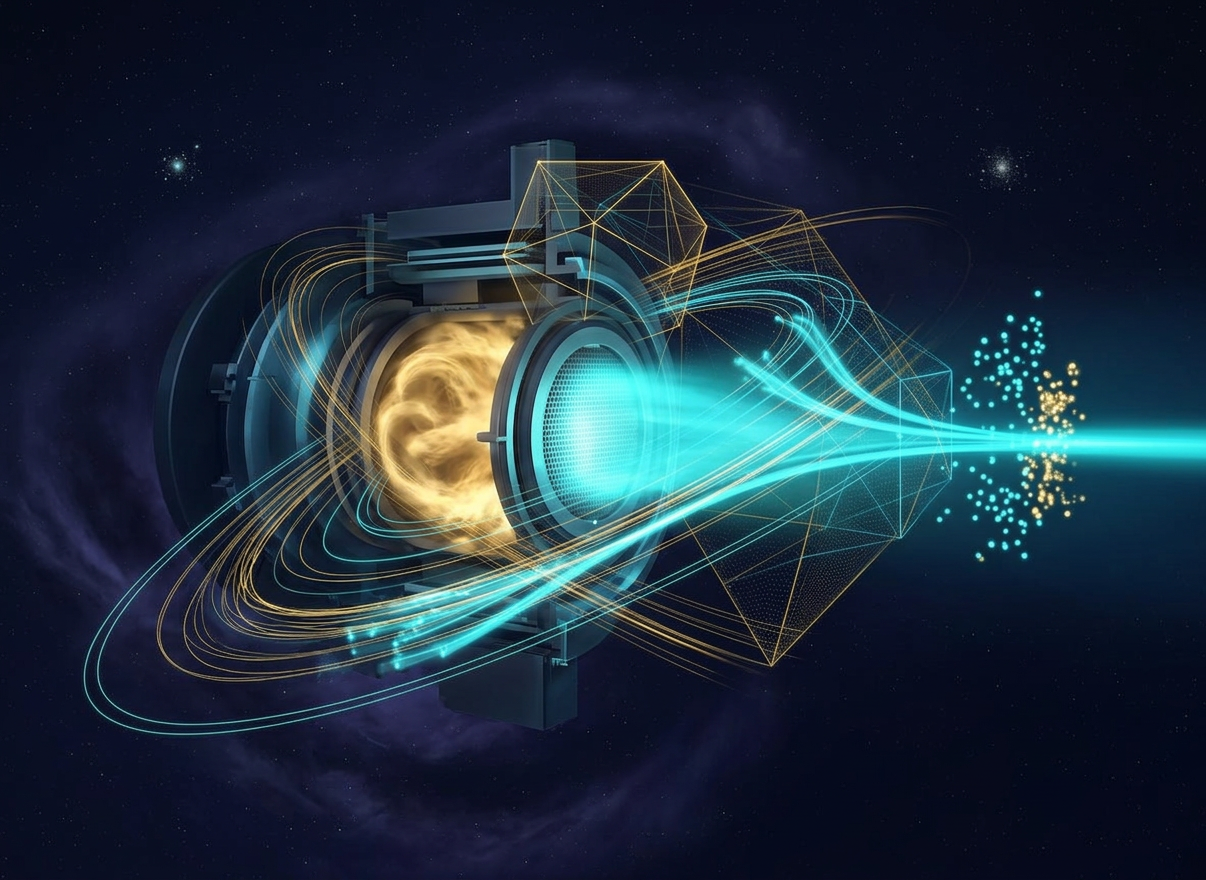

Ion propulsion system optimization demands precise control over plasma physics, electrode degradation, and power-thrust coupling that no single classical solver handles cleanly.
Specific impulse targets, beam neutralization stability, and propellant ionization efficiency interact across timescales ranging from microseconds to mission years creating an optimization surface that shifts as hardware ages. Getting this wrong doesn't just reduce efficiency; it ends the mission.
Ion thruster optimization is where physics, chemistry, and combinatorial scheduling collide.
This article covers:
- The dominant electrochemical and systems-level constraints that define the ion propulsion design boundary
- Three proven optimization methods including quantum inspired optimization via BQP, surrogate-assisted evolutionary methods, and direct collocation applied to electric propulsion trajectories
- Execution workflows specific to ion propulsion not adapted from generic thruster optimization playbooks
Precision in method selection and execution is what separates a viable deep-space propulsion architecture from one that degrades prematurely.
What Limits Ion Propulsion System Performance?
Ion propulsion optimization begins by isolating the physical and electrochemical constraints that define what operating points are actually achievable across a mission lifetime.
1. Screen and Accelerator Grid Erosion
Xenon ion bombardment progressively erodes the screen and accelerator grids, widening apertures and degrading beam collimation geometry over thousands of operating hours.
Grid erosion shifts the optimal beam voltage and propellant flow rate over time, forcing the optimizer to plan throttle schedules that account for hardware degradation trajectories rather than fixed performance maps.
2. Propellant Utilization Efficiency
Propellant utilization measures the fraction of injected xenon that is successfully ionized and accelerated un-ionized propellant is wasted and cannot contribute to thrust generation.
Maximizing utilization competes directly with discharge chamber stability; pushing utilization too high induces plasma oscillations that destabilize the beam and trigger automatic throttle reduction events.
3. Power Processing Unit Bandwidth
The power processing unit (PPU) regulates discharge voltage, beam voltage, and neutralizer flow simultaneously within tight electromagnetic compatibility constraints aboard the spacecraft.
PPU bandwidth limits constrain how rapidly the optimizer can command throttle level transitions, imposing minimum dwell times at each operating point that affect trajectory planning on mission timescales.
4. Neutralizer Cathode Coupling Voltage
The hollow cathode neutralizer must maintain stable electron emission to neutralize the ion beam; coupling voltage instability at low flow rates causes beam divergence and spacecraft surface charging.
Neutralizer coupling constraints set hard lower bounds on thruster operating power, eliminating otherwise-attractive low-thrust operating points from the feasible propulsion design space entirely.
These four constraints collectively define the feasible operating envelope. For context on how hardware-level limits feed into broader systems design, see aerospace optimization techniques.
What Are the Optimization Methods for Ion Propulsion System?
Three methods have demonstrated practical results for ion propulsion system optimization across component-level design and mission-level trajectory scheduling.
Method 1: Quantum Inspired Optimization Using BQP
BQP is a quantum inspired optimization framework that encodes combinatorial engineering problems as QUBO models and solves them on classical hardware using quantum-adjacent heuristics.
For ion propulsion systems, BQP encodes the discrete throttle table the set of validated operating points defined by beam voltage, discharge power, and xenon flow rate as binary variables, optimizing the scheduling sequence across mission phases without violating hardware degradation constraints.
BQP is best suited when throttle table selection involves discrete operating states, interdependent hardware wear constraints, and mission-phase power budgets that change non-smoothly across the trajectory.
Step-by-Step Execution for Ion Propulsion System Using BQP
Step 1: Map Throttle Table to Binary Operating Point Variables
Discretize the thruster's validated throttle table into binary on/off variables for each operating point. Each variable represents one power level, flow rate, and beam voltage combination approved for flight use.
Step 2: Encode Grid Erosion Budget as Cumulative Penalty Terms
Translate screen grid erosion rate data (ions/cm² at each throttle level) into cumulative penalty functions. Penalize operating point sequences that exhaust the grid erosion budget before mission end.
Step 3: Incorporate PPU Bandwidth as Transition Constraints
Add binary constraints that prevent back-to-back selection of throttle levels requiring faster transitions than the PPU can execute. This enforces minimum dwell time between operating point changes.
Step 4: Build the QUBO Matrix Across Mission Phase Blocks
Assemble the Q matrix encoding interactions between operating point selections across mission phase time blocks. Cross-terms capture power budget conflicts and wear-rate accumulation between consecutive phases.
Step 5: Run BQP Solver and Extract Throttle Schedule
Submit the QUBO matrix to BQP's solver. The lowest-energy binary configuration maps directly to the optimal throttle operating sequence across all mission phases within hardware and power constraints.
Step 6: Validate Schedule Against Neutralizer Stability Bounds
Check each extracted operating point against neutralizer coupling voltage stability data. Flag any scheduled transitions that approach neutralizer instability thresholds and substitute the nearest feasible alternative.
Step 7: Reoptimize for End-of-Life Grid Geometry
Rerun the QUBO with updated erosion-adjusted performance maps for beginning-of-life, mid-life, and end-of-life grid states. Confirm the schedule remains feasible across the full hardware aging trajectory.
Practical Constraints and Failure Modes with BQP
QUBO matrix complexity grows with throttle table size and mission phase granularity. Thrusters with large throttle tables (25+ operating points) require variable clustering to keep matrix dimensions tractable for BQP resolution.
BQP encodes performance degradation as static penalty terms derived from pre-computed erosion models. If actual in-flight erosion diverges from the model, the optimized schedule may become infeasible mid-mission without replanning.
Method 2: Surrogate-Assisted Evolutionary Optimization
Surrogate-assisted evolutionary optimization combines high-fidelity physics simulations with trained response surface or Gaussian process models to approximate expensive function evaluations during population-based search across the design space.
Ion thruster discharge chamber design, grid geometry, and magnetic field configuration require particle-in-cell (PIC) or hybrid plasma simulations that take hours per evaluation surrogate models reduce this to milliseconds, making evolutionary search computationally viable for multi-objective ion propulsion design.
This method performs best during the discharge chamber geometry and magnetic circuit design phase, where multiple competing objectives efficiency, erosion rate, beam uniformity must be explored before committing to hardware fabrication. For a detailed treatment of multi-objective evolutionary methods in propulsion contexts, see quantum inspired optimization for aerospace and defense.
Step-by-Step Execution for Ion Propulsion System Using Surrogate-Assisted Evolution
Step 1: Define Discharge Chamber Geometry as Design Variables
Parameterize the discharge chamber using variables including cathode position, anode geometry, magnetic field coil current, and screen grid transparency. These form the chromosome for evolutionary search across the design space.
Step 2: Generate Initial Training Set via High-Fidelity PIC Simulations
Run 50 to 150 Latin hypercube sampled design configurations through the plasma simulation. These simulation outputs form the labeled dataset for training the surrogate model across the design variable space.
Step 3: Train Gaussian Process or Kriging Surrogate Model
Fit a Gaussian process surrogate to the simulation training data, capturing discharge efficiency, beam current density, and erosion rate as separate output surfaces across the design variable space.
Step 4: Run Evolutionary Search on the Surrogate
Execute NSGA-II or differential evolution using the surrogate as the fitness evaluator. The optimizer explores thousands of design configurations in minutes by querying the model instead of the full plasma simulation.
Step 5: Apply Expected Improvement Infill Criterion
Identify the most promising non-evaluated design points using expected improvement over the current Pareto front. Queue these for actual PIC simulation to refine surrogate accuracy in high-value design regions.
Step 6: Update Surrogate and Rerun Until Convergence
Add new simulation results to the training set, retrain the surrogate, and re-execute the evolutionary search. Repeat until Pareto front movement between iterations falls below the convergence threshold.
Practical Constraints and Failure Modes
Surrogate accuracy degrades sharply outside the training data convex hull. Evolutionary operators that push designs outside sampled regions produce surrogate predictions with high uncertainty that mislead the optimizer toward infeasible geometries.
Gaussian process surrogates scale poorly with training set size beyond a few hundred points. Sparse Gaussian process approximations or neural network surrogates become necessary for high-dimensional discharge chamber parameterizations with many design variables.
Method 3: Direct Collocation for Low-Thrust Trajectory Optimization
Direct collocation methods transcribe continuous low-thrust trajectory optimization problems into large-scale nonlinear programs by discretizing the state and control histories at collocation nodes distributed across the trajectory arc.
Ion propulsion systems operate at thrust levels orders of magnitude below chemical propulsion, requiring burn arcs spanning weeks to months a continuous optimal control problem that direct collocation handles natively without the convergence fragility of shooting methods.
Direct collocation performs best for orbit-raising, deep-space cruise, and gravity-assist sequencing problems where burn duration is long, thrust magnitude is tightly constrained by available solar power, and the trajectory must satisfy multiple flyby or rendezvous timing constraints. Understanding how these methods fit within the broader landscape of quantum optimization problems helps position direct collocation alongside quantum-inspired alternatives for mission planning.
Step-by-Step Execution for Ion Propulsion System Using Direct Collocation
Step 1: Parameterize Thrust Vector and Power Profile as Control History
Define thrust magnitude and pointing direction as time-varying controls at each collocation node. Include solar array power availability as a time-varying parameter that bounds maximum beam power at each node.
Step 2: Encode Thruster Operating Mode Constraints at Each Node
At every collocation point, constrain the control variables to lie within the validated throttle table envelope specific impulse and thrust are functions of power input, not freely chosen parameters.
Step 3: Set Boundary Conditions for Each Mission Phase
Specify initial and terminal state vectors (position, velocity, mass) for each mission segment including departure, cruise, gravity assists, and arrival. Multi-phase problems require interior point matching constraints.
Step 4: Select Mesh Density Based on Trajectory Arc Complexity
Use coarse meshes for long cruise arcs with smooth dynamics. Refine mesh density near gravity-assist flybys and low-periapsis maneuvers where state variable gradients are large and collocation accuracy is critical.
Step 5: Solve the NLP and Extract Optimal Burn Arc Sequence
Pass the transcribed problem to IPOPT or SNOPT. The solution provides the optimal time history of thrust vector and power level that minimizes propellant consumption while satisfying all mission boundary conditions.
Step 6: Assess Propellant Margin at Each Mission Phase Boundary
Check remaining xenon mass at the end of each phase against minimum required reserves. Insufficient margin at any phase boundary indicates the trajectory requires rescheduling or mission objective relaxation.
Practical Constraints and Failure Modes
Direct collocation NLP size scales with mesh density and mission arc length. Deep-space ion propulsion trajectories discretized at one-day nodes over multi-year missions produce NLPs with tens of thousands of variables that require careful solver configuration.
Low-thrust trajectories have many local minima, particularly for multi-revolution orbit raising. Without a good initial guess from a shape-based or analytic approximation, direct collocation converges to locally optimal but globally suboptimal burn sequences.
Key Metrics to Track During Ion Propulsion System Optimization
Three metric categories govern whether an optimized ion propulsion design is mission-viable or requires redesign before advancing to hardware qualification testing.
Specific Impulse Variation Across Throttle States
Specific impulse variation measures how efficiently the thruster converts propellant mass into momentum across different power levels in the validated throttle table operating range.
Isp variation directly determines total xenon propellant mass required for the mission unexpectedly low Isp at frequently used throttle states forces propellant loading increases that may exceed spacecraft mass budget allocations.
Thrust-to-Power Ratio Degradation Rate
Thrust-to-power ratio degradation tracks how much thrust output the thruster delivers per watt of input power as grid erosion and cathode aging accumulate across operating hours.
T/P degradation defines the trajectory replanning trigger threshold when T/P falls below the mission-planning floor, the optimal burn arc sequence is no longer achievable with available power, requiring mission-level trajectory revision.
Neutralizer Coupling Voltage Stability Window
Neutralizer coupling voltage stability window measures the range of operating conditions over which the hollow cathode neutralizer maintains stable electron emission without beam divergence or spacecraft charging events.
A narrowing stability window as the neutralizer ages compresses the set of valid operating points, reducing throttle flexibility and forcing the mission trajectory to avoid power levels that were available at beginning of life.
These three metrics collectively determine mission viability. An optimized design that degrades outside acceptable bounds on any one metric invalidates the architecture regardless of nominal performance. For foundational context, see design optimization in engineering.
Start Optimizing Ion Propulsion Systems with BQP
Ion propulsion optimization spans discrete throttle scheduling, high-fidelity discharge geometry design, and continuous low-thrust trajectory shaping each demanding a different method applied at the right phase of the design process.
BQP addresses the combinatorial scheduling dimension that classical continuous solvers cannot handle: discrete operating point sequencing under coupled hardware wear, power budget, and neutralizer stability constraints simultaneously.
If you are working on quantum optimization problems in electric propulsion design or mission planning, BQP gives you a practical platform without requiring quantum hardware.
Start your free trial and run your first ion propulsion throttle schedule optimization on BQP today no setup overhead, no hardware requirements, results from the first session.
Frequently Asked Questions About Ion Propulsion System Optimization
Why is throttle table optimization more complex for ion thrusters than chemical propulsion?
Ion thruster throttle tables define discrete validated operating points each a specific combination of beam voltage, discharge power, and xenon flow rate that has been tested for plasma stability. You cannot interpolate freely between points.
This discreteness makes scheduling a combinatorial problem. Chemical throttling operates over continuous ranges with smooth dynamics, so gradient methods apply directly. Ion propulsion scheduling requires combinatorial solvers that handle discrete feasibility constraints explicitly.
How does grid erosion affect the optimization problem over a multi-year mission?
Grid erosion widens screen apertures and shifts the optimal beam voltage progressively over thousands of hours. A throttle schedule optimized at beginning of life becomes suboptimal and eventually infeasible as geometry changes accumulate.
The optimizer must either plan a single schedule robust to the full erosion trajectory or implement scheduled replanning at defined mission checkpoints using updated performance maps reflecting actual measured degradation.
What role does solar array power availability play in low-thrust trajectory optimization?
Solar array output decreases as the spacecraft moves away from the sun, directly capping maximum beam power and therefore maximum thrust. This makes available thrust a time-varying constraint, not a fixed parameter, throughout the trajectory.
Direct collocation methods handle this naturally by encoding power availability as a time-dependent bound on the control variable at each mesh node, forcing the optimizer to plan burn arcs consistent with actual available power at each mission phase.
Can BQP handle the joint optimization of throttle scheduling and trajectory shaping simultaneously?
BQP's QUBO formulation handles the discrete throttle scheduling layer effectively. Full trajectory shaping with continuous orbital mechanics is outside the native QUBO encoding without discretization that introduces significant approximation error.
The practical approach is hierarchical: use BQP to optimize the throttle operating point sequence for each mission phase, then pass that schedule as a constraint to a direct collocation solver that optimizes the continuous trajectory arc within those power envelopes.
What is the difference between specific impulse optimization and thrust optimization for ion systems?
Higher specific impulse requires higher beam voltage, which increases propellant efficiency but reduces thrust at a fixed power level. Maximizing Isp and maximizing thrust are competing objectives at any given input power.
Mission trajectory requirements determine which objective dominates: time-critical missions favor higher thrust at lower Isp, while propellant-constrained deep-space missions favor maximum Isp even at the cost of longer burn arcs and extended mission duration.
.png)
.png)

.svg)
.svg)
.svg)
.svg)