



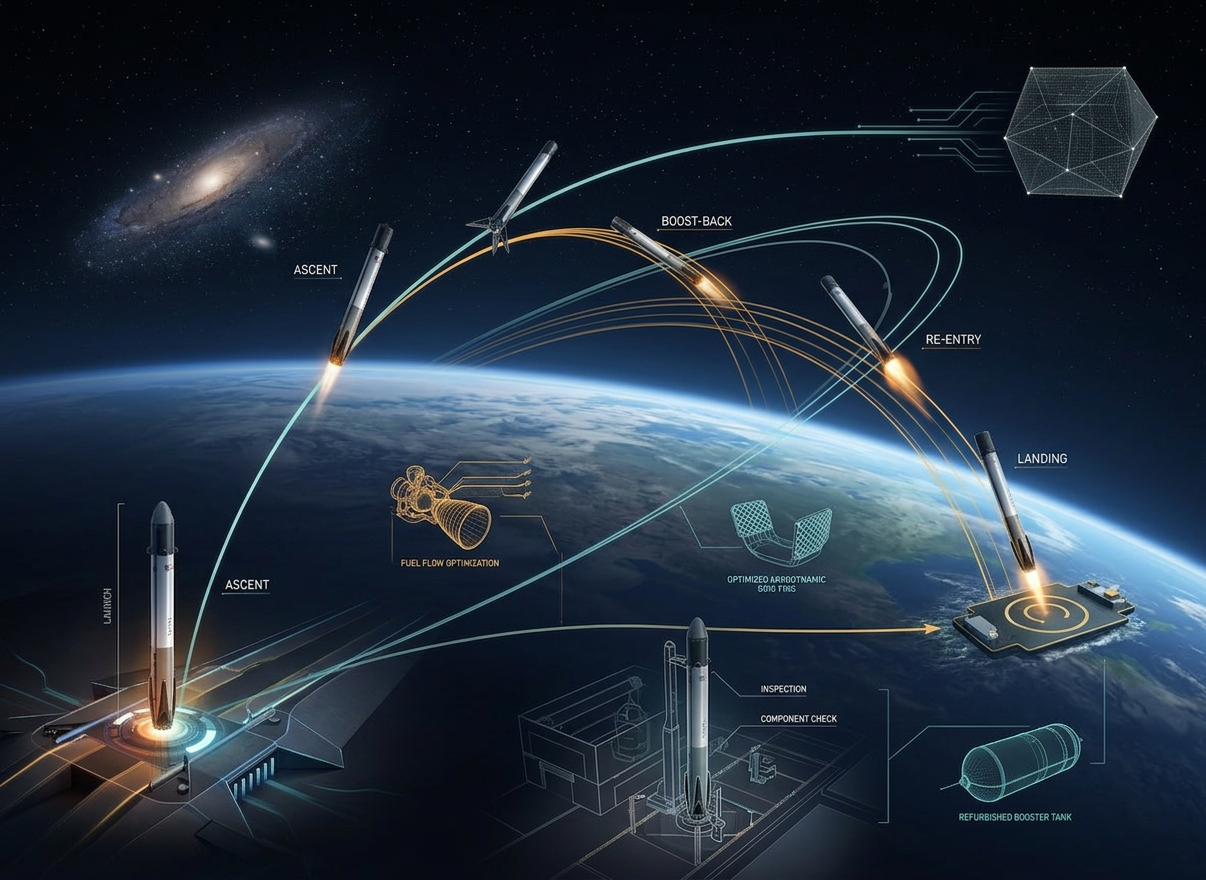

Reusable booster optimization is a coupled multi-phase problem ascent, staging, recovery, and refurbishment interact simultaneously across every design variable.
Gradient-based methods fail here because the objective space is non-convex across flight phases and recovery constraints couple back into ascent performance in ways that sequential discipline analysis cannot capture. A booster optimized purely for ascent payload fraction will exhaust landing burn propellant on dispersed recovery conditions; one sized conservatively for multi-flight structural life will carry too much dry mass to compete commercially.
Getting the feasible design envelope right requires the right method at every phase.
This article covers:
- The dominant propellant, recovery trajectory, and structural constraints that compress reusable booster performance across ascent and recovery phases
- Three optimization methods including quantum inspired optimization via BQP, multidisciplinary design optimization, and convex programming with step-by-step execution workflows for each
- Key metrics that determine whether a booster design survives engineering performance and operational cost validation simultaneously
No introductory rocketry. This is execution-level material for launch vehicle engineers working live programs.
What Limits Reusable Booster Performance?
Optimization starts by identifying the dominant constraints that define where the feasible reusable booster design space actually sits across all flight phases.
1. Propellant Mass Fraction Penalty
Reusability hardware landing legs, grid fins, residual propellant reserves, and structural reinforcements directly cuts into propellant mass fraction. Recovery hardware and reserved propellant consume a meaningful delta-v budget that an expendable stage would convert entirely to payload delivery.
Every kilogram of reusability hardware added to dry mass reduces the Tsiolkovsky mass ratio exponentially, and structural reinforcement for multi-flight fatigue loading compounds this penalty across subsystems that expendable designs size to minimum weight.
2. Recovery Trajectory Coupling
The booster must execute a second trajectory optimization problem concurrently with ascent performance. Boost-back burn timing, re-entry burn windows, and landing burn reserves are not independent of ascent staging velocity selection.
Recovery constraints maximum deceleration loads, touchdown velocity limits, and landing zone accuracy feed back into ascent trajectory shaping, forcing the optimizer to treat ascent and recovery as a single coupled problem rather than two sequential ones.
3. Thermal Load Management During Re-entry
Reusable boosters experience repeated high-dynamic-pressure re-entry events. Maximum heat flux constraints typically bound at 200 kW/m² for VTVL configurations set hard limits on re-entry trajectory steepness and deceleration profile shape.
Thermal load constraints couple re-entry trajectory geometry directly to refurbishment cost and booster service life, making thermal management a first-order design driver rather than a secondary analysis check.
4. Inert Mass Fraction Across Multi-Flight Structural Requirements
Reusable booster structures must carry ascent, max-Q, staging, boost-back, re-entry, and landing loads across a design service life of 10 to 100 flights a fatigue loading spectrum that forces structural sizing well above expendable equivalents at every joint and bulkhead.
Composite material use for airframes and tanks can partially recover structural index performance but introduces inspection requirements that affect refurbishment turnaround time and therefore per-flight cost economics.
These four constraints define the feasible design envelope. Any optimization that ignores one produces solutions that fail validation before reaching hardware. For how multi-phase coupling constraints drive aerospace vehicle design more broadly, see aerospace optimization techniques.
What Are the Optimization Methods for Reusable Boosters?
Three methods dominate reusable booster optimization at engineering execution level, each addressing a different region of the constraint landscape across the design and operations cycle.
Method 1: Quantum Inspired Optimization Using BQP
BQP is a quantum inspired optimization framework running on classical hardware that applies probabilistic search derived from quantum computing principles to high-dimensional engineering problems encoded as QUBO models.
For reusable booster optimization, BQP addresses the core structural challenge: ascent trajectory parameters, recovery burn profiles, staging velocity, propellant allocation fractions, and structural sizing variables must be jointly optimized under tightly coupled constraints across all flight phases simultaneously rather than phase by phase.
BQP performs best when recovery trajectory coupling creates non-convex objective landscapes that gradient-based methods cannot navigate reliably and the combined variable space across ascent, recovery, and structural disciplines exceeds classical direct method convergence limits.
Step-by-Step Execution for Reusable Booster Optimization Using BQP
Step 1: Map the Multi-Phase Design Variable Space
Define ascent trajectory control variables, staging velocity targets, propellant allocation fractions for ascent and landing burns, and structural sizing parameters as simultaneous inputs across all flight phases. Each variable set becomes a component of the QUBO encoding.
Step 2: Encode Recovery Constraint Sets as Hard Boundaries
Specify maximum re-entry deceleration loads, heat flux limits, landing burn ignition altitude windows, touchdown velocity bounds, and landing zone footprint accuracy as non-negotiable constraint boundaries encoded as large quadratic penalty terms in the Q matrix.
Step 3: Couple Structural Sizing to Multi-Flight Fatigue Requirements
Link structural index variables to multi-flight fatigue loading spectra. BQP explores structural mass tradeoffs against propellant mass fraction gain simultaneously across the full allowable design range without decoupling the two competing objectives.
Step 4: Run Parallel Pareto Front Exploration
Set competing objectives: maximize payload mass fraction, minimize refurbishment cost per flight, maximize booster service life, and minimize recovery propellant burn. BQP maps the Pareto front across these simultaneously rather than cycling through them sequentially.
Step 5: Extract Ranked Configurations for Downstream Validation
Filter top-ranked Pareto configurations against thermal load envelopes and refine landing propellant reserve allocations. Export results for MDO or convex programming handoff before committing high-fidelity simulation time to any single design point.
Practical Constraints and Failure Modes with BQP
Problem formulation quality directly determines BQP output quality. Under-specified recovery constraint boundaries allow infeasible landing solutions to appear Pareto-optimal until high-fidelity validation fails them at the trajectory simulation stage.
BQP does not replace physics-based trajectory simulation for terminal guidance verification. Final landing burn profiles require convex or pseudospectral validation after BQP identifies the viable configuration range.
Method 2: Multidisciplinary Design Optimization (MDO)
Multidisciplinary Design Optimization integrates propulsion performance models, aerodynamic coefficient databases, trajectory simulation routines, and structural mass estimation tools into a unified framework, coupling a genetic algorithm to explore the combined design space across all disciplines simultaneously.
MDO fits reusable booster optimization because propellant selection affects gross lift-off weight, tank sizing, structural index, and engine performance simultaneously sequential discipline hand-offs miss those coupling effects and produce configurations that look optimal within each discipline but fail system-level integration checks.
MDO performs best during early design phases when propellant combinations, engine cycle selection, staging architecture, and recovery method are still open variables and the goal is minimum gross lift-off weight or minimum structural mass across the full mission scenario set. For how MDO integrates within broader design optimization in engineering practice, further context is available.
Step-by-Step Execution for Reusable Booster Using MDO
Step 1: Define the Propellant Trade Space
Load competing propellant combinations RP-1/LOX, LH2/LOX, methane/LOX with corresponding specific impulse values, propellant density parameters, and tank sizing implications for simultaneous evaluation across the full design variable set.
Step 2: Build Subsystem Mass Estimation Models
Populate the MDO framework with mass estimation routines for propellant tanks, engine cluster, landing legs, grid fins, interstage, and recovery hardware. Size each subsystem consistently against mission parameters rather than independently against subsystem-level requirements.
Step 3: Integrate Ascent and Recovery Trajectory Routines
Connect trajectory tools covering both ascent delta-v and landing propellant consumption. The framework must calculate propellant mass for ascent and landing simultaneously to produce valid total propellant budgets that account for recovery coupling.
Step 4: Apply Thrust-to-Weight Constraints and Engine Sizing Logic
Enforce thrust-to-weight requirements for liftoff and landing burn. If the ascent thrust-to-weight ratio falls below threshold at any propellant-engine combination, trigger engine count increase and restart stage sizing within the same optimization iteration.
Step 5: Couple the Genetic Algorithm and Score Against Multiple Objectives
Activate the genetic algorithm over propellant type, stage count, engine count, staging velocity, and structural sizing targets. Score configurations against minimum gross lift-off weight, minimum structural mass, and minimum recovery propellant consumption before selecting the mission-optimal configuration.
Practical Constraints and Failure Modes
MDO framework accuracy depends entirely on subsystem mass estimation model fidelity. Low-fidelity mass correlations produce plausible-looking optimal configurations that fail sizing validation once high-fidelity models are applied at the next design phase.
Genetic algorithm convergence requires sufficient population size and generation count for the full variable space. Premature convergence in early generations misses propellant-recovery configuration combinations that only emerge after broader exploration of the joint design space.
Method 3: Convex Programming with Successive Convexification
Convex programming reformulates powered descent and landing burn trajectory optimization as a convex feasibility problem, enabling real-time trajectory generation on flight-qualified onboard processors without requiring pre-computed trajectory tables.
Successive convexification extends this by linearizing non-convex constraints iteratively around a reference trajectory until the solution satisfies the original non-convex problem making it applicable to the reusable booster landing burn where thrust direction constraints and aerodynamic terms introduce mild non-convexity.
This method performs best for the powered descent and landing burn phase where terminal state constraints are tight, thrust magnitude bounds are the primary control constraint, and rapid repeatable trajectory computation is required across dispersed initial conditions from boost-back and re-entry. This connects to the broader class of quantum optimization problems where real-time constrained guidance benefits from structured mathematical programming approaches.
Step-by-Step Execution for Reusable Booster Landing Burn Using Convex Programming
Step 1: Formulate Powered Descent as a Convex Relaxation
Cast the landing burn with thrust magnitude bounds, minimum altitude constraint, and terminal state requirements. Apply lossless convexification to the thrust magnitude constraint to convert the non-convex control norm constraint into a convex form without changing the optimal solution.
Step 2: Encode Terminal State and Landing Zone Constraints
Specify zero-velocity, zero-altitude, and vertical attitude as hard terminal constraints at the final time node. Encode landing zone footprint accuracy as a geographic position bound at the terminal state to prevent landing zone boundary violations under dispersed re-entry conditions.
Step 3: Apply MPC for Engine Ignition Timing
Use model predictive control to determine the powered descent ignition point across the range of initial conditions entering the landing burn phase. Early ignition wastes propellant margin; late ignition leaves insufficient landing burn budget for dispersed conditions.
Step 4: Execute Successive Convexification Iterations
Linearize non-convex constraints around the current reference trajectory. Solve the convex subproblem, update the reference trajectory with the new solution, and iterate until convergence within acceptable constraint violation tolerance across all encoded boundary conditions.
Step 5: Validate Deceleration Loads and Deploy Onboard
Confirm converged trajectories stay within structural deceleration limits across the full dispersion envelope before flight implementation. Implement the validated guidance policy for real-time trajectory regeneration under in-flight dispersions during actual booster recovery operations.
Practical Constraints and Failure Modes
Successive convexification convergence depends on the quality of the initial reference trajectory. Poor initialization particularly for high-initial-velocity dispersed re-entry conditions produces slow convergence or divergence when non-convex constraint violations compound across iterations.
Convex programming handles the powered descent phase cleanly but does not extend to the full multi-phase problem covering ascent, boost-back, and re-entry simultaneously. Phase decomposition before convex reformulation is required, and the interfaces between phases must be handled carefully to prevent feasibility gaps at phase boundaries.
Key Metrics to Track During Reusable Booster Optimization
Three metric categories determine whether the optimized reusable booster design closes on both engineering performance and per-flight operational cost simultaneously across its intended service life.
Payload Mass Fraction at Target Orbit
Payload mass fraction measures delivered payload against gross lift-off weight across the full mission, accounting for both ascent and recovery propellant consumption as competing loads on the total propellant budget.
It is the primary commercial performance metric designs that sacrifice too much payload capacity to recovery hardware fail market viability regardless of how well refurbishment cost and service life metrics perform against internal program targets.
Recovery Propellant Budget Consumed
Recovery propellant budget consumed tracks the fraction of total propellant used by boost-back, re-entry, and landing burns rather than ascent delta-v delivery. Minimizing this fraction while maintaining landing success probability across the full dispersion envelope is the central tension in every reusable booster optimization.
Recovery propellant consumption directly competes with ascent delta-v budget understanding and quantifying this trade at the design stage determines whether payload fraction closes commercially before the program commits to hardware.
Structural Index Across Design Service Life
Structural index quantifies dry mass relative to propellant capacity. As flight cycles accumulate, structural inspection findings may require hardware replacement that increases effective structural index over the vehicle's operational service life beyond the design-phase prediction.
Tracking structural index against multi-flight fatigue data from actual flight campaigns validates whether the design survives its intended flight count within the per-flight cost models that justify the reusability investment. For how lifecycle cost metrics integrate with structural design decisions, see quantum inspired optimization for aerospace and defense.
These metrics decide whether the design is viable across both engineering performance and operational economics both must close simultaneously before the program advances to hardware commitment.
Start Optimizing Your Reusable Booster Design with BQP
Reusable booster optimization requires methods that navigate coupled multi-phase design spaces without simplifying away the recovery-ascent coupling that defines real commercial performance. BQP is purpose-built for exactly this class of problem high-dimensional, multi-physics, with competing constraints across flight phases that gradient methods cannot resolve cleanly.
If your team is working on quantum optimization problems across launch vehicle design, trajectory optimization, or structural sizing, BQP provides the computational framework to map the full Pareto front before committing to high-fidelity simulation time on any single design point.
Start your free trial and run your first reusable booster multi-phase optimization on BQP today with no hardware requirements, no setup overhead, results from the first session.
Frequently Asked Questions About Reusable Booster Optimization
What makes reusable booster optimization fundamentally different from expendable launch vehicle optimization?
Reusable booster optimization must solve two trajectory problems simultaneously: ascent performance and recovery sequencing. Recovery hardware mass, reserved propellant for landing burns, and structural reinforcement for multi-flight loading all reduce propellant mass fraction in ways that compound nonlinearly.
Expendable designs optimize against a single trajectory objective. Reusable designs must balance competing objectives across ascent, boost-back, re-entry, and landing phases which is why design optimization in engineering at this level requires methods beyond gradient-based solvers operating on simplified single-phase models.
Why does propellant choice affect reusable booster structural optimization?
Different propellants produce different tank sizing requirements, gross lift-off weights, and engine cluster configurations. Liquid hydrogen delivers high specific impulse but requires large-volume tanks that increase structural mass significantly relative to the propellant mass they contain.
Hydrocarbon fuels produce denser, smaller tanks with better structural index performance for first stages carrying heavy recovery hardware. Propellant choice must be treated as a live design variable in the MDO framework rather than a fixed input established before structural optimization begins.
How does boost-back burn timing constrain ascent staging velocity?
Higher staging velocities require more propellant to reverse horizontal velocity during boost-back, directly trading against upper stage delivery performance and compressing net payload fraction below commercial targets at high staging velocities.
Resolving this coupling requires simultaneous evaluation of ascent gain against recovery propellant penalty across the full staging velocity range. Sequential discipline analysis that fixes staging velocity before evaluating recovery propellant budget consistently misses the optimal tradeoff point.
What is successive convexification and when is it applied in booster recovery?
Successive convexification reformulates non-convex trajectory problems as sequences of convex subproblems. Each iteration linearizes non-convex constraints around a reference trajectory, solves the resulting convex problem, and updates the reference until the solution converges within acceptable violation tolerance.
It is applied for landing burn guidance because powered descent admits convex relaxation bounded thrust magnitude, small aerodynamic perturbations relative to thrust, and tight terminal constraints enabling the rapid repeatable computation that real-time onboard trajectory regeneration under flight dispersions requires.
What role does refurbishment planning play in reusable booster design optimization?
Optimization does not stop at landing. Refurbishment planning requires decisions about inspection intervals, hardware replacement thresholds, and turnaround time targets that directly affect launch cadence economics and per-flight cost performance across the vehicle's service life.
Vehicles designed for 10 to 100 reuses require integrated optimization across the full operational lifecycle higher launch cadence makes refurbishment scheduling as important as the original design optimization in determining whether the reusability investment delivers the per-flight cost reduction the business case requires.
.png)
.png)



.svg)
.svg)
.svg)
.svg)