


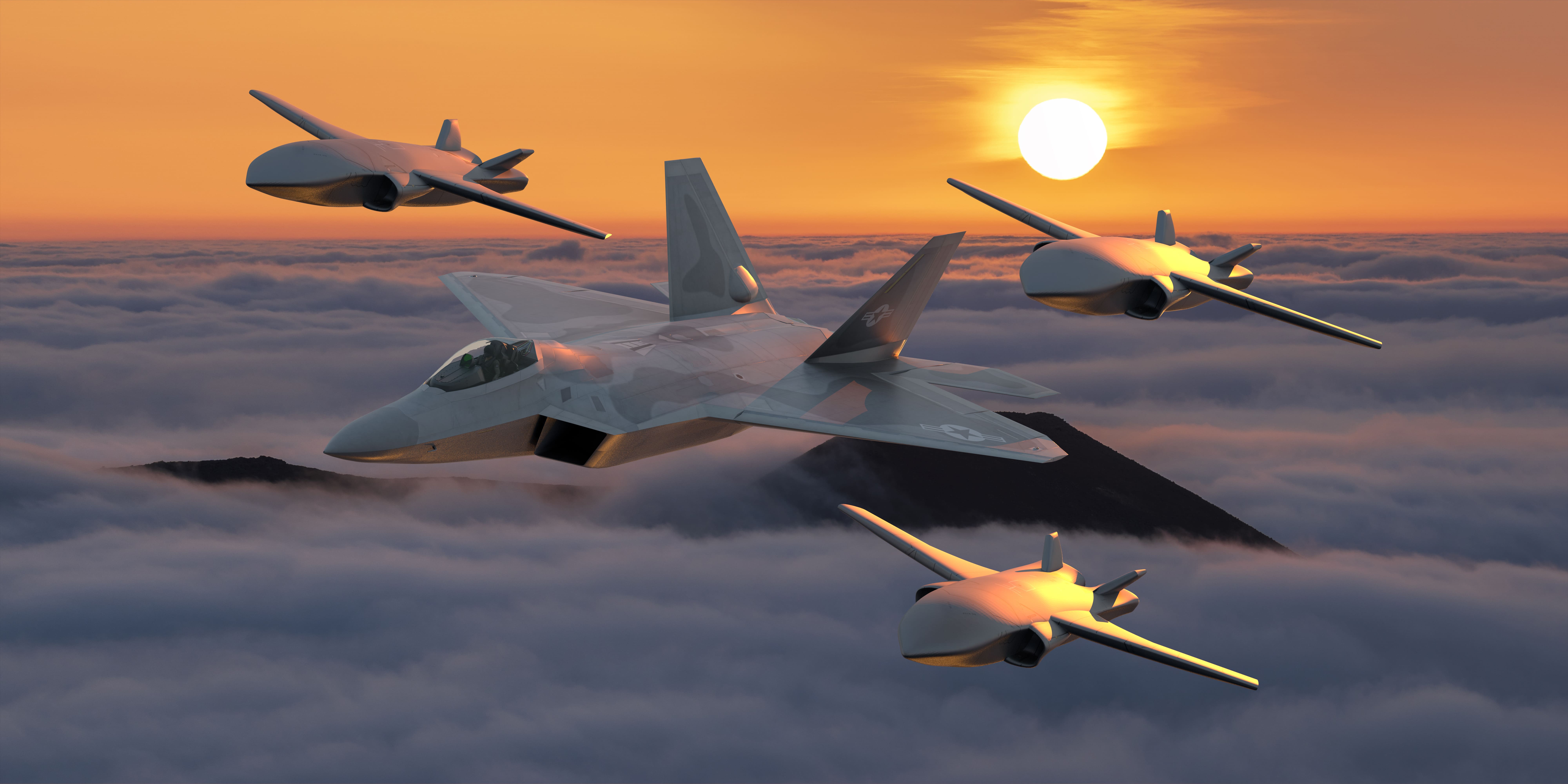

Manned-Unmanned Teaming (MUM-T) coordinates aviation operations in which a crewed aircraft works alongside multiple uncrewed aircraft, commonly referred to as loyal wingmen. These aircraft maintain coordinated formations while operating within defined safety and resource constraints.
Formation planning involves more than determining the relative positions of aircraft at a single point in time. It requires evaluating how their trajectories evolve throughout a planning horizon, ensuring that the desired formation of geometry is maintained without violating minimum separation requirements or fuel limits.
As the number of aircraft increases, the number of pairwise formation relationships grows rapidly. Each candidate formation plan must account for these relationships across multiple time steps. This creates a computationally demanding optimization problem, particularly when candidate trajectories must be evaluated repeatedly through an aircraft dynamics or simulation model.
Quantum-Inspired Optimization (QIO) offers an alternative approach to exploring this solution space. By applying evolutionary search techniques inspired by quantum computing concepts, it can be used to investigate candidate formation configurations and trajectories within an existing simulation-driven planning workflow.
Formation of Planning Problem
Consider a formation consisting of one crewed aircraft and multiple uncrewed wingmen. The planning objective is to maintain a prescribed separation between aircraft throughout a defined time horizon.
Let:
- N represents the total number of aircraft in the formation.
- T represents the set of evaluation time steps.
- x represents the decision variables defining candidate trajectories and formation positions.
- dij(t;x) represents the actual distance between aircraft i and j at time t, as evaluated using the simulation model.
- dij* represents the desired nominal separation between aircraft i and j.
- dmin represents the prescribed minimum separation.
- Efuel(x) represents the fuel consumption associated with the candidate formation plan.
- Emax represents the available fuel limit.
The optimization problem is formulated around one primary objective: minimizing deviations from the desired pairwise formation spacing.
Formation-spacing objective
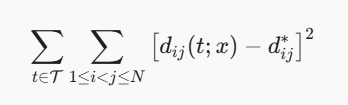
This objective evaluates the difference between the actual and desired separation of every aircraft pair across the planning horizon. Squared deviations penalize departures from the nominal formation geometry, whether aircraft are closer together or farther apart than intended.
The formulation is subject to two constraints.
1. Minimum separation constraint

This constraint ensures that no aircraft pair falls below the prescribed minimum separation at any evaluation time step.
2. Fuel consumption constraint
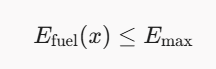
This establishes an upper limit on the fuel required by the candidate formation plan. Fuel consumption is treated as a feasibility constraint rather than a separate optimization objective.
Together, these conditions define a constrained optimization problem in which the search process seeks formation of trajectories that maintain the desired relative geometry while satisfying minimum separation and fuel requirements.
Why Formation Planning Becomes Computationally Demanding
The computational complexity of formation planning increases with the number of aircraft and the length of the planning horizon.
For a formation of (N) aircraft, the number of unique pairwise separation relationships is:
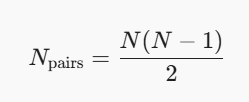
For example, the formation of four aircraft has six unique pairwise relationships. Increasing the formation size introduces additional relationships that must be evaluated throughout the planning horizon.
The computational workload also depends on the number of decision variables used to describe each trajectory, the fidelity of the simulation model, and the number of candidate solutions evaluated during optimization.
In a population-based search, these calculations are repeated across multiple candidate solutions and optimization generations. Consequently, the total computational effort depends not only on the formation size but also on the search strategy and the cost of evaluating each candidate.
This makes the choice of optimization method an important consideration when developing scalable formation-planning workflows.
Applying Quantum-Inspired Evolutionary Optimization
Quantum-Inspired Optimization (QIO) is a population-based optimization approach that uses mathematical concepts associated with quantum computing to represent and update candidate solutions.
Unlike quantum algorithms that require a physical quantum processor, QIEO operates on classical computing infrastructure. It uses probability amplitudes and quantum-inspired rotation operations to guide the exploration of a solution space.
In the context of formation planning, the algorithm can be applied to search for candidate trajectory parameters that minimize the formation-spacing objective while satisfying the specified constraints.
1. Quantum-inspired state representation
A single qubit is mathematically represented as a superposition of two computational basis states:
|ψ≥ 𝛼0>+𝛽|1>
where,
α and β are probability amplitudes satisfying the normalization condition: |α|2+|β|2=1
with:
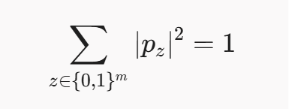
This representation allows the algorithm to maintain a probabilistic description of possible candidate states rather than relying on a single fixed solution at every stage of the search.
2. Population initialization
A quantum individual containing (m) qubit can be represented as:
q=(α1,…,αm; β1,…,βm)
The complete population of (n) quantum individuals is:
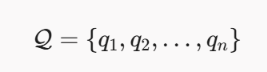
This initialization provides a probability-based representation from which classical candidate solutions can be sampled.
An equal superposition can be established using Hadamard operations:
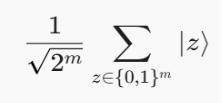
This initialization provides a probability-based representation from which classical candidate solutions can be sampled.
3. Candidate generation and evaluation
The quantum-inspired population is used to generate classical candidate solutions. These candidates are decoded into trajectory and formation parameters, which are then evaluated using the simulation model.
For each candidate, the evaluation process calculates the pairwise separation values across the planning horizon and determines the associated fuel consumption. The resulting values are used to evaluate the formation-spacing objective and check compliance with the two constraints.
Candidates that satisfy the constraints can be considered for selection and subsequent population updates.
4. Probability-amplitude updates
Following candidate evaluation, the probability amplitudes are updated through rotation operations. A rotation update can be expressed as:
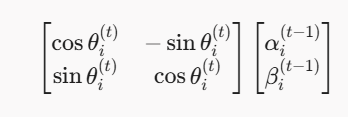
Here,
θi(t) is the rotation angle applied to the (i)-th qubit during iteration (t). The update modifies the probability amplitudes that guide subsequent candidate generation.
The process continues through successive generations, using the quality and feasibility of evaluated candidates to guide the search. It terminates when a defined stopping condition is reached, such as a maximum number of generations or a convergence criterion.
Integrating QIO into an Existing Simulation Workflow
A quantum-inspired optimizer does not need to replace the existing aircraft dynamics model, trajectory generator, or simulation environment. It can operate as an optimization layer that proposes candidate solutions and uses simulation outputs to evaluate their quality and feasibility.
A potential implementation can follow this workflow:
- Define the planning variables: Establish the decision variables that describe candidate aircraft trajectories and formation positions.
- Initialize the optimization population: Generate the initial quantum-inspired population using the selected QIO representation.
- Generate candidate trajectories: Sample and decode classical candidate solutions from the population.
- Evaluate through simulation: Pass candidate trajectories to the existing simulation environment to calculate pairwise separation and fuel consumption.
- Assess feasibility and objective values: Evaluate formation-spacing deviations and check compliance with minimum separation and fuel constraints.
- Update the population: Select suitable feasible candidates and update probability amplitudes through rotation operations.
- Repeat the search: Continue candidate generation, simulation and population updates until the specified stopping condition is met.
BQPhy®’s QuantumNOW™ optimization application can be evaluated as the optimization layer for this type of problem. The existing simulation environment remains responsible for evaluating candidate trajectories and their physical feasibility.
This approach preserves the distinction between optimization and simulation: the optimizer explores the decision space, while the simulation model determines whether a proposed solution satisfies the underlying formation requirements.
Evaluating Optimization Performance
The effectiveness of a QIO-based formation-planning approach must be established through systematic benchmarking. A suitable evaluation should consider both solution quality and computational performance.
Key evaluation metrics include:
- Formation-spacing objective: The total deviation between actual and desired pairwise separation across the planning horizon.
- Minimum achieved separation: The smallest pairwise distance recorded during candidate trajectory evaluation.
- Fuel constraint compliance: Whether the candidate formation plan remains within the specified fuel limit.
- Feasible-solution rate: The proportion of evaluated candidates that satisfy both constraints.
- Convergence behaviour: How the objective value and feasibility of candidate solutions evolve across optimization generations.
- Computational performance: The time and computational resources required to identify feasible solutions.
- Scalability: How solution quality and computational requirements change as the number of aircraft, decision variables and evaluation time steps increase.
Comparisons with established classical optimization methods should use the same simulation model, constraints and computational conditions. This is necessary to distinguish improvements attributable to the optimization method from differences in simulation fidelity, hardware or evaluation settings.
Loyal wingman formation planning presents a constrained optimization challenge in which aircraft must maintain prescribed pairwise spacing throughout a planning horizon while remaining within minimum separation and fuel limits. As formation size and trajectory complexity increase, the computational effort required to evaluate candidate solutions also grows.
Quantum-Inspired Optimization provides a population-based approach to exploring this solution space. Its potential value can be assessed through:
- Formation consistency: Evaluating how effectively candidate trajectories maintain desired pairwise spacing.
- Constraint compliance: Ensuring that minimum separation and fuel limits are satisfied throughout the planning horizon.
- Search efficiency: Measuring the number of candidate evaluations, convergence behaviour and computational resources required to identify feasible solutions.
- Scalability: Assessing how the optimization process performs as formation size, planning horizon and decision-variable count increase.
Integrated with an existing simulation environment, QIEO can be investigated as an additional optimization capability without replacing the underlying aircraft models or planning infrastructure. Its practical suitability, however, must be established through simulation-based benchmarking, constraint validation and comparison with established optimization approaches.