

.jpeg)

Quantum-inspired trajectory optimization is now the most practical method for planning multi-satellite missions at scale. Satellite constellations are becoming the foundation of modern space operations, supporting Earth observation, communication networks, scientific missions, and defense systems. Organizations now deploy groups of small satellites rather than relying on a single large spacecraft, which dramatically increases the coordination challenge.
Operating many satellites together requires precise path planning. Each spacecraft must follow a planned trajectory, maintain formation with others, avoid collisions, and consume fuel efficiently. As constellations grow larger, traditional planning methods cannot find good solutions fast enough to meet operational demands.
This guide covers why multi-satellite trajectory optimization matters, the limitations of classical methods, how quantum-inspired optimization works in practice, and how BQPhy's QIO engine delivers collision-free, fuel-efficient trajectories for complex constellation missions.
Why Multi-Satellite Trajectory Optimization Matters
Governments and commercial operators now launch many small satellites rather than a single large spacecraft. This improves coverage, reduces mission risk, and enables distributed sensing where multiple satellites collect data from different positions and combine it into a complete picture.
For Earth observation, communication systems, and defense monitoring to function properly, every satellite in the constellation must follow the correct path and maintain safe separation from others. Maneuvers must occur at precisely the right time.
Key operational constraints that make this planning problem difficult include fuel limits that restrict how often satellites can change position, mission timing requirements that control when maneuvers must execute, and constellation coordination rules that enforce safe spacing and formation geometry.
Because of these constraints, spacecraft trajectory optimization is not optional. It determines whether a constellation can operate safely, how long satellites remain mission-capable, and whether coordinated objectives can be achieved at all.
Challenges in Classical Satellite Trajectory Optimization
High-Dimensional Decision Space
Each satellite has its own position, velocity, fuel level, and maneuver options. As the number of satellites grows, the number of possible decisions increases exponentially. A constellation of 20 satellites creates a search space that classical solvers cannot explore thoroughly within mission planning timeframes.
Nonlinear Orbital Dynamics
Small changes in thrust or timing cause large variations in a satellite's path. Classical solvers struggle to model these nonlinear behaviors accurately, making it difficult to guarantee that planned trajectories will execute as expected.
Collision Avoidance Complexity
Satellites in a constellation operate in close proximity. Optimizing safe paths requires constant monitoring of inter-satellite distances and continuous adjustments to avoid collisions, particularly during formation deployment and reconfiguration maneuvers.
Resource Constraints
Fuel limits, strict maneuver timing windows, and computational restrictions compound the planning difficulty. Every constraint that is added to the problem narrows the feasible solution space and increases the cost of finding optimal paths.
Limitations of Classical Optimization Methods
Classical optimization solvers fail at scale with nonlinear systems and large decision spaces, a problem examined in detail in our article on trajectory optimization challenges. Genetic Algorithms improve global search but can converge prematurely or settle on suboptimal trajectories when the problem involves many satellites with coupled objectives.
Problem Formulation: Constellation Initialization
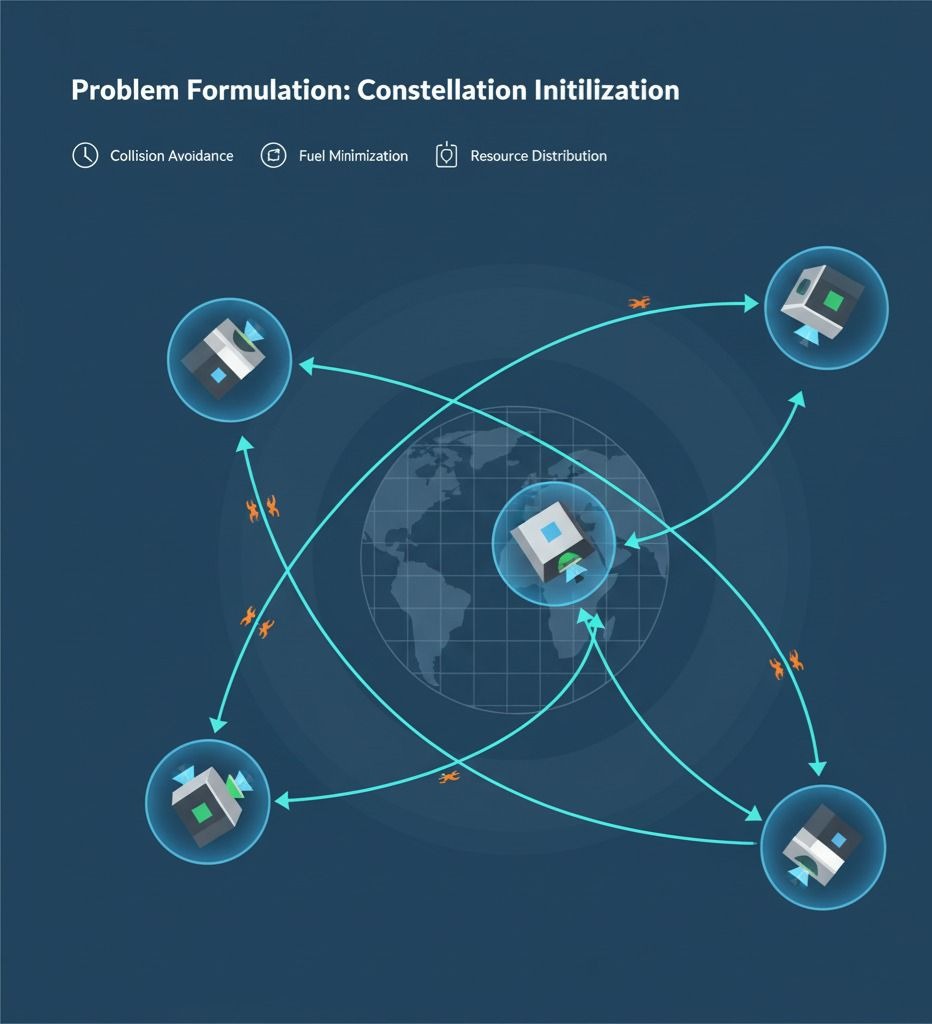
Constellation initialization involves moving multiple satellites from their starting positions to a desired operational formation. It arises in three main scenarios: post-launch deployment where satellites must reach operational orbits after rocket release, satellite failure recovery where remaining spacecraft adjust positions to maintain mission capability, and mission reconfiguration where changing objectives require satellites to reposition for new tasks.
The main goals during initialization are to maintain safe inter-satellite distances at all times, minimize total fuel consumption across the constellation, complete maneuvers as quickly as possible, and distribute fuel usage fairly so no individual satellite is depleted prematurely.
These goals mirror the principles applied in rocket fuel optimization, where every unit of propellant directly determines mission range and duration.
Each spacecraft is modeled as a rigid body with six degrees of freedom, actuated by on-off thrusters. Control variables include the thrust forces and torques applied during maneuvers. Trajectories are represented in a compact form that reduces computational complexity while maintaining enough flexibility to find efficient solutions.
Methodology: Maneuver Parameterization
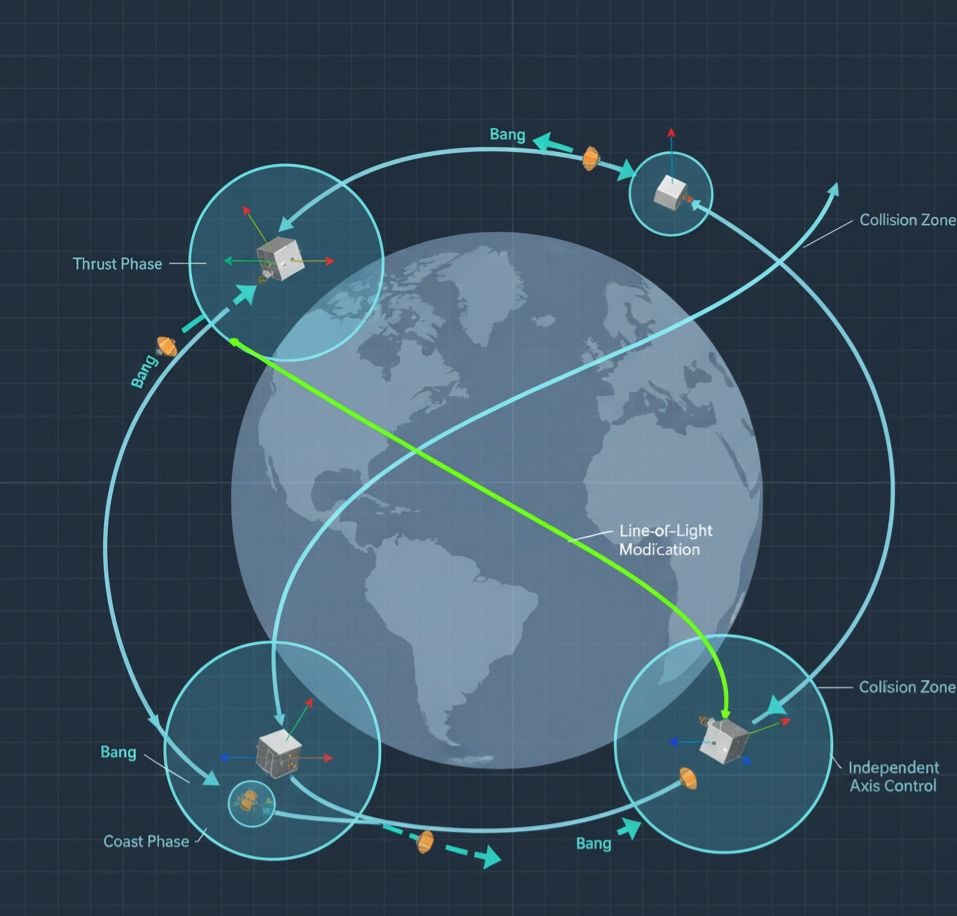
Six-Degree-of-Freedom Dynamics
Satellite motion is modeled using six-degree-of-freedom dynamics where each spacecraft is treated as a rigid body to capture realistic movement, including both translational and rotational behavior during maneuvers.
Bang-Coast-Bang Maneuver Strategy
Maneuvers follow a bang-coast-bang structure: an initial thrust phase, a coasting phase with no thrust, and a final thrust phase to reach the target. This structure keeps trajectories simple, fuel-efficient, and predictable. The same approach underpins efforts to optimize drone trajectory in similarly constrained environments where minimizing energy expenditure is critical.
Line-of-Sight Paths and Collision Avoidance
Trajectories are planned as line-of-sight paths. A collision avoidance system adjusts paths whenever satellites approach within a defined collision radius, making safety checks computationally fast. Satellites are controlled using on-off thrusters that apply forces and torques along each axis to adjust position and orientation simultaneously.
This approach balances simplicity, accuracy, and fuel efficiency, making it practical for coordinating constellations of any size.
Genetic Algorithm Framework for Trajectory Planning
Genetic algorithms are evolutionary methods inspired by natural selection that have proven effective for global search and multi-objective optimization in aerospace applications.
A GA begins with a population of candidate solutions, each representing a possible spacecraft trajectory set. These are evaluated using a fitness function that measures solution quality against mission objectives. Through successive generations, solutions evolve using three operators:
- Selection: Fitter solutions survive and influence the next generation
- Recombination (crossover): Combining traits from parent solutions to create new offspring
- Mutation: Introducing small random variations to maintain population diversity
Tuning a GA requires careful selection of population size, crossover and mutation rates, and initialization methods. Compact yet general representations of decision variables are essential to explore the solution space efficiently without oversimplifying the problem.
Objective Functions for Multi-Satellite Trajectory Planning
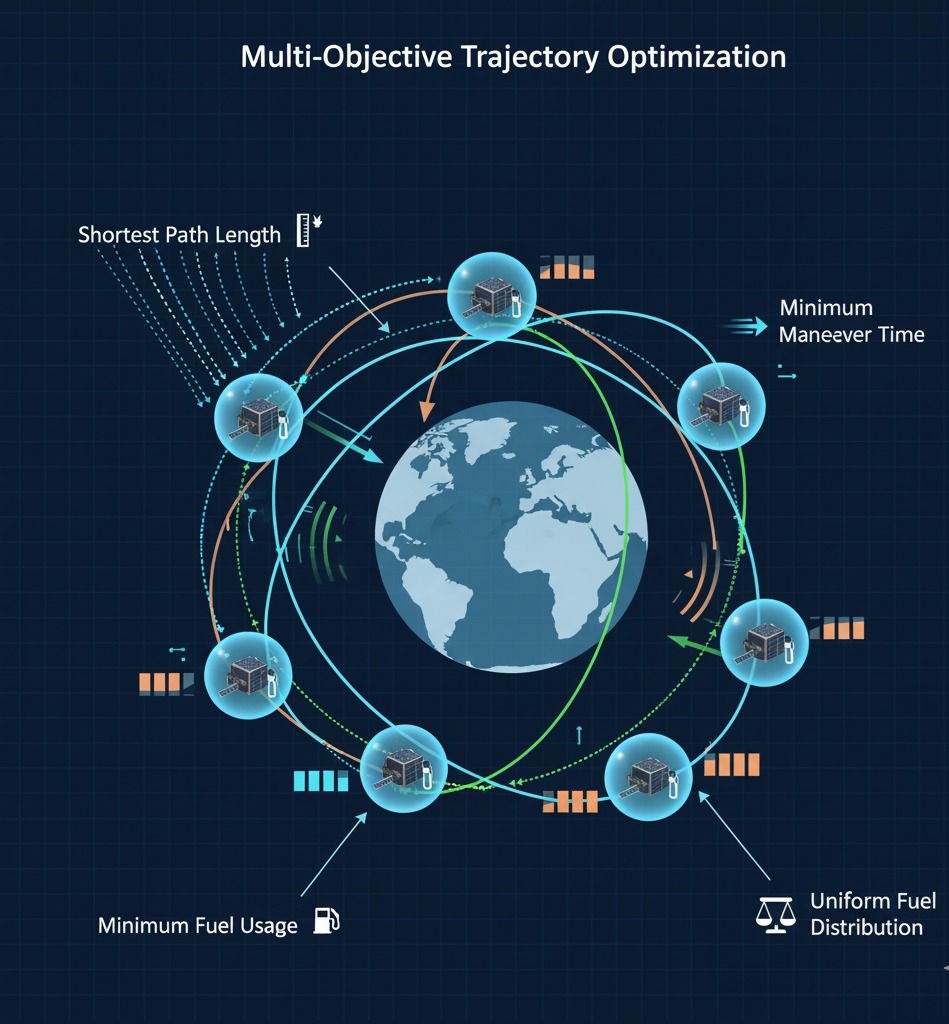
Trajectory planning for multiple satellites is a multi-objective optimization problem. Engineers balance several goals to ensure safe, efficient, and fair constellation operations.
Key objectives include collision avoidance where unsafe paths are penalized, a constraint structurally similar to those addressed in multitier missile trajectory optimization where safe separation across simultaneous flight paths is equally critical. Additional objectives include path length minimization to reduce fuel consumption and maneuver complexity, execution time minimization for coordinated operations, and fuel balance across all satellites to keep the constellation uniformly capable throughout the mission.
These objectives are combined into a satellite trajectory cost function, with weights assigned to each factor. Adjusting the weights lets engineers prioritize safety, efficiency, or fairness depending on mission requirements.
The approach highlights real trade-offs: the safest path may consume more fuel, while the fastest path may bring satellites closer together. Multi-objective spacecraft trajectory optimization balances these factors, producing solutions that perform acceptably across all dimensions rather than optimally on just one.
Quantum-Inspired Trajectory Optimization: How QIO Works
Classical genetic algorithms are useful for trajectory planning but struggle with complex multi-satellite missions. They may converge prematurely to suboptimal solutions or require excessive computation time as constellation size grows. Quantum-Inspired Optimization (QIO) extends GAs to address these limitations directly.
QIO improves the balance between exploration and exploitation, allowing the algorithm to search a broader region of the solution space while still refining high-quality trajectories. This makes it well-suited for multi-satellite maneuvers with multiple coupled objectives including safety, fuel efficiency, and timing.
Applying quantum-inspired algorithms rooted in quantum optimization principles, BQPhy's QIO engine consistently outperforms classical GAs on scalability, convergence speed, and mission assurance. Applied to constellation initialization and trajectory planning, it produces collision-free, fuel-efficient, and time-optimized paths for the full constellation.
Key advantages QIO delivers over classical GAs:
- Better global search: Finds safer, more efficient trajectories by exploring a wider solution space
- Faster convergence: Reaches high-quality solutions more quickly, enabling tighter planning cycles
- Scalability: Handles large constellations and high-dimensional optimization problems that defeat classical methods
QIO does not require quantum hardware. It runs on classical HPC and GPU systems using quantum-inspired mathematical principles to achieve its performance advantages.
Benefits of Quantum-Inspired Optimization for Space Missions
Fuel Efficiency
QIO balances fuel usage across all satellites, ensuring no spacecraft depletes its reserves prematurely. This extends mission life and reduces the need for costly refueling or early replacements.
Collision-Free Maneuvers
Trajectories are planned to maintain safe distances between satellites throughout all maneuver phases. This reduces collision risk and keeps the constellation operating smoothly across deployment, reconfiguration, and failure recovery scenarios.
Scalability
QIO handles large constellations with hundreds of satellites. Its capacity for high-dimensional optimization makes it suitable for the complex, multi-satellite missions that modern space programs are building toward.
Real-Time Adaptation
The method adjusts trajectories in response to mission updates, satellite failures, or changing orbital conditions. Constellations continue to operate efficiently even when circumstances diverge from the original plan.
Mission Resilience
By optimizing safety, fuel, and timing simultaneously, QIO strengthens the overall reliability of missions. Satellites complete their tasks predictably even in unpredictable operational environments.
Applications in Modern Space Missions
Quantum-inspired trajectory optimization is becoming operationally valuable across multiple mission types.
Earth Observation Constellations
Satellites work in groups to capture imagery from different positions. QIO keeps trajectories safe and maintains proper formation spacing while minimizing fuel expenditure across large imaging constellations.
Communication Satellite Networks
Constellations require stable positioning for continuous coverage. Optimization keeps satellites in formation and manages position adjustments as network demand or coverage zones shift.
Defense and Surveillance Missions
Precise satellite coordination is critical for monitoring and tracking. QIO supports fast maneuvers while maintaining safe separation, enabling the rapid reconfiguration that defense missions require. These principles connect directly to quantum optimization astrodynamics methods developed for high-stakes orbital maneuver planning.
Deep-Space Exploration Fleets
Multiple spacecraft operating around the Moon, Mars, or beyond face long-duration maneuver challenges with no opportunity for real-time human correction. QIO manages complex paths and ensures fuel reserves remain viable across extended missions.
Autonomous Orbital Servicing
Satellites inspecting or repairing other spacecraft need safe, precise engagement paths. QIO ensures fuel-efficient and collision-free approaches under the tight constraints that proximity operations require.
Aircraft and UAV Trajectory Applications
The same nonlinear dynamics that limit classical methods for satellite trajectories also constrain aircraft trajectory optimization and UAV path planning, making QIO a common framework across aerospace domains.
Why Quantum-Inspired Optimization Is the Future of Satellite Mission Planning
Satellite constellations are growing larger and more complex. Coordinating hundreds of satellites requires planning tools that classical solvers cannot provide at the required speed or scale.
Autonomous space systems are also expanding. Satellites that adjust positions and respond to failures on their own need optimization engines that compute safe, fuel-efficient maneuvers in near-real time. QIO is built for exactly this operational model.
Integration with AI-driven mission planning and digital twins, as outlined in our guide on quantum-inspired optimization for mission planning, allows engineers to simulate and test trajectories before executing them in orbit. This reduces risk and improves mission reliability at every phase of operations.
BQPhy's QIO engine is scalable and adaptive, handling large constellations and dynamic mission updates. Its combination of evolutionary algorithms and quantum-inspired search strategies makes it a practical quantum optimization solution for aerospace and defense teams that need faster, safer, and more fuel-efficient satellite operations without waiting for quantum hardware to mature.
Frequently Asked Questions About Quantum-Inspired Trajectory Optimization
What is quantum-inspired multi-satellite trajectory optimization?
It is an advanced planning method that combines evolutionary algorithms with quantum-inspired mathematical techniques to find safe, fuel-efficient, and time-optimized trajectories for multiple satellites operating in coordination. It addresses the high-dimensional, nonlinear planning problems that classical solvers cannot handle at constellation scale.
How is quantum-inspired optimization different from classical genetic algorithms?
Classical GAs can converge prematurely to suboptimal trajectories in complex, multi-satellite scenarios. QIO improves the balance between exploration and exploitation, searching a broader region of the solution space while still refining high-quality trajectories. The result is faster convergence and better solutions across all mission objectives simultaneously.
Can quantum-inspired optimization scale to large satellite constellations?
Yes. QIO is specifically designed to handle the high-dimensional decision spaces created by large constellations. It scales to hundreds of satellites and remains computationally practical for real mission planning cycles.
Does quantum-inspired trajectory optimization require quantum computers?
No. QIO runs entirely on classical HPC and GPU systems. It applies algorithms derived from quantum mathematical principles without requiring quantum hardware, making it deployable today with existing infrastructure.
What mission scenarios benefit most from QIO?
Post-launch constellation deployment, satellite failure recovery, mission reconfiguration, and autonomous orbital servicing all benefit significantly. Any scenario involving coordinated maneuvers across multiple spacecraft with coupled constraints on fuel, timing, and collision avoidance is a strong candidate for QIO.
How does QIO handle real-time mission changes?
QIO can recompute trajectories in response to satellite failures, updated mission objectives, or unexpected orbital conditions. This adaptive capability makes it suitable for autonomous satellite operations where human intervention windows are limited.
Which industries benefit most from quantum-inspired satellite trajectory optimization?
Aerospace, defense, Earth observation, and commercial satellite operators gain the greatest advantages. QIO helps them plan coordinated missions safely, minimize fuel consumption, and maintain constellation integrity across dynamic operational environments.
.png)
.png)


.svg)
.svg)
.svg)
.svg)