



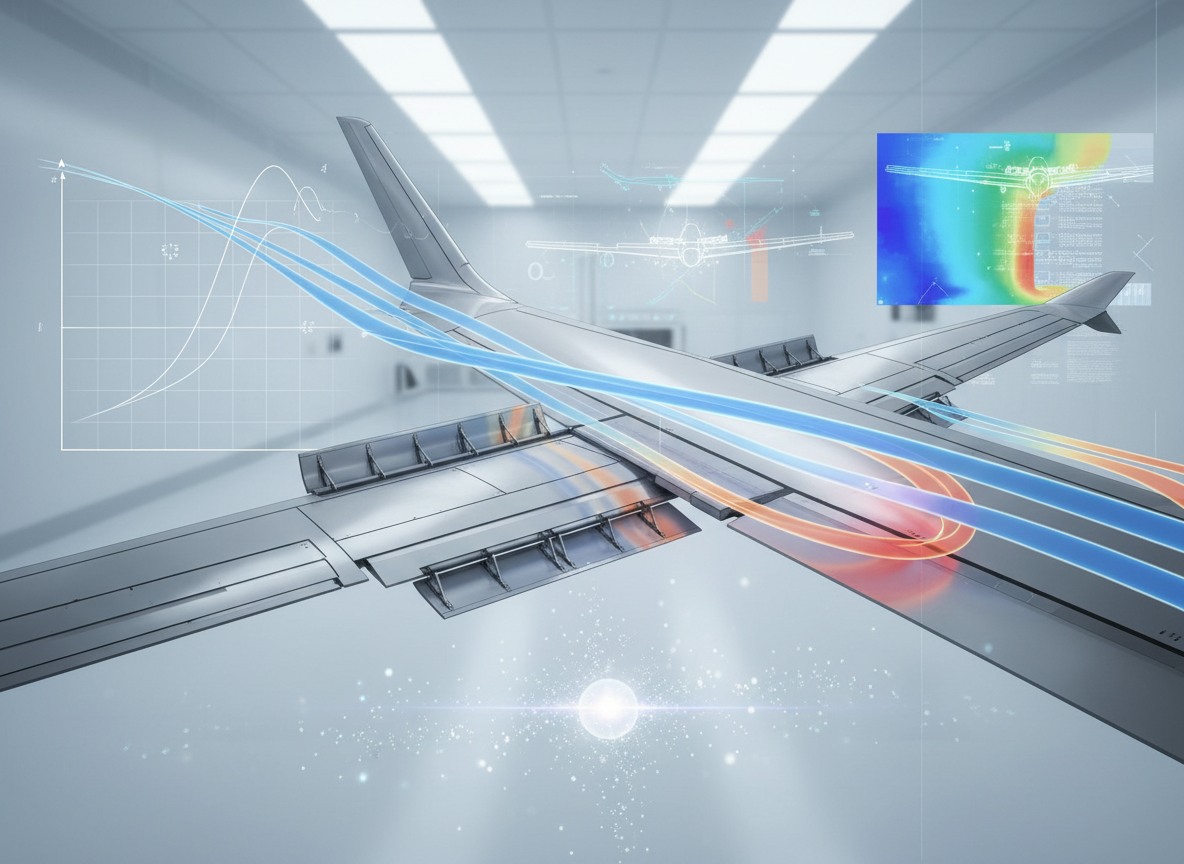

Flap configuration optimization maximizes CLmax through gap, overlap, and deflection angle selection under coupled aerodynamic and mechanical constraints.
Multi-element high-lift system design coordinates flap kinematics, CFD-evaluated flow behavior, and structural actuation requirements to meet takeoff and landing lift-to-drag and stall delay targets. Design choices couple across spanwise segments, actuator paths, and approach speed margins.
Every configuration trades lift gain against drag penalty.
This article covers:
- How kinematic collision limits, drag rise, and stall onset constrain the feasible flap configuration design space
- Three optimization methods: quantum inspired optimization using BQP, genetic algorithms, and PSO with Kriging, with step-by-step execution for each
- Key metrics including CLmax, lift-to-drag ratio, and stall angle of attack to track at each CFD evaluation pass
Implement flap configuration optimization via adjoint-CFD coupled loops for aerodynamically and mechanically viable designs.
What Limits Flap Configuration Performance?
Optimization starts by identifying dominant constraints including kinematic collisions, drag rise, and stall onset across the deflection range.
1. Kinematic and Mechanical Constraints
Actuator-driven deployment paths define achievable gap, overlap, and deflection angle combinations while requiring collision-free motion between flap and wing structure.
These mechanical limits restrict aerodynamically optimal settings and require iterative mechanical redesign when aero-optimal configurations conflict with actuator paths.
2. Aerodynamic Drag Penalty
Flap deployment increases wetted area and flow separation, causing lift-to-drag ratio to drop sharply beyond 20 degrees of deflection angle, making aerodynamic drag penalty one of the most critical constraints in flap configuration design.
Full deflection is limited to landing configurations. Partial deployment is used for takeoff to manage the drag penalty against available thrust.
3. Stall and Separation Onset
Excessive flap deflection lowers the stall angle of attack by inducing flow separation at the flap hinge line under high lift conditions.
Maximum CL at high angle of attack is constrained by separation onset. Slotted configurations re-energize the boundary layer to extend the usable deflection range.
4. Actuator Power and Weight
Hydraulic and electric actuation systems impose limits on maximum deflection rate and actuation force for multi-segment flap systems on large aircraft.
Actuation system weight adds directly to aircraft mass and penalizes cruise efficiency, creating a system-level tradeoff against high-lift performance gains.
Together, these four constraints define the feasible design envelope for any flap configuration optimization program.
What Are the Optimization Methods for Flap Configuration?
Three methods address flap position, deflection angle, and gap geometry for maximum CLmax and minimum approach noise under coupled aero-mechanical constraints.
Method 1: Quantum Inspired Optimization Using BQP
BQP applies quantum-inspired solvers to QUBO-formulated problems running on classical HPC infrastructure, scaling to high-variable engineering design spaces.
It applies to flap configuration by encoding discrete flap segment positions, gap sizes, and overlap values as binary variables within a QUBO Hamiltonian that maximizes CLmax while penalizing drag violations.
BQP is best suited for high-variable multi-segment flap topology problems and integrated wing-flap systems where classical methods face combinatorial scaling limits.
Step by Step Execution for This Component Using BQP
Step 1: Discretize Flap Position Parameters
Encode deflection angles, gap sizes, and overlap values as binary variables covering the feasible kinematic range for each flap segment.
Step 2: Construct QUBO Hamiltonian for Lift and Drag
Formulate the objective to maximize CLmax and minimize drag penalty terms, capturing the aerodynamic tradeoff across all encoded segment configurations.
Step 3: Embed Collision and Deflection Limit Penalties
Add penalty terms enforcing collision-free actuator paths and maximum deflection angle bounds across all flap segments within the QUBO formulation.
Step 4: Run BQPhy Solver for Global Configuration Search
Execute the quantum-inspired solver on HPC infrastructure to search globally across encoded flap segment combinations for minimum Hamiltonian configurations.
Step 5: Decode Solver Output to Flap Segment Settings
Translate binary solver outputs back to physical gap, overlap, and deflection angle values for each spanwise flap segment position.
Step 6: Validate Decoded Configuration via RANS CFD
Simulate the decoded configuration using RANS CFD to confirm CL and L/D performance and check for separation at the design approach angle of attack.
Practical Constraints and Failure Modes with BQP
QUBO binarization introduces approximation error for continuous gap and overlap variables. HPC resources are required as the number of encoded flap variables grows.
Local traps occur when variable counts exceed solver thresholds. Kinematic collision constraints require explicit penalty calibration and are not natively enforced by the solver.
Method 2: Genetic Algorithms (GA)
Genetic algorithms evolve populations of flap geometries and deflection settings through fitness-based selection, crossover, and mutation across successive generations, similar to techniques used in GPU-optimized QIEO vs Genetic Algorithm benchmark comparisons.
GA fits flap configuration optimization because it handles multi-objective problems involving CLmax and stall angle simultaneously, with repair mechanisms enforcing kinematic and separation constraints throughout the search.
GA performs best for 2D and 3D high-lift configurations with XFOIL or CFD-coupled evaluation, where discrete gap and overlap parameters define the primary design variables.
Step by Step Execution for This Component Using Genetic Algorithms
Step 1: Parametrize Flap Gap, Overlap, and Deflection
Define gap size, overlap distance, and deflection angle as the primary design variables representing each individual flap configuration in the population.
Step 2: Seed Initial Population via Latin Hypercube Sampling
Generate the starting population of random flap configurations using Latin hypercube sampling across the defined geometric parameter bounds.
Step 3: Evaluate CLmax and Drag Fitness via Panel or CFD
Compute CLmax using panel method or CFD for each individual, applying drag penalty terms to configurations that exceed separation or L/D thresholds.
Step 4: Select Elite Configurations via Tournament
Rank the population by weighted fitness combining CLmax and drag penalty results. Advance the top-performing elite configurations to the next generation.
Step 5: Apply Single-Point Crossover and Mutation
Perform single-point crossover on elite parents and apply mutation with a probability of 0.5 to introduce geometric variation across gap and deflection parameters.
Step 6: Iterate for 50 to 200 Generations
Repeat evaluation, selection, crossover, and mutation cycles until fitness stagnation is detected or the maximum generation count is reached.
Step 7: Validate Best Configuration at Stall Angle of Attack
Run high-fidelity simulation on the final best configuration to confirm CLmax, stall angle, and separation behavior before design freeze.
Practical Constraints and Failure Modes
Convergence is slow when population size is insufficient, and diversity loss causes premature convergence to local CLmax optima without exploring the full gap-deflection space.
Repair operators are required for configurations that produce kinematic collisions or separation-prone deflection settings. Without them, GA may converge to aerodynamically infeasible designs.
Method 3: Particle Swarm Optimization (PSO) with Kriging
PSO moves swarm particles toward optimal flap positions by updating velocities based on individual and collective best configurations found during the search.
It applies to flap configuration by optimizing leading edge position coordinates, x and y, and deflection angle simultaneously for combined aerodynamic lift and far-field noise objectives using Kriging surrogate predictions to avoid repeated direct CFD calls.
PSO with Kriging performs best for noisy aero-acoustic trade studies where lift and far-field noise are evaluated together and CFD evaluation cost is the binding constraint.
Step by Step Execution for This Component Using Particle Swarm Optimization with Kriging
Step 1: Sample Flap Leading Point and Angle via LH DOE
Generate the initial design-of-experiments point set using Latin hypercube sampling across flap leading point x-y coordinates and deflection angle bounds.
Step 2: Run CFD at All DOE Points for CL and Noise
Compute lift coefficient and far-field noise values at each DOE configuration using CFD under the target approach flow conditions.
Step 3: Build Kriging Surrogate on Collected Objectives
Fit Kriging response surface models to the CFD-collected CL and noise observations, mapping flap position and angle variables to both objectives.
Step 4: Initialize PSO Swarm and Update Toward Optimum
Launch the PSO swarm across the surrogate model landscape, updating particle velocities to minimize far-field noise while satisfying the CL constraint boundary.
Step 5: Adaptively Infill High-Uncertainty Surrogate Regions
Identify regions where Kriging prediction error is highest and add targeted CFD evaluations to refine surrogate accuracy near the candidate optimum.
Step 6: Iterate PSO Until Convergence at 100 Evaluations
Continue swarm updates and adaptive infill cycles until the objective change falls below convergence tolerance or 100 total evaluations are completed.
Step 7: Confirm Optimal Flap Position with Full CFD
Run complete CFD analysis on the final PSO-identified optimum to confirm that CL and noise targets are met before finalizing the flap position.
Practical Constraints and Failure Modes
Kriging surrogate accuracy degrades at the edges of the DOE-sampled space. PSO swarm stagnation occurs when all particles converge prematurely before exploring the full objective landscape.
DOE size limits the initial exploration range. Far-field noise predictions are sensitive to CFD boundary conditions, and surrogate noise sensitivity can mislead the PSO search.
Key Metrics to Track During Flap Configuration Optimization
Maximum Lift Coefficient (CLmax)
CLmax measures the peak sectional or three-dimensional lift coefficient achieved by the flap configuration immediately before stall onset at approach conditions.
It determines takeoff and landing field length requirements. Slotted Fowler flaps boost CLmax by up to 100%, making maximum lift coefficient the primary performance metric for any flap configuration optimization program.
Lift-to-Drag Ratio (L/D)
L/D measures the ratio of lift to total drag at approach speed for the optimized flap configuration under landing or takeoff conditions.
It governs glide path angle and fuel burn during approach. Distributed four-by-two flap segment configurations have demonstrated drag reductions of 13 counts at Mach overspeed conditions.
Stall Angle of Attack
Stall angle of attack measures the angle at which CLmax is reached and flow separation initiates across the deployed flap configuration.
Flap deployment lowers stall angle by 2 to 5 degrees. Maintaining adequate stall margin above approach angle is a hard certification and safety constraint.
Together, these three metrics, evaluated post-CFD at the landing angle of attack, determine whether the flap configuration is aerodynamically viable for certification.
Frequently Asked Questions About Flap Configuration Optimization
Do flaps lower the stall angle of attack during optimization?
Yes. Flap deployment increases CLmax but reduces the stall angle of attack by 2 to 5 degrees due to accelerated flow separation at the hinge line.Slotted configurations re-energize the boundary layer to mitigate separation onset.
How many flap segments produce the best aerodynamic performance?
A distributed layout of four spanwise by two chordwise segments has demonstrated a drag reduction of 13 counts at Mach overspeed conditions relative to conventional configurations.Additional segmentation provides incremental gains.
When should GA be used instead of PSO with Kriging for flap optimization?
GA is better suited when gap and overlap are primary discrete variables and global search across the high-lift configuration space is required. Both methods converge within 50 to 200 iterations.PSO with Kriging is faster when CFD evaluation cost dominates and aero-acoustic objectives are included alongside lift targets.
How much do kinematic constraints limit aerodynamic optimization outcomes?
Kinematic collision constraints reject configurations across iterative design loops, requiring mechanical redesign when aerodynamically optimal gap and deflection settings conflict with actuator paths.Aero-mechanical coupling means that optimization must run both disciplines together.
.png)
.png)

.svg)
.svg)
.svg)
.svg)