




Engineering optimization problems are getting harder to solve with fixed infrastructure. Design spaces are larger, physics is more coupled, and simulation workloads exceed what on-premise hardware can handle within program timelines.
Scalable compute is no longer optional.
Cloud-based quantum and quantum-inspired optimization platforms are changing how engineering teams access, run, and iterate on complex solvers. Elastic infrastructure, distributed workloads, and faster experimentation cycles are now within reach without building dedicated HPC clusters.
- Cloud deployment accelerates experimentation across large combinatorial design spaces
- Distributed workloads allow parallel optimization runs at scale
- Collaboration across engineering teams becomes infrastructure-independent
You will learn how to improve solver performance, reduce infrastructure overhead, and evaluate the leading cloud-based quantum optimization software platforms available for engineering teams today.
A Quick Comparison: Top 8 Cloud-Based Quantum Optimization Softwares
Why Does Cloud Infrastructure Matter for Optimization?
Engineering optimization at full fidelity is computationally expensive. Large-scale structural design, aerodynamic shape optimization, and satellite mission planning generate design spaces that exhaust fixed hardware quickly.
Cloud infrastructure changes the constraint.
Elastic compute scales with problem size. Distributed workloads split evaluation across nodes. Experimentation cycles compress because teams are not waiting for shared hardware to free up.
Industries already leveraging this include:
- Aerospace: running parallel MDO evaluations across cloud HPC clusters
- Manufacturing: optimizing production scheduling across large combinatorial variable spaces
- Logistics: solving routing and supply chain problems at scale with hybrid solvers
- Satellite systems: planning constellation deployment and station-keeping across distributed compute environments
The fundamental advantage is flexibility. Cloud infrastructure scales up for large design runs and scales back down when the problem is solved. No sunk hardware cost. No idle compute.
What Are the Limitations of Traditional On-Premise Optimization?
On-premise optimization infrastructure was built for a different scale of problem. Most engineering teams encounter their limits before they encounter a solution.
The core constraints are structural, not incidental:
- Hardware ceiling: fixed node count limits parallelism; large design spaces cannot be explored within a feasible wall-clock time
- Scalability gap: adding compute capacity requires capital expenditure, procurement cycles, and physical space
- High infrastructure cost: maintaining HPC clusters for intermittent optimization workloads produces poor utilization rates
- Hybrid algorithm difficulty: running quantum-inspired or hybrid quantum-classical algorithms requires software environments that on-premise infrastructure rarely supports out of the box
- Collaboration friction: distributed engineering teams working across sites cannot share compute environments or synchronize optimization runs without significant IT overhead
These are not problems that better algorithms alone can solve. A superior solver running on constrained infrastructure still produces inferior results to a good solver running on elastic compute with adequate parallelism.
Cloud platforms remove the infrastructure constraint from the optimization equation. The algorithm becomes the binding variable, not the hardware.
Top 8 Cloud-Based Quantum Optimization Software Platforms
The platforms below represent the current landscape of cloud quantum and quantum-inspired optimization tools available to engineering teams. Each has a distinct architecture, optimization focus, and applicability profile.
1. BQP (Quantum-Inspired Optimization for Engineering)
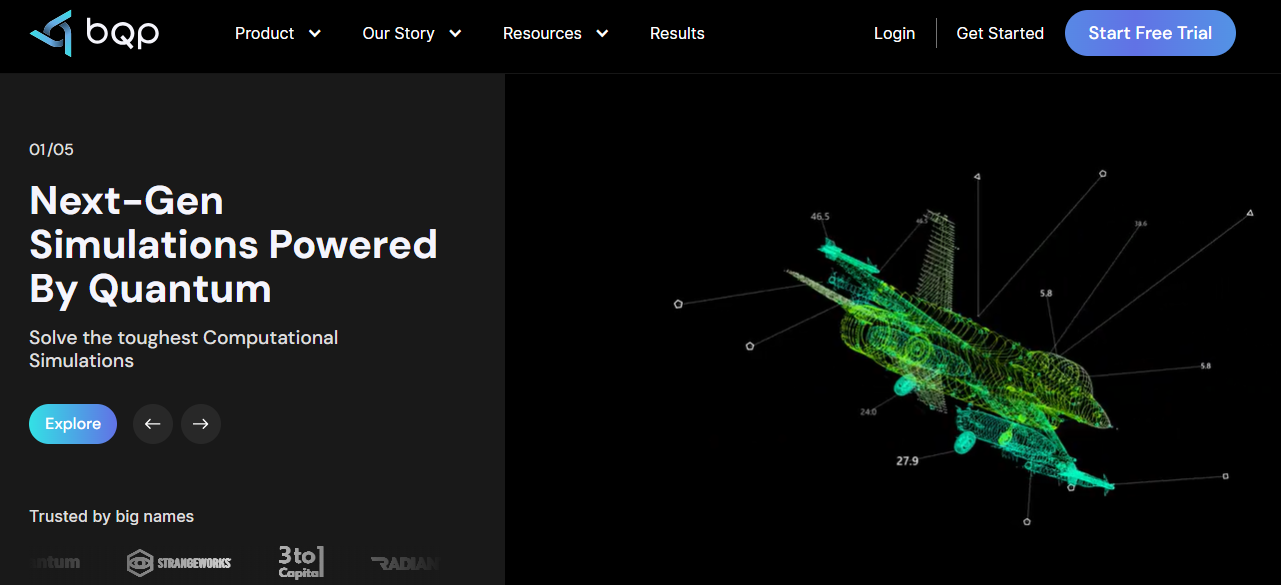
Most cloud quantum optimization platforms were built for research environments or general-purpose combinatorial problems. BQP, developed by BosonQ Psi, is the exception.
It is built for engineering teams solving physics-based optimization problems in aerospace, structural design, and satellite systems.
Where IBM Quantum and Google Cirq require circuit-level quantum programming, BQP plugs directly into existing HPC and GPU workflows. Where D-Wave's annealing architecture is constrained to QUBO-formulated combinatorial problems, BQP handles continuous, nonlinear, multi-physics design spaces that reflect how aerospace engineering actually works.
Key capabilities that separate BQP from the field:
- QIO solvers delivering up to 20x speed improvement over classical methods on complex structural and aerospace design problems
- Physics-Informed Neural Networks (PINNs) that embed governing physical laws directly into AI model architectures, improving accuracy without full high-fidelity solver cost at every evaluation
- Quantum-Assisted PINNs (QA-PINNs) that accelerate training and improve generalization in sparse-data environments, exactly where rare failure scenarios and edge-of-envelope predictions live
- Native MATLAB and enterprise engineering workflow integration, reducing adoption friction for teams already using industry-standard simulation toolchains
- Industry-tailored templates pre-configured for aerospace, defense, and structural engineering with domain-specific constraints, mesh settings, and data preprocessing routines
- Hybrid cloud and on-premise deployment supporting both elastic cloud HPC and data-sovereign on-premise clusters, with no system overhaul required
Applications where BQP delivers measurable performance gains:
- Aerospace structural design and topology optimization across large, nonconvex design spaces
- Satellite constellation deployment, orbital transfer sequencing, and station-keeping optimization
- Multidisciplinary design optimization coupling aerodynamics, structures, and propulsion simultaneously
Teams can validate performance on their specific use case through a free pilot program before any commitment to full deployment.
2. IBM Quantum Cloud Optimization Tools
IBM Quantum, developed by IBM, provides cloud access to gate-based quantum processors through the IBM Quantum Network. The primary development framework is Qiskit, an open-source Python SDK for building and running quantum circuits.
Key capabilities include:
- Cloud access to real quantum hardware and simulators through IBM Cloud
- Qiskit optimization modules supporting QAOA and variational quantum eigensolver (VQE) workflows
- Hybrid classical-quantum solver integration for combinatorial optimization problems
- Enterprise cloud environment compatibility for research and production workflows
IBM Quantum is primarily oriented toward research teams and enterprises exploring quantum advantage on combinatorial problems in logistics, finance, and scheduling. Engineering applicability is strongest for teams already operating within IBM Cloud infrastructure and comfortable with circuit-level quantum programming.
3. Microsoft Azure Quantum
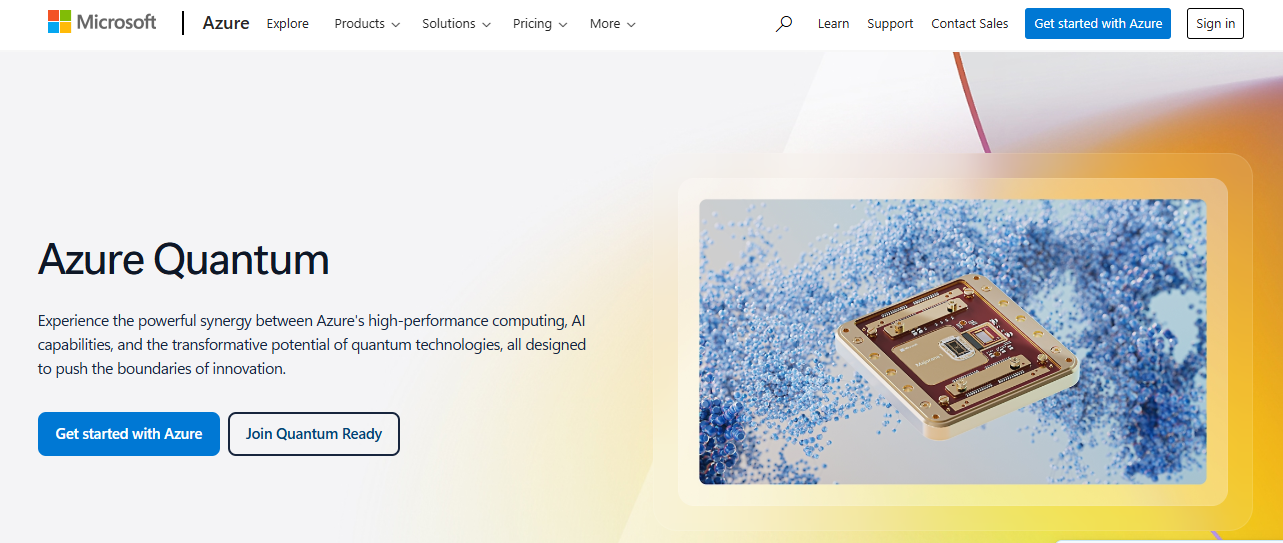
Microsoft Azure Quantum is a cloud-based quantum computing ecosystem hosted on Microsoft Azure infrastructure. It provides access to multiple quantum hardware backends alongside classical and quantum-inspired solvers.
Key capabilities include:
- Support for QAOA and hybrid optimization workflows
- Python-based toolchains compatible with existing data science environments
- Integration with Azure cloud services, including compute, storage, and ML pipelines
- Access to multiple quantum hardware providers through a single cloud interface
Azure Quantum suits enterprise teams already operating within Microsoft infrastructure. Its hybrid optimization support makes it accessible to teams not yet ready for full quantum hardware workflows. Engineering applicability spans logistics, scheduling, and combinatorial design problems.
4. D-Wave Leap Cloud Platform
D-Wave Leap, developed by D-Wave Systems, provides cloud access to quantum annealers alongside hybrid classical-quantum solvers through the Ocean SDK.
Key capabilities include:
- Direct cloud access to D-Wave quantum annealing processors
- Ocean SDK for building and submitting optimization problems in Python
- Hybrid solvers combining quantum annealing with classical optimization for large-scale combinatorial problems
- Pre-built problem structures for scheduling, logistics, and network optimization
D-Wave's annealing architecture is specifically suited to combinatorial optimization problems that can be formulated as quadratic unconstrained binary optimization (QUBO) problems. Engineering applicability is strongest for discrete design space problems, scheduling, and logistics rather than continuous physics-based engineering simulation.
5. QC Ware Forge
QC Ware Forge is an enterprise cloud quantum optimization platform developed by QC Ware. It provides access to multiple quantum hardware backends through a unified cloud interface.
Key capabilities include:
- Multi-backend quantum access, including IBM, IonQ, and D-Wave hardware
- Optimization tools targeting logistics, finance, and combinatorial problem classes
- Enterprise-grade cloud deployment with security and compliance support
- Python SDK for algorithm development and deployment
QC Ware Forge suits enterprise teams running quantum optimization experiments across multiple hardware providers without managing individual provider relationships. Engineering applicability is strongest for logistics, supply chain, and financial portfolio optimization.
6. Xanadu PennyLane Cloud Workflows

PennyLane, developed by Xanadu, is an open-source framework for hybrid quantum-classical optimization using variational algorithms. It supports cloud-based workflow execution across multiple quantum hardware backends.
Key capabilities include:
- Variational quantum algorithms, including VQE and QAOA
- Python integration with machine learning libraries including PyTorch and TensorFlow
- Hardware-agnostic design supporting multiple quantum backends
- Cloud workflow execution for distributed optimization experiments
PennyLane is particularly well-suited to teams integrating quantum optimization with machine learning pipelines. Its differentiable programming model makes it accessible to ML engineers transitioning into quantum optimization research.
7. Google Cirq Cloud Quantum Optimization

Cirq is a quantum circuit simulation and optimization framework developed by Google Quantum AI. It supports quantum optimization experiments using QAOA and integrates with Google Cloud research environments.
Key capabilities include:
- Quantum circuit construction and simulation for NISQ-era hardware
- QAOA implementation for combinatorial optimization problems
- Integration with Google Cloud Compute for large-scale circuit simulation
- Open-source framework with an active research community support
Cirq is primarily a research platform. Engineering applicability is strongest for teams conducting quantum algorithm research rather than deploying production optimization workflows. It integrates well with Google Cloud infrastructure for teams already operating in that environment.
8. Rigetti Quantum Cloud Services

Rigetti Quantum Cloud Services (QCS), developed by Rigetti Computing, provides cloud access to Rigetti's superconducting quantum processors alongside hybrid optimization workflow tools.
Key capabilities include:
- Direct cloud access to Rigetti quantum processors
- Hybrid quantum-classical optimization workflows using the Quil programming environment
- Python SDK for algorithm development and job submission
- Integration with classical HPC resources for hybrid workload management
Rigetti QCS suits research teams and enterprises exploring near-term quantum advantage on optimization problems. Its hybrid workflow support makes it accessible to teams building quantum-classical pipelines for combinatorial and scheduling problems.
What Should You Look For in Cloud Quantum Optimization Software?
Choosing the right platform requires evaluating more than raw quantum capability. Engineering teams need solvers that fit into existing workflows, scale with problem complexity, and meet enterprise security requirements.
Key evaluation criteria include:
- Scalability: the platform must handle large combinatorial design spaces without degrading solution quality as variable count increases
- Cloud compute efficiency: GPU and HPC support determines whether high-fidelity engineering simulations are feasible within practical runtimes
- Integration with engineering tools: compatibility with MATLAB, Python, CAD, and CAE workflows reduces adoption friction and preserves existing team toolchains
- Hybrid optimization algorithm support: pure quantum hardware access is insufficient for most engineering problems; classical-quantum hybrid capability is essential
- API and workflow integration: REST APIs and Python SDKs enable embedding optimization within existing simulation and design pipelines
- Enterprise security: cloud compliance, data sovereignty options, and role-based access control are non-negotiable for aerospace and defense applications
Not every platform serves every problem class. Teams should evaluate against their specific optimization use case, not against general quantum capability benchmarks.
What Are the Benefits of Cloud-Based Quantum Optimization?
Cloud deployment changes the economics and practicality of engineering optimization in ways that algorithm improvements alone cannot.
Key benefits include:
- Elastic compute: workloads scale dynamically with problem size; large design space explorations that exceed on-premise capacity become feasible
- Faster experimentation: parallel optimization trials run simultaneously across cloud nodes, compressing design iteration cycles
- Lower infrastructure cost: no capital expenditure on dedicated HPC hardware; compute cost aligns with actual usage
- Team collaboration: distributed engineering teams access shared optimization environments without site-specific hardware dependencies
- AI and ML pipeline integration: cloud quantum optimization combines naturally with machine learning surrogate models, enabling hybrid physics-AI workflows that on-premise infrastructure cannot support efficiently
These benefits are not theoretical. AI-driven optimization methods applied to aviation operations have demonstrated up to 15% reductions in fuel consumption in reported case studies. Cloud infrastructure is what makes that scale of experimentation economically viable.
How Do Engineering Teams Use Cloud Quantum Optimization?
Cloud quantum optimization is already in active use across engineering domains where problem complexity exceeds classical solver capability.
Representative applications include:
- Aerospace design optimization: running parallel MDO evaluations across aerodynamic, structural, and propulsion disciplines simultaneously on cloud HPC clusters
- Satellite mission planning: optimizing constellation deployment sequences, orbital transfer maneuvers, and station-keeping schedules across large combinatorial variable spaces
- Structural engineering optimization: exploring topology optimization design spaces for lightweight aerospace components that classical solvers cannot navigate within program timelines
- Supply chain optimization: solving large-scale routing, scheduling, and inventory allocation problems using hybrid quantum-classical solvers
- Energy system optimization: optimizing grid dispatch, renewable integration, and storage allocation across complex multi-variable energy network models
Each application shares a common structure. The design space is too large for classical methods to explore exhaustively. The physics or combinatorics are nonconvex. And the compute budget is finite.
What Is the Future of Cloud Quantum Optimization?
The trajectory of cloud quantum optimization is toward broader engineering adoption, deeper AI integration, and more accessible hybrid toolchains.
Several trends are shaping the near-term outlook:
- Hybrid quantum-classical platforms are becoming standard: pure quantum hardware workflows remain limited by qubit count and error rates; hybrid architectures that combine quantum optimization algorithms with classical solvers are the practical path to engineering value
- Increasing enterprise adoption: aerospace, defense, energy, and manufacturing teams are moving from quantum research pilots to production optimization deployments
- AI and ML integration: quantum optimization combined with physics-informed machine learning enables surrogate models that are both faster and more physically accurate than classical alternatives
- GPU acceleration and HPC scaling: quantum-inspired solvers running on GPU clusters are delivering quantum-like performance today, without waiting for fault-tolerant quantum hardware
- More accessible quantum experimentation: cloud platforms are lowering the barrier to quantum optimization experimentation, enabling engineering teams without quantum expertise to run meaningful trials
The competitive advantage will go to engineering teams that build cloud quantum optimization into their workflows now, while the tooling matures around them.
Frequently Asked Questions
1. What is cloud-based quantum optimization software?
Software platforms that run quantum or quantum-inspired optimization algorithms on cloud infrastructure, enabling scalable, elastic compute access without dedicated on-premise hardware.
2. Do cloud quantum optimization platforms require quantum hardware?
No. Most engineering-focused platforms use quantum-inspired algorithms running on cloud HPC and GPU infrastructure, delivering quantum-like performance without physical quantum hardware access.
3. What industries use cloud quantum optimization?
Aerospace, manufacturing, logistics, satellite systems, and energy sectors use cloud quantum optimization for design, scheduling, mission planning, and supply chain problems.
4. Is cloud quantum optimization expensive?
Cost depends on compute usage, platform licensing, and enterprise features. Cloud deployment eliminates upfront HPC capital expenditure, aligning cost with actual optimization workload.
5. What is the difference between quantum and quantum-inspired optimization?
Quantum optimization runs on physical quantum hardware. Quantum-inspired optimization uses quantum-mechanical algorithm principles on classical cloud HPC and GPU infrastructure, delivering comparable performance today.
6. Can cloud quantum optimization integrate with existing engineering tools?
Yes. Platforms like BQP support MATLAB and Python integration. Most platforms provide REST APIs and Python SDKs compatible with standard CAD, CAE, and simulation workflows.
.png)
.png)



.svg)
.svg)
.svg)
.svg)