


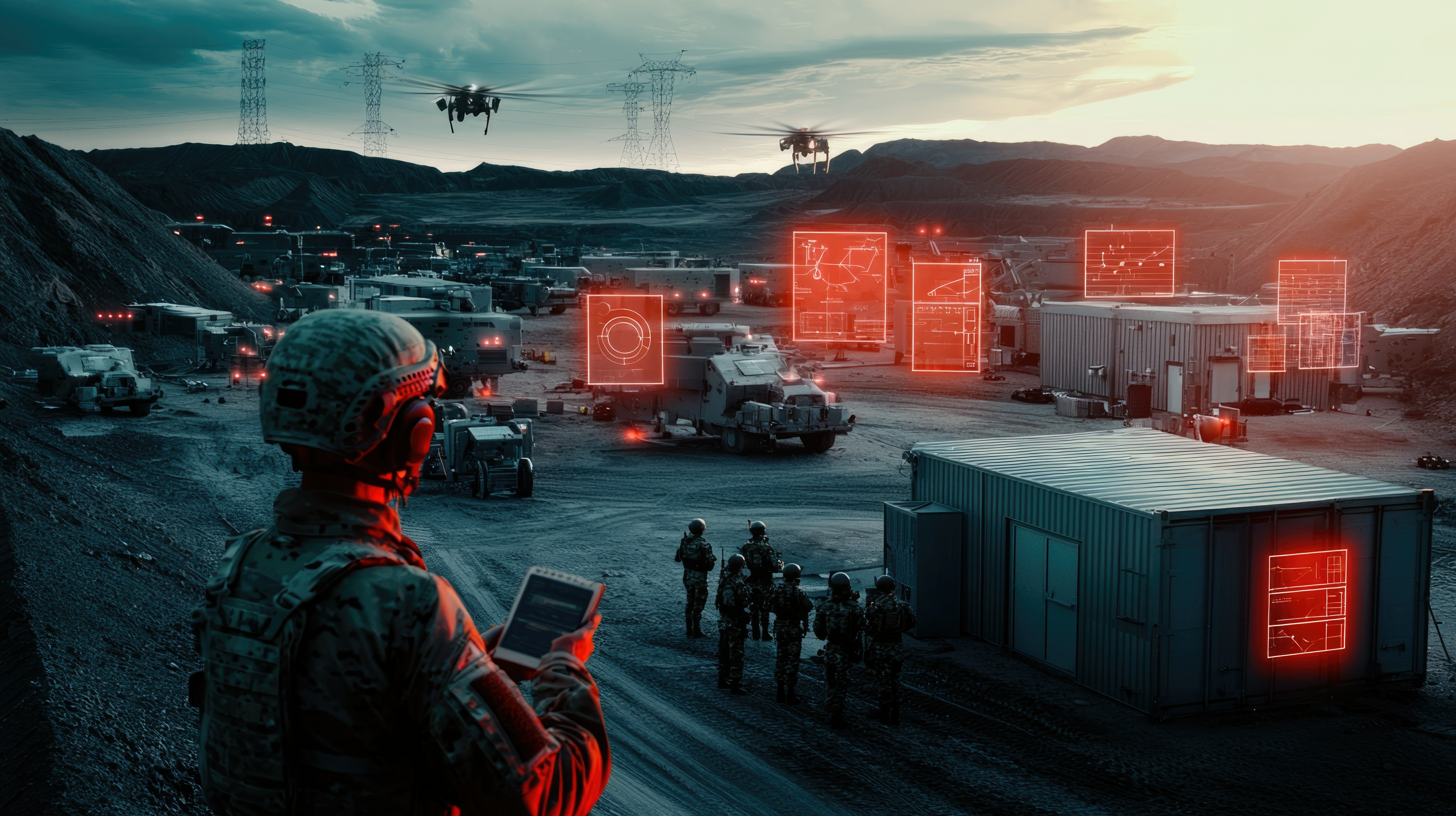

Modern military operations demand supply chains that adapt in real-time to contested environments, dynamic threats, and evolving surge requirements. Legacy logistics planning methods increasingly fail to meet these demands, creating critical mission readiness gaps.
The Global Defense Logistics Market reaches $455.22 billion in 2026, growing at a 9.6% CAGR, driven by AI and advanced supply chain automation.
From spare parts positioning to threat-resilient routing, defense organizations are adopting advanced optimization platforms to ensure mission-critical assets reach the right place at the right time.
This blog covers:
- How AI, quantum-inspired algorithms, and digital tools are reshaping military supply chain operations
- Why legacy planning systems fail in contested, multi-domain battlefield environments
- Which high-impact use cases deliver measurable improvements in mission readiness
- How to measure defense logistics optimization success through mission-critical KPIs
You will learn how to improve defense logistics readiness using quantum-inspired and AI technologies, build resilient supply chains, and adopt mission-ready optimization strategies for modern battlefield demands.
Why Defense Logistics Optimization is Critical for Modern Military Operations
Defense logistics optimization has become a foundational requirement for military readiness, ensuring the right resources reach operational units under increasingly complex, constrained, and contested battlefield conditions.
- Multi-domain operational complexity requires logistics systems that adapt instantly to contested environments where supply corridors face active disruption across land, air, sea, and cyber domains—including optimizing air defense networks that depend on real-time logistics responsiveness.
- Surge demand unpredictability means peacetime consumption models consistently fail when operational tempo escalates, leaving frontline units without critical parts, fuel, or equipment at decisive moments.
- Multi-echelon inventory complexity forces military planners to manage millions of parts across strategic depots, intermediate facilities, and operational units simultaneously and with minimal margin for error.
- Real-time intelligence integration is essential as modern battlefields generate continuous streams of maintenance, geospatial, and threat data requiring immediate logistics decisions, not delayed planning cycles.
- Budget and readiness trade-offs demand optimization tools capable of balancing mission-capable rates, lifecycle costs, and supply chain resilience in parallel, not sequentially.
- Regulatory and audit requirements mean every logistics decision must be fully traceable and explainable under DFARS and ITAR frameworks, ruling out black-box planning methods.
Without structured optimization, these compounding pressures create readiness gaps that directly compromise mission outcomes and personnel safety.
Core Challenges in Defense Logistics Optimization
Structural friction points that prevent existing systems from achieving true optimization.
1.Demand Variability, Obsolescence, and Echelon Complexity
Military demand patterns defy conventional forecasting models. Peacetime consumption rates provide limited insight into operational tempo requirements, while obsolescence cycles for defense systems often span decades. Multi-echelon inventory optimization compounds this complexity—parts must flow efficiently from strategic depots through intermediate facilities to operational units, with each echelon maintaining appropriate stock levels.
2.Fragile Logistics Corridors Under Threat
Modern military operations assume contested logistics environments where supply routes face active disruption. Traditional optimization models assume static transportation networks; reality involves dynamic threat landscapes where primary supply corridors may become unavailable with minimal warning. Optimization systems must simultaneously plan primary logistics flows while maintaining contingency routes.
3.System Silos and Data Latency
Defense logistics operates across interconnected but independently managed systems. Maintenance data resides in one system, supply information in another, operational planning in a third. Integration challenges create information latencies where decisions are made with outdated information, reducing efficiency and potentially compromising mission readiness.
4.Verification, Compliance, and Oversight Demands
Defense logistics operates under strict regulatory frameworks including DFARS and ITAR requirements. Every optimization decision must be auditable and explainable, with full traceability of logic and data sources. Traditional black-box optimization algorithms cannot meet these transparency requirements.
High-Impact Use Cases of Defense Logistics Optimization
Five proven applications where advanced optimization delivers measurable operational improvements.
1.Spares & Multi-Echelon Inventory Optimization
Multi-echelon inventory optimization positions spare parts across the supply chain to maximize equipment availability while minimizing carrying costs. Quantum optimization algorithms enable exploration of vastly larger solution spaces, considering complex interactions between echelon levels, demand uncertainty, and supply constraints. Implementations typically achieve 15-20% improvements in fill rates while reducing inventory investment.
2.Threat-Resilient Routing & Mobility Planning
Supply routing in contested environments—including scenarios involving quantum missile defense coordination—requires algorithms that incorporate dynamic threat assessments, infrastructure vulnerability, and alternative transportation modes. Advanced real-time optimization software continuously evaluates route alternatives based on updated intelligence, automatically triggering contingency plans when primary corridors become untenable. This capability demonstrates 25-30% improvements in supply reliability.
3.Depot Throughput and MRO Scheduling
Maintenance depot optimization coordinates technician availability, parts flow, facility utilization, and equipment priorities to minimize turnaround times. Quantum-inspired scheduling algorithms simultaneously optimize resource allocation across hundreds of maintenance tasks while accounting for skill requirements and operational priorities. Implementations typically achieve 20-25% reductions in maintenance cycle times.
4.Condition-Based Maintenance Integration
Predictive maintenance systems generate massive data streams about equipment health, enabling proactive maintenance scheduling. Advanced optimization platforms integrate condition-based maintenance predictions with supply chain planning, automatically positioning maintenance kits based on predicted failure probabilities. This integration demonstrates 30-35% reductions in unscheduled maintenance.
5.Surge Prepositioning & Contested Theater Resilience
Military operations require rapid deployment capabilities that depend on strategically positioned equipment and supplies. Quantum-inspired algorithms excel at large-scale, multi-scenario optimization problems—from missile fire plan optimization to broad theater prepositioning—simultaneously evaluating thousands of configurations across multiple deployment scenarios. Advanced implementations enable 40-50% improvements in deployment timelines.
Measuring Success: KPIs for Defense Logistics Optimization
Critical metrics that demonstrate optimization impact on mission readiness and operational efficiency.
1. Readiness Metrics
- Mission-capable rates: Percentage of equipment operationally ready at any given time. Effective optimization of spare parts positioning and maintenance scheduling typically delivers 10–15% improvement.
- Fill rates: Ability to satisfy supply requests immediately from available inventory, without expedited or emergency action.
- Mean Time to Repair (MTTR): Measures maintenance turnaround efficiency for critical systems; lower MTTR directly translates to higher operational availability.
2. Resilience and Risk Measures
- Time-to-recover: How quickly logistics systems restore normal operations after disruption. Advanced optimization with built-in contingency planning typically achieves 25–30% improvement in recovery speed.
- Mission preservation rate: Tracks the ability to sustain operational capability across various degradation scenarios, from supply route denial to depot throughput reduction.
3. Efficiency and Cost Metrics
- Carrying cost percentage: Measures inventory investment relative to throughput; quantum-inspired optimization typically delivers 15–20% cost reduction while maintaining or improving service levels.
- Expedited freight percentage: Frequency of emergency supply actions; a high rate signals planning failures upstream. Effective optimization drives this metric down consistently.
- Utilization rates: Resource efficiency across facilities, transportation assets, and maintenance depots—achievable through structured fleet management optimization bqp approaches; under-utilization and over-utilization both indicate optimization gaps.
4. Compliance and Explainability
- Audit trail completeness: Ability to document and retrieve full decision logic and data sources for DFARS and ITAR regulatory review.
Optimization transparency: Degree to which algorithmic recommendations can be explained, reviewed, and approved by logistics commanders without requiring technical expertise.
Key Technologies Powering Defense Logistics Optimization
Modern defense logistics optimization is built on a convergence of advanced technologies that enable faster, smarter, and more resilient supply chain decisions across every echelon of military operations.
1. AI and Machine Learning
AI-driven forecasting models analyze historical consumption patterns, operational tempo data, and supplier performance to predict demand with up to 85% accuracy. Machine learning continuously refines these models as new operational data flows in, reducing the gap between planning assumptions and battlefield reality.
2. Digital Twins and High-Fidelity Simulation
Digital twin platforms replicate entire logistics networks in a virtual environment, enabling planners to simulate disruption scenarios, test routing alternatives, and validate prepositioning strategies before committing resources in the field. This capability is central to shifting from reactive to proactive logistics management.
3. Quantum-Inspired Optimization
Where classical solvers struggle with the scale and combinatorial complexity of military logistics, quantum algorithms defence optimization approaches explore vastly larger solution spaces simultaneously—solving problems that would take conventional methods hours. This enables real-time multi-objective decisions across inventory allocation, threat-resilient routing, and maintenance scheduling.
4. Real-Time Data Fusion
Integrating ERP systems, IoT sensor networks, geospatial intelligence feeds, and threat assessments into a unified operational picture enables real-time optimization software to respond instantly when supply conditions, routes, or mission priorities change—a foundation for capabilities like faster interceptions smarter control that depend on low-latency logistics decisions.
5. Condition-Based Maintenance (CBM) Platforms
CBM systems analyze sensor data to forecast equipment failure probabilities. When tightly integrated with supply chain planning, they automatically position maintenance kits ahead of predicted failures, reducing unscheduled maintenance downtime by 30–35%.
6. BQP's Hybrid Solver Architecture
BQP's quantum optimization software combines classical operations research, reinforcement learning, and quantum-inspired algorithms into a single unified Quantum Optimization solution platform. This hybrid architecture solves complex defense logistics problems up to 15x faster than conventional approaches, without disrupting existing enterprise workflows.
Full decision explainability ensures every optimization recommendation meets DFARS and ITAR compliance requirements out of the box.
Implementation Blueprint for Defense Adoption
A phased approach to deploying quantum-inspired optimization with minimal risk and maximum impact.
Phase 1: Pilot on a Focused Use Case
Initial deployment focuses on a specific logistics domain such as spare parts inventory optimization for a single weapon system or supply route optimization for a particular theater of operations. This approach enables validation of BQP's capabilities while minimizing implementation risk.
Pilot programs typically demonstrate measurable improvements within 90 days, providing the foundation for broader organizational adoption.
Phase 2: Fuse Data Sources
Data integration expands to include Enterprise Resource Planning systems, maintenance databases, threat intelligence feeds, and operational planning systems. This phase establishes the comprehensive data foundation required for enterprise-scale optimization.
Successful data fusion enables cross-functional optimization that addresses interdependencies between logistics domains.
Phase 3: Expand Logistics Domains
Optimization capabilities extend across multiple logistics functions including inventory management, transportation planning, maintenance scheduling, and facility utilization. This phase realizes the full potential of integrated logistics optimization.
Multi-domain optimization typically achieves significantly greater improvements than single-function approaches through better coordination and resource sharing.
Phase 4: Establish Continuous Optimization and Alerting Loops
Final implementation phase establishes autonomous optimization capabilities that continuously adapt to changing conditions and automatically alert decision-makers to significant changes requiring attention.
Continuous optimization ensures that logistics systems maintain peak efficiency even as operational conditions evolve.
Why Simulation-Driven Platforms are the Future of Defense Logistics Optimization
Traditional optimization tools generate single-scenario plans that break down the moment operational conditions diverge from assumptions. Simulation-driven platforms take a fundamentally different approach: they continuously generate, stress-test, and validate logistics decisions across thousands of scenarios simultaneously, before any real-world commitment is made.
This shift matters because Modern military logistics failures are rarely caused by a lack of data. They occur when planning systems cannot process complexity fast enough to keep pace with evolving threats, route denials, and surge demands—challenges that extend from ground operations to space command and control environments.
Why simulation-driven approaches define the next generation of defense logistics optimization:
- Stress-tested decision-making - Planners simulate port denial, transport bottlenecks, and supplier failures in advance, enabling proactive response protocols rather than improvised reactions.
- Multi-scenario prepositioning - Quantum-inspired simulation evaluates thousands of prepositioning configurations across multiple deployment scenarios simultaneously, achieving up to 40–50% improvements in deployment timelines.
- Continuous autonomous adaptation - Unlike static planning tools, simulation-driven platforms continuously update logistics recommendations as real-world conditions evolve, maintaining peak readiness without requiring manual re-planning cycles.
- Auditable scenario outputs - Every simulated outcome carries full decision traceability, supporting regulatory compliance while accelerating command-level approval workflows.
Leading quantum computing companies are already embedding simulation-driven optimization into defense logistics workflows.
BQP's platform exemplifies this direction, combining high-fidelity simulation with advanced quantum optimization algorithms to deliver logistics recommendations that are operationally robust, fully explainable, and ready for real-world deployment.
For defense organizations, this is no longer a future capability. Simulation-driven optimization is the current operational standard for mission readiness.
Conclusion: Enabling Mission Success with Smarter Logistics
Defense logistics optimization is no longer a back-office efficiency initiative. It is a direct determinant of mission success, personnel safety, and strategic advantage. As military operations grow more complex, contested, and data-intensive, the gap between organizations using advanced optimization and those relying on legacy methods will widen rapidly.
The convergence of AI, quantum-inspired algorithms, digital twins, and real-time data fusion is redefining what is achievable in military supply chain management. Organizations that adopt simulation-driven, explainable optimization platforms today will define tomorrow's operational standards.
Key reasons to act now:
- Legacy planning systems cannot scale to the combinatorial complexity of modern multi-domain operations
- Simulation-driven platforms shift logistics from reactive firefighting to proactive, mission-ready decision-making
- Explainable AI ensures every optimization recommendation meets DFARS and ITAR compliance without added overhead
- Quantum-inspired approaches deliver measurable, auditable improvements across readiness, cost, and resilience metrics
BQP's quantum-inspired optimization platform delivers the speed, intelligence, and auditability that modern defense logistics demands. Through hybrid solver architecture, threat-aware planning, and full decision transparency, BQP enables logistics leaders to move from reactive planning to mission-ready operations, at scale, under pressure, and in compliance.
The future of defense logistics belongs to those who optimize it intelligently.
Ready to enable resilient, mission-ready logistics optimization?
Book a demo to explore how BQP's quantum-inspired platform can transform your defense logistics operations with measurable improvements in readiness, efficiency, and resilience.
Frequently Asked Questions
1. What is defense logistics optimization, and why is it important?
Defense logistics optimization is the structured process of planning, allocating, and managing military resources, including vehicles, supplies, parts, and personnel—areas covered in depth through military fleet optimization—to maximize mission readiness, reduce operational costs, and ensure supply chain resilience in dynamic, contested environments.
2. How does AI improve defense logistics optimization?
AI improves defense logistics by forecasting component maintenance needs with up to 85% accuracy, analyzing supply chain data for smarter procurement decisions, and delivering real-time visibility across complex, multi-echelon logistics networks, shifting operations from reactive to proactive.
3. What is quantum-inspired optimization in defense logistics?
Quantum-inspired optimization applies mathematical principles derived from quantum computing to solve large-scale, complex logistics challenges such as multi-echelon inventory positioning, threat-resilient routing, and surge prepositioning, faster and more accurately than classical algorithms, without requiring physical quantum computers.
4. What are the key use cases of defense logistics optimization?
Key use cases include spare parts and multi-echelon inventory optimization, threat-resilient supply routing, depot throughput and MRO scheduling, condition-based maintenance integration, and surge prepositioning for contested theater operations.
5. How do you measure success in defense logistics optimization?
Success is measured through readiness metrics (mission-capable rates, fill rates, MTTR), resilience indicators (time-to-recover, mission preservation), efficiency metrics (carrying costs, expedited freight rates, utilization), and compliance indicators (audit trail completeness, optimization transparency).
6. What should organizations look for in logistics optimization software?
Organizations should prioritize platforms offering hybrid solver architectures that combine AI, classical OR, and quantum-inspired methods; real-time data fusion across ERP, maintenance, and intelligence systems; full decision explainability for regulatory compliance; and simulation-driven scenario testing built for contested environment planning.
.png)
.png)


.svg)
.svg)
.svg)
.svg)