



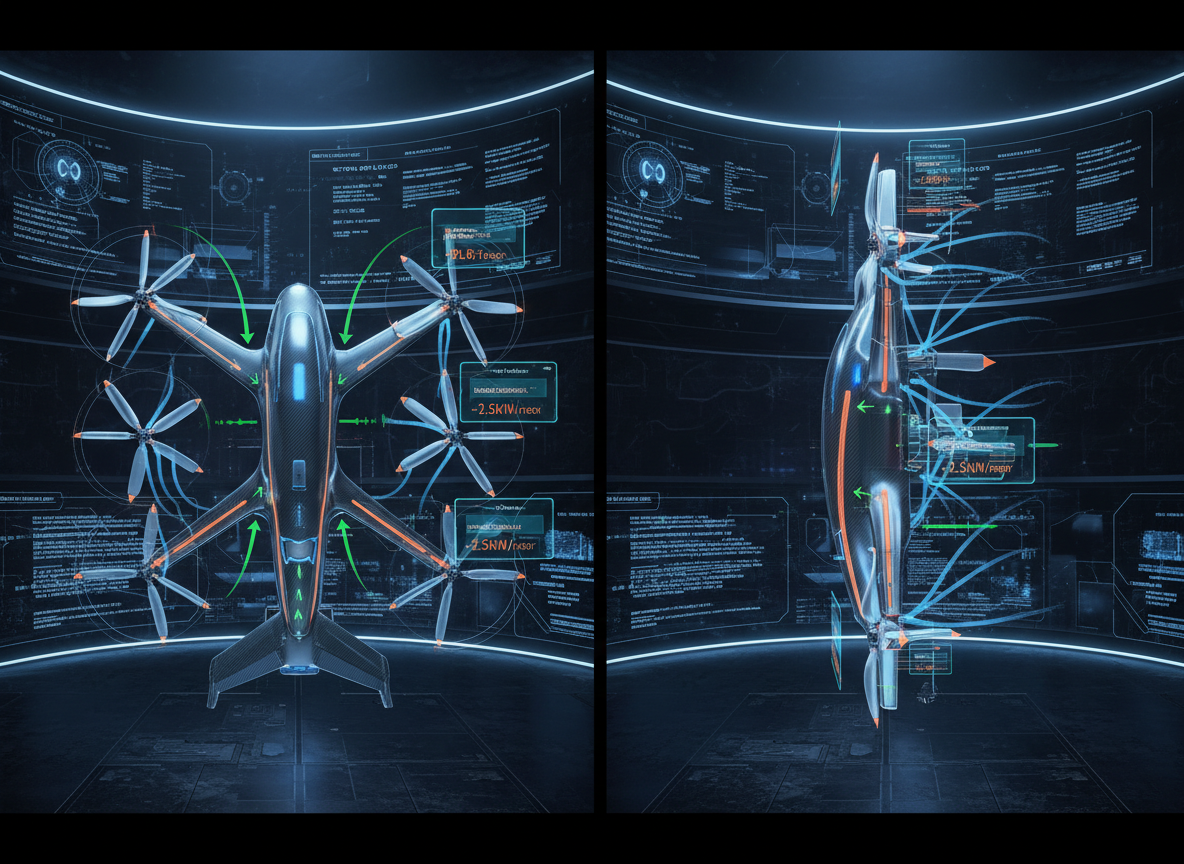

Rotor layout determines whether an eVTOL meets power budgets, certification noise limits, and mission range simultaneously.
Most layout failures originate in the optimization phase, not the manufacturing phase. Constraint misidentification of early compounds into unfixable trade-offs later.
Getting layout right requires more than solver selection.
You will learn about:
- How rotor interference, disk loading, and forward flight asymmetry constrain the design envelope
- Three optimization methods with step-by-step execution workflows for rotor layout problems
- Key metrics that determine whether an optimized layout is operationally viable
Execution details apply directly to multirotor, lift+cruise, and tilt-rotor configurations.
What are the Limitations of eVTOL Rotor Layout Performance?
Effective rotor layout optimization begins by isolating the constraints that most directly govern hover efficiency, forward flight range, and power consumption.
1. Rotor Interference
Aerodynamic interference occurs when overlapping rotor wakes reduce effective lift and generate complex turbulence across adjacent rotors.
This limits how tightly rotors can be spaced, directly restricting layout density and hover performance in compact configurations.
2. Disk Loading
Disk loading is total aircraft weight divided by the combined rotor swept area. Distributed propulsion with multiple smaller rotors increases this value significantly.
Higher disk loading raises power requirements and reduces hover efficiency, constraining payload capacity and operational range.
3. Forward Flight Asymmetry
In forward flight, the advancing blade encounters compressibility effects while the retreating blade experiences flow separation, creating aerodynamic asymmetry.
At advance ratios above 1, the reverse flow region on retreating blades expands, sharply limiting cruise efficiency and mission duration.
4. Tip Speed Constraints
Mach tip speed must be maintained between 0.35 and 0.6 to avoid compressibility-induced shock and associated noise penalties.
This directly constrains rotor diameter and rotational speed choices, forcing trade-offs between hover power and cruise performance in the optimizer.
These four constraints define the feasible design envelope within which any rotor layout solution must operate.
What Are the Optimization Methods for eVTOL Rotor Layout?
Three methods address the high-dimensional, multi-objective nature of rotor layout problems across different fidelity and configuration requirements.
Method 1: Quantum Inspired Optimization Using BQP
BQP applies quantum mathematical principles, including superposition-inspired search and quantum-inspired evolutionary optimization, to classical HPC infrastructure.
For rotor layout, BQP explores the full configuration space covering rotor positions, counts, diameters, and tilt angles while simultaneously evaluating aerodynamic and structural trade-offs.
It performs best in eVTOL layout problems involving more than 50 design iterations, coupled multi-objective objectives like weight distribution and energy management, and non-smooth search spaces.
Step by Step Execution for This Component Using BQP
Step 1: Define Rotor Layout Design Variables
Specify genes representing rotor positions, diameters, tilt angles, and count within aerodynamic and structural feasibility constraints.
Step 2: Initialize Quantum-Inspired Population
Generate the initial chromosome population using superposition-inspired random and low-discrepancy sequences to maximize early design space coverage.
Step 3: Evaluate Aero-Propulsive Fitness Function
Compute hover power, cruise efficiency, and energy consumption objectives using aerodynamic simulations for each candidate layout.
Step 4: Apply Quantum Evolutionary Operators
Execute elitism at 10%, crossover at 20%, and mutation at 40% on selected population samples to drive exploration without premature convergence.
Step 5: Update Population via Gate Rotation
Rotate qubit angles dynamically using PSO-based angle updates to refocus search toward high-fitness layout regions.
Step 6: Converge on Optimal Rotor Configuration
Iterate until fitness values stabilize, then extract the rotor layout configuration with the best aerodynamic and energy performance.
Practical Constraints and Failure Modes with BQP
High-dimensional rotor layout spaces risk local optima trapping without a hybrid gradient refinement stage applied after initial quantum-inspired convergence.
Aerodynamic simulation overhead per candidate evaluation increases computational load significantly; population sizing must be balanced against available HPC capacity.
Method 2: Genetic Algorithm Optimization
Genetic algorithms evolve a population of candidate rotor layouts through selection, crossover, and mutation to generate multi-objective Pareto fronts.
GA fits eVTOL rotor layout because it handles discrete variables like rotor count and non-smooth objective surfaces, balancing energy consumption against mission time across configurations.
It performs best in lift+cruise and multirotor screening problems with trip distances of 80 to 150 km, where NSGA-II multi-objective sorting efficiently surfaces viable design families.
Step by Step Execution for This Component Using Genetic Algorithm Optimization
Step 1: Encode Rotor Layout Chromosomes
Represent rotor radius, position coordinates, and rotor count as genes within each individual design candidate.
Step 2: Generate Constrained Initial Population
Initialize 20 to 50 layout designs using constrained random sampling to ensure early population diversity across configuration types.
Step 3: Simulate Mission-Level Fitness
Evaluate energy consumption and mission time for each layout through aerodynamic sizing models covering hover, transition, and cruise phases.
Step 4: Apply Non-Dominated Fitness Sorting
Select parent designs using non-dominated sorting to maintain Pareto-optimal layout candidates across competing energy and time objectives.
Step 5: Execute Crossover and Gene Perturbation
Apply single-point crossover at 0.5 probability and gene-level mutation at 0.5 probability to generate varied offspring layouts.
Step 6: Evolve Across Generation Cycles
Iterate across 50 to 200 generations until the Pareto front stabilizes and no further improvement in layout fitness is observed.
Practical Constraints and Failure Modes
GA slows substantially in high-dimensional layout spaces, and clustered initialization reduces population diversity, increasing the risk of premature convergence.
Discrete rotor count variables limit continuous exploration; insufficient mutation rates cause the population to collapse into a narrow configuration band before global optima are identified.
Method 3: Gradient-Based MDO
Gradient-based multidisciplinary design optimization applies automatic differentiation to compute local sensitivities across coupled aero, structural, propulsion, and acoustic subsystems.
It applies to eVTOL rotor layout by enabling sensitivity-driven updates on blade parameters, battery energy, and tip speed within a tightly coupled multiphysics framework.
It performs best in tilt-rotor configurations where detailed noise and range trade-offs require high-fidelity Pareto evaluation, achieving up to 3.1% range gain with full acoustic modeling.
Step by Step Execution for This Component Using Gradient-Based MDO
Step 1: Integrate Multiphysics Subsystem Models
Couple low-fidelity aerodynamic, structural, propulsion, and acoustic tools into a unified MDO framework for rotor layout evaluation.
Step 2: Define Mission-Constrained Objective Functions
Formulate hover and cruise power, range, and noise level as objective functions with explicit tip Mach and power margin constraints.
Step 3: Compute Auto-Differentiated Sensitivities
Use automatic differentiation to calculate gradients of all objectives with respect to payload, battery energy density, and rotor tip speed.
Step 4: Update Layout Variables via Gradient Descent
Apply gradient descent or method of moving asymptotes to update rotor geometry variables toward locally optimal configurations.
Step 5: Enforce Constraint Boundary Compliance
Check each updated design against tip Mach limits between 0.35 and 0.6, voltage margins, and battery power constraints before accepting the update.
Step 6: Iterate to Multi-Point Pareto Front
Evaluate multiple design starting points until a viable range-noise Pareto front is populated with certified constraint-compliant layouts.
Practical Constraints and Failure Modes
Gradient-based MDO is highly sensitive to initialization; non-convex rotor layout spaces frequently trap the optimizer in local minima far from the global optimum.
Intermediate-fidelity acoustic models lack full physics representation, and without a hybrid evolutionary outer loop, the method systematically misses multimodal design regions.
Key Metrics to Track During eVTOL Rotor Layout Optimization
Power Consumption
Power consumption measures total energy use across hover, transition, and cruise phases for a given rotor layout configuration.
It governs battery sizing, operational range, and endurance limits, making it the dominant design driver in battery-constrained eVTOL architectures.
Aerodynamic Efficiency
Aerodynamic efficiency tracks the combined propulsive efficiency, lift-to-drag ratio, and disk loading across the full mission profile.
Optimized layout has demonstrated up to 14% improvement in the combined efficiency metric, directly determining the viability of hover versus cruise performance trade-offs.
Noise Levels
Noise levels quantify tonal and broadband acoustic emissions produced by rotor tip speed, blade passing frequency, and rotor wake interactions.
Urban air mobility certification and community acceptance require explicit noise constraints in the optimization loop, as tip speed alone is insufficient as a noise proxy.
Together, these three metrics determine whether an optimized rotor layout is operationally deployable or remains a simulation artifact.
Frequently Asked Questions About eVTOL Rotor Layout Optimization
How does rotor interference affect eVTOL layout optimization outcomes?
Rotor interference reduces effective lift and creates turbulence between adjacent rotors in close proximity. This forces the optimizer to enforce minimum spacing constraints that significantly narrow the feasible layout space.
Why does disk loading matter more in eVTOLs than in conventional helicopters?
eVTOLs use multiple smaller rotors instead of a single large rotor, which raises disk loading for the same aircraft weight. Higher disk loading directly increases power draw and reduces hover efficiency.
When should gradient-based MDO be used instead of genetic algorithms for rotor layout?
Gradient-based MDO is appropriate when the design problem is tightly constrained around a known configuration and acoustic or range sensitivity analysis is the primary objective.
What makes quantum-inspired optimization better suited for high-dimensional rotor layout problems?
Classical methods struggle when rotor positions, diameters, tilt angles, and counts are optimized simultaneously as coupled variables across aerodynamic and structural objectives.
.png)
.png)


.svg)
.svg)
.svg)
.svg)