



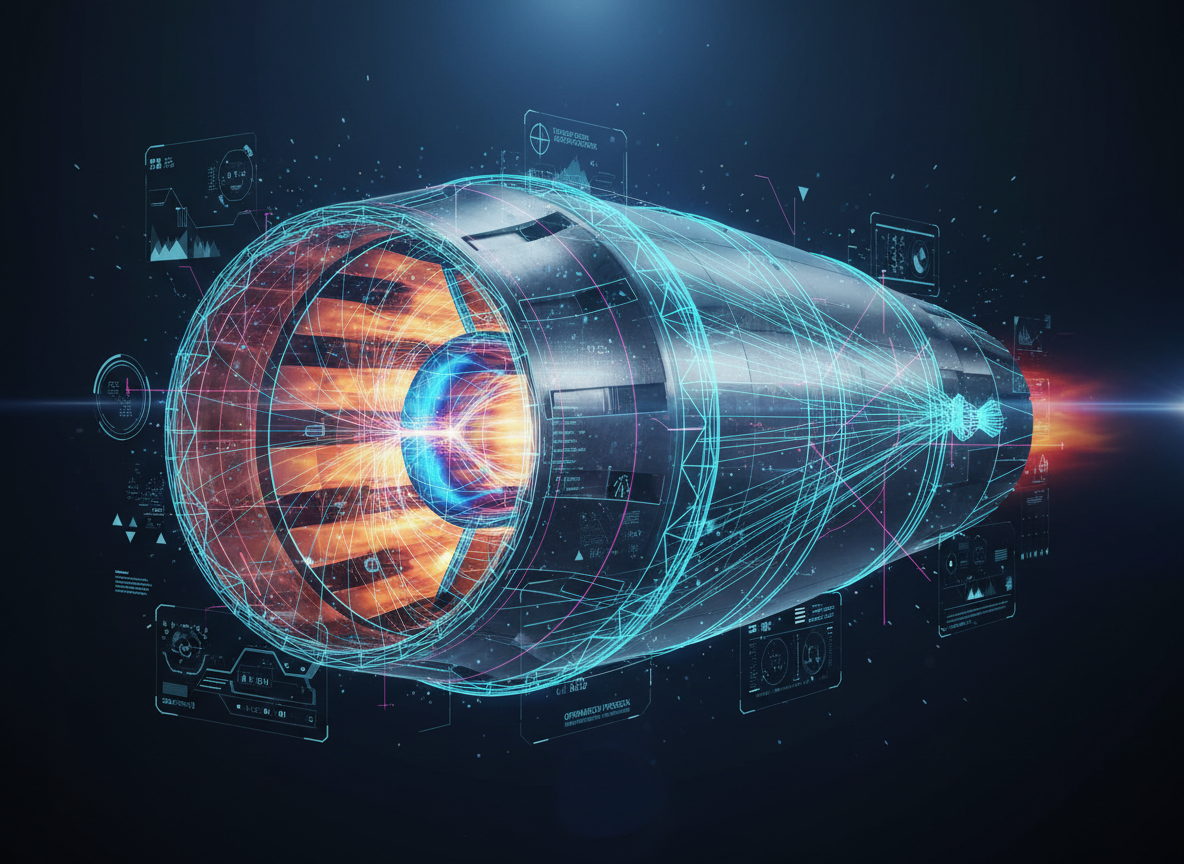

Convergent-divergent nozzles generate more thrust than convergent designs, but installation changes everything.
Installed nozzle settings differ from uninstalled ones because aerodynamic drag interacts directly with the propulsion system. Afterbody drag alone accounts for up to 15% of total aircraft drag.
Optimization is not about isolated nozzle performance — it requires integrated aerospace optimization techniques that account for the full installed system.
You will learn about:
- How expansion mismatches, afterbody drag, thermal limits, and geometry constraints define the feasible nozzle design space
- How Quantum Inspired Optimization using BQP, CFD-based shape optimization, and Genetic Algorithm methods are applied to nozzle optimization
- Step-by-step execution workflows and practical failure modes for each method
Execution decisions at each stage determine whether optimization delivers measurable thrust and drag improvements.
What are the Limitations of Fighter Engine Nozzle Performance?
Nozzle optimization begins by identifying which constraints dominate the design space and restrict achievable performance.
1. Nozzle Expansion Mismatch
Over-expansion occurs when exit pressure drops below ambient, causing flow separation and losses that exceed those from under-expansion. Under-expansion reduces thrust potential and worsens with increasing Mach number.
Variable geometry becomes necessary above Mach 1.5 to manage pressure ratio variations across the flight envelope.
2. Aerodynamic Drag
Afterbody drag decreases as jet pressure ratio increases in both subsonic and supersonic regimes, but it varies significantly with nozzle area ratio. Drag rises then falls as area ratio increases through over-expanded and fully expanded conditions.
Shock waves forming on external flaps at supersonic speeds further complicate drag management during area ratio selection.
3. Thermal Management
Cooling flow is required across the nozzle surface; longer divergence sections demand more cooling, which trades directly against expansion efficiency — a thermal-propulsion trade-off also encountered in rocket fuel optimization. Shorter nozzles reduce surface temperature, skin friction, and structural weight.
The TF-30 in the F-14A is a confirmed case where cooling constraints limited the achievable area ratio.
4. Weight and Geometry
Two-dimensional high-aspect-ratio nozzles required for stealth configurations are longer, heavier, and carry measurable performance penalties. Managing these trade-offs demands dedicated structural optimization software, as fixed factors such as exit aspect ratio, axial length, and vertical offset in serpentine nozzles constrain design freedom further.
These four constraints define the feasible design envelope within which any optimization method must operate — a boundary condition central to design optimization in engineering.
What Are the Optimization Methods for Fighter Engine Nozzle?
Three methods, each representing a distinct class of engineering optimization software, address fighter nozzle optimization at different levels of computational complexity and design fidelity.
Method 1: Quantum Inspired Optimization Using BQP
BQP applies quantum-inspired optimization algorithms to classical HPC infrastructure, enabling high-dimensional optimization without requiring quantum hardware.
For fighter nozzle optimization, QIO aero applications within BQP encode geometric and aerodynamic parameters as combinatorial variables and search the design space with quantum-inspired efficiency unavailable to classical gradient methods.
BQP fits best for multi-objective optimization when nozzle problems involve multiple competing constraints — expansion ratio, drag, cooling, and geometry running simultaneously across a wide Mach envelope.
Step by Step Execution for This Component Using BQP
Step 1: Encode Nozzle Design Variables as QUBO
Translate throat area, divergence angle, area ratio, and cooling flow parameters into a Quadratic Unconstrained Binary Optimization formulation.
Step 2: Define Multi-Objective Constraint Set
Specify thrust coefficient targets, drag limits, thermal bounds, and geometry restrictions as constraint weights within the QUBO problem structure.
Step 3: Run Quantum-Inspired Annealing on Classical HPC
Execute the quantum-inspired optimization solver across the encoded design space, allowing parallel exploration of configurations infeasible for sequential classical search.
Step 4: Extract Pareto-Optimal Candidate Designs
Identify candidate nozzle configurations that satisfy competing constraints without sacrificing thrust for drag reduction or thermal margin.
Step 5: Validate Candidates Through High-Fidelity CFD
Pass shortlisted configurations into CFD simulation as part of a simulation-driven optimization loop to verify thrust coefficient and drag behavior under installed flight conditions.
Step 6: Refine Final Configuration and Lock Geometry
Apply results from CFD validation to tighten the design to its optimal area ratio, divergence angle, and cooling flow allocation.
Practical Constraints and Failure Modes with BQP
No public benchmark data exists for BQP applied directly to fighter engine nozzles; current evidence comes from airfoil and combustion optimization applications.
These are characteristic quantum optimization problems where QUBO formulation quality determines solution accuracy. Poorly weighted constraints can produce candidates that optimize one parameter while violating thermal or geometry limits.
Method 2: CFD-Based Shape Optimization
CFD-based shape optimization uses adjoint methods and finite difference sensitivity analysis to iteratively deform nozzle and afterbody geometry toward improved propulsive performance.
It fits fighter nozzles because it captures the interaction between exhaust flow, external afterbody shape, and installed dragfactors that isolated nozzle analysis cannot resolve.
This method performs best when installed performance integration, low-boom characteristics, or near-field pressure management are primary design objectives.
Step by Step Execution for This Component Using CFD-Based Shape Optimization
Step 1: Build CAD Model of Nozzle and Afterbody
Define the complete geometric model including nozzle internal flowpath, external flaps, and aft-body contour for integrated aerodynamic analysis.
Step 2: Set Thrust and Drag Objectives With Geometry Constraints
Specify optimization targetsnet thrust, afterbody drag coefficient and constrain exit aspect ratio, axial length, and structural bounds.
Step 3: Compute Shape Sensitivities via Adjoint or Finite Differences
Calculate how each geometric parameter affects thrust and drag using adjoint solver or finite difference perturbations to guide deformation direction.
Step 4: Iteratively Deform Geometry on Adapted Mesh
Apply shape deformation to the CAD and CFD mesh, refining grid resolution around viscous features and shock locations as geometry changes.
Step 5: Evaluate Near-Field Compression and Expansion Behavior
Assess how each iterated shape manages over-expansion, underexpansion, and shock formation on external flaps under target Mach conditions.
Step 6: Refine for Propulsion-Airframe Integration
Finalize geometry balancing low-boom pressure attenuation, propulsive efficiency, and installed afterbody drag within the full aircraft configuration.
Practical Constraints and Failure Modes
Integrating detailed CAD into adjoint workflows is technically demanding; high geometric dimensionality slows convergence and increases setup time significantly.
Mesh adaptation for viscous features and deformed grids adds computational cost. Poorly adapted grids introduce numerical error that corrupts sensitivity calculations.
Method 3: Genetic Algorithm Optimization
Genetic algorithms search nozzle design spaces by evolving populations of candidate geometries through selection, crossover, and mutation without requiring gradient information.
GA applies directly to fighter nozzles because throat diameter, convergence angle, divergence angle, and exit area are discrete parametric variables well-suited to population-based search. When combined with adjoint refinement, GA has demonstrated thrust coefficient of 0.9615 and thrust increase of 3.6%.
GA performs best for parametric nozzle geometry problems where the design space is discontinuous or where multiple local optima exist across the area ratio range.
Step by Step Execution for This Component Using Genetic Algorithm Optimization
Step 1: Select Parametric Design Variables
Define throat diameter, convergence angle, divergence angle, and exit area ratio as the optimizable parameters spanning the target design space.
Step 2: Build Design of Experiments Using Taguchi L9 Array
Structure an initial population using a three-level Taguchi L9 array to systematically cover the parameter space with minimum CFD evaluations.
Step 3: Run CFD Simulation for Each Design Candidate
Evaluate thrust coefficient and exit Mach number for each population member through CFD to generate the fitness landscape.
Step 4: Score Fitness Against Thrust Coefficient and Flow Targets
Rank designs by thrust coefficient performance and flow uniformity, filtering candidates that violate thermal or geometry constraints.
Step 5: Evolve Population Through Selection and Crossover
Apply genetic operators to create a new generation of nozzle designs, combining high-fitness traits and introducing controlled parameter variation.
Step 6: Converge on Optimal Geometry Parameters
Continue evolution until the population convergesvalidated examples include throat diameter of 0.304 m, 28° convergence angle, and 20° divergence angle.
Practical Constraints and Failure Modes
High-dimensional parameter spaces demand surrogate models; running full CFD on every generation becomes computationally prohibitive without them.
Small population sizes increase the risk of converging on local optima rather than the global optimum across the area ratio design space.
Key Metrics to Track During Fighter Engine Nozzle Optimization
Thrust Performance
Thrust performance measures gross and net thrust output, thrust coefficient, and exit Mach number across the nozzle operating range.
It matters because nozzle thrust accounts for approximately 20% of total engine thrust, making coefficient losses directly measurable against propulsive efficiency targets.
Drag Coefficient
Drag coefficient tracks afterbody drag and jet-induced drag as functions of area ratio and pressure ratio across subsonic and supersonic conditions.
Installed drag is the primary differentiator between uninstalled and installed nozzle performance afterbody drag alone reaches up to 15% of total aircraft drag.
Expansion Efficiency
Expansion efficiency captures area ratio accuracy, exit pressure recovery, and alignment between nozzle geometry and ambient pressure at each Mach condition.
It determines the feasible Mach range for a fixed or variable geometry nozzle, directly constraining how broadly a design can operate.
Tracking all three metrics together determines whether the optimized nozzle configuration is viable across the full operational envelope.
Frequently Asked Questions About Fighter Engine Nozzle Optimization
What is the difference between installed and uninstalled nozzle optimization?
Uninstalled optimization evaluates nozzle performance in isolation thrust, expansion ratio, pressure recovery without accounting for the aircraft body. Installed optimization includes afterbody drag and aerodynamic interactions that shift the optimal nozzle area ratio and geometry.
Why does variable geometry become necessary above Mach 1.5?
Pressure ratio across the nozzle changes significantly with Mach number. Fixed geometry cannot maintain proper expansion across the full flight envelope. Above Mach 1.5, pressure ratio variations create over-expansion or under-expansion losses severe enough to warrant the added weight and complexity of variable geometry systems.
How does thermal management constrain nozzle area ratio selection?
Longer divergence sections require more cooling flow to maintain structural integrity. That cooling flow is traded against expansion efficiencymore cooling means less useful thrust. The TF-30 engine in the F-14A is a documented case where cooling requirements directly limited the maximum achievable area ratio.
Where does Genetic Algorithm optimization outperform CFD adjoint methods for nozzles?
Adjoint methods rely on gradient information, which becomes unreliable in discontinuous or highly non-linear design spaces. Genetic algorithms explore the design space without gradients, making them effective when multiple viable optimas exist across the area ratio range.
.png)
.png)

.svg)
.svg)
.svg)
.svg)