





Modern engineering systems rarely optimize for a single variable. Engineers must simultaneously balance competing objectives, including cost, performance, reliability, energy consumption, and structural weight across increasingly complex design spaces.
The multi-cloud optimization tool market, encompassing multi-objective optimization tools, is projected to reach $3.5 billion by 2026, reflecting growing demand across engineering sectors.
Traditional single-objective approaches cannot handle this complexity. Engineering optimization software enables engineers to evaluate thousands of design alternatives and identify optimal solutions systematically.
Real-world engineering challenges span every industry:
- Aerospace design must balance fuel efficiency, payload capacity, and structural safety.
- Manufacturing systems must optimize throughput, energy usage, and production quality simultaneously.
- Energy systems must manage generation efficiency, emissions output, and operational cost.
- Logistics networks must balance delivery speed, routing efficiency, and fuel consumption.
You will learn how to improve engineering design decisions by identifying which multi-objective optimization software platforms best fit your specific use case and technical workflow requirements.
A Quick Comparison: Multi-Objective Optimization Software Platforms
Why Multi-Objective Optimization Is Critical for Modern Engineering
Engineering design is inherently multi-dimensional. Every real-world system involves conflicting objectives that cannot all be optimized simultaneously without structured trade-off analysis.
Consider the practical reality: an aerospace engineer cannot maximize fuel efficiency without accounting for payload capacity, structural integrity, and safety margins.
These are not isolated variables. They are interconnected constraints that shift in relation to one another. Optimizing for one frequently worsens another, which is precisely why single-objective methods are insufficient for design optimization in engineering.
Industries where multi-objective optimization plays a critical role include:
- Aerospace Engineering - Balancing payload capacity, fuel efficiency, and structural integrity across aircraft and spacecraft systems. Every kilogram and joule carries a significant mission impact, making systematic trade-off analysis essential
- Manufacturing Systems - Optimizing production throughput, energy consumption, and quality metrics simultaneously. Improving output without inflating operational costs requires a structured multi-variable evaluation
- Energy Systems- Balancing power generation efficiency, emissions reduction, and operational cost across energy infrastructure. Sustainability requirements are making multi-objective approaches increasingly mandatory
- Logistics and Transportation - Optimizing delivery speed, fuel usage, and routing efficiency across supply chain networks. Dynamic constraints and multiple variables make single-objective methods inadequate
Adopting multi-objective optimization platforms shifts engineering teams from sequential, single-variable analysis to systematic trade-off evaluation across the full design space, a critical capability as system complexity continues to grow.
How Multi-Objective Optimization Software Works
Multi-objective optimization software solves problems where multiple conflicting objectives must be evaluated simultaneously. The foundational concept underlying these systems is Pareto optimization.
Most multi-objective optimization platforms follow a five-stage process:
1. Problem Definition
Engineers specify decision variables, objective functions, and system constraints that define the boundaries of the design problem. Clear problem formulation at this stage directly determines the quality of the Pareto frontier generated downstream.
2. Simulation or Model Evaluation
Engineering models evaluate each candidate configuration against every defined objective. This stage connects the optimization engine to the physical or computational representation of the system being designed.
3. Optimization Algorithms
Algorithms search the solution space, generating candidate solutions that span the range of objective trade-offs. Different problem types call for different strategies. The most widely used include:
- Quantum optimization algorithms for large-scale, nonlinear engineering problems exceeding classical solver limits
- Genetic algorithms engineering optimization approaches such as NSGA-II and NSGA-III, are well-suited for complex, discontinuous design spaces
- Particle Swarm Optimization, a population-based search method effective for continuous problems with large variable counts
- Multi-Objective Evolutionary Algorithms (MOEA) are designed for problems where gradient-based methods struggle due to irregular objective landscapes
- Multi-Objective Gradient Optimization, applied to smooth, well-defined objective functions where derivatives are computable
4. Pareto Frontier Generation
The platform produces a structured set of Pareto-optimal solutions representing the best available configurations across all competing objectives. This output is the core deliverable of any multi-objective optimization workflow.
5. Decision Selection
Engineers evaluate the Pareto frontier and select the design that best fits their operational and mission requirements. Modern platforms integrate these algorithms with simulation models, digital twins, and high-performance computing environments to address large-scale engineering design problems that exceed the capacity of manual iteration.
Top 7 Multi-Objective Optimization Software
1. BQP - Best for quantum-inspired multi-objective engineering optimization
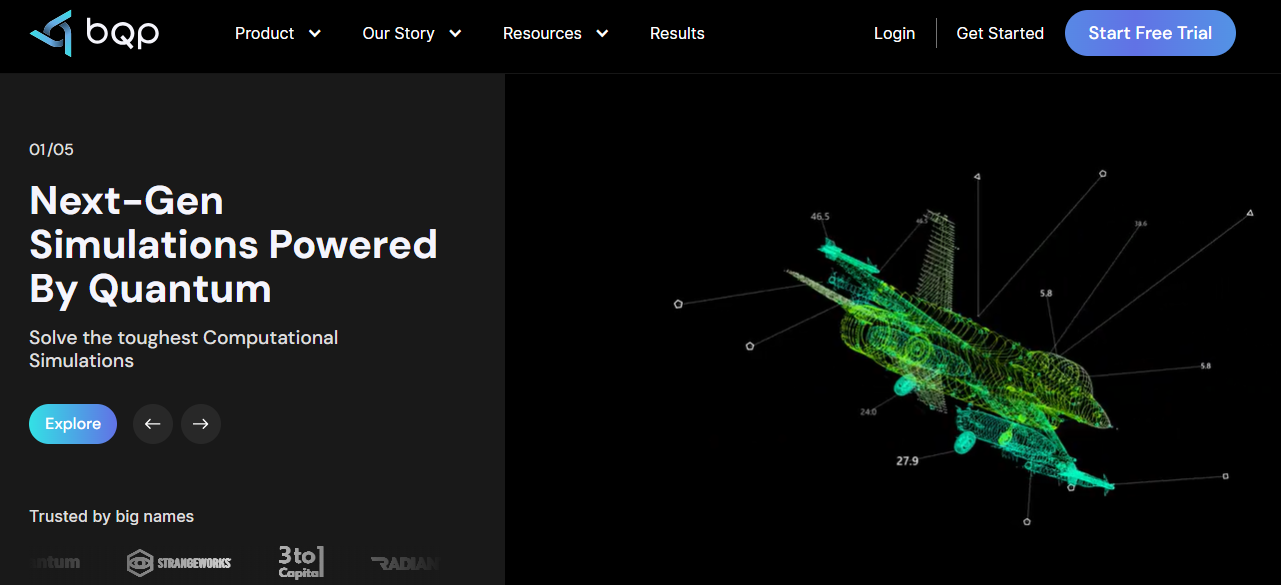
BQP is a quantum-inspired optimization platform built for engineering teams solving complex, large-scale problems involving multiple competing objectives and nonlinear constraints. Unlike conventional tools, BQP navigates high-dimensional design spaces where traditional solvers encounter significant performance degradation and scalability limits.
BQP integrates directly with simulation models, digital twin environments, and HPC infrastructure to support production-scale engineering optimization workflows across aerospace, structural, and energy domains.
BQP covers a wide range of complex optimization use cases including aerospace trajectory optimization, structural trade-off analysis, and multi-system design exploration, making it purpose-built for engineering teams working with many variables and nonlinear constraints.
Key Features
- Quantum-inspired optimization algorithms designed for large-scale, nonlinear engineering problems with multiple objectives
- High-performance computing integration supporting simulation-driven optimization workflows at scale
- Support for nonlinear and constrained multi-objective problem formulations across engineering domains
- Direct compatibility with digital twin environments and high-fidelity simulation pipelines
- Engineering system modeling across aerospace, structural, and energy application domains
- Modular architecture supporting custom objective definitions, constraint configurations, and solver integration
Pros
- Designed from the ground up for complex engineering optimization with multiple nonlinear constraints
- Handles large-scale design spaces where classical evolutionary and gradient-based methods degrade in performance
- Integrates directly with simulation models and digital twin environments without requiring workflow restructuring
- Applicable to production-scale engineering problems, not just research or prototyping scenarios
- Positioned at the frontier of quantum-inspired optimization, extending the practical limits of multi-objective analysis
Cons
- Requires engineering modeling expertise for full platform utilization across advanced use cases
- An enterprise-focused deployment model may not suit smaller teams or early-stage research workflows
- Onboarding complexity may require dedicated setup time for organizations new to quantum-inspired optimization infrastructure
2. Ansys OptiSLang - Best for sensitivity-driven multidisciplinary design exploration

Ansys OptiSLang is a simulation-driven design optimization software platform used extensively in multidisciplinary engineering environments for design exploration and sensitivity analysis.
Key Features
- Multi-objective design exploration workflows integrated with the Ansys simulation ecosystem
- Sensitivity analysis to identify the influence of individual design variables
- Automated design space exploration with configurable objective functions
- Native integration with Ansys Mechanical, Fluent, and other CAE solvers
Pros
- Deep integration with the Ansys simulation suite
- Well-established in mechanical and structural engineering workflows
Cons
- Requires the Ansys ecosystem for full functionality
- Enterprise licensing model
3. Siemens Simcenter HEEDS - Best for HPC-parallel automated design space search

Siemens Simcenter HEEDS is an optimization platform built for simulation-based design exploration, with strong support for multi-objective engineering problems across complex product development workflows. It is particularly well-suited for teams working across aerospace optimization techniques that require parallel design evaluation at scale.
Key Features
- Multi-objective optimization across engineering simulations with multiple competing objectives
- Automated design exploration with HPC integration for parallel evaluation
- Compatible with a broad range of third-party simulation solvers
Pros
- Strong HPC integration for large-scale parallel design runs
- Multi-solver compatibility across different engineering simulation environments
Cons
- Enterprise pricing model
- Primarily built for simulation-driven rather than standalone mathematical optimization
4. IBM Decision Optimization - Best for enterprise operational and supply chain decisions

IBM Decision Optimization is an enterprise-grade platform designed for operational decision-making involving resource allocation, scheduling, logistics, and supply chain network planning.
Key Features
- Mathematical programming for large-scale operational optimization
- Resource allocation and workforce scheduling optimization
- Supply chain and logistics network configuration
Pros
- Scales effectively for large enterprise decision problems
- Integrates with IBM analytics and data platforms
Cons
- Oriented toward operations and business decision problems rather than engineering simulation workflows
5. Gurobi Optimizer - Best for high-speed mathematical programming at scale

Gurobi is a high-performance mathematical optimization solver widely used in operations research, linear programming, and mixed-integer programming applications.
Key Features
- Linear, integer, and mixed-integer programming solvers
- High-performance solver engine with broad API support across Python, Java, and C++
- Cloud and on-premise deployment options
Pros
- Extremely fast solver for well-defined mathematical optimization problems
- Widely deployed in operations research and financial optimization
Cons
- Limited native multi-objective support compared to engineering-focused platforms; better suited for single-objective or goal-programming formulations
6. pymoo - Best for Python-native multi-objective evolutionary algorithm research
pymoo is an open-source Python-based framework built specifically for multi-objective evolutionary optimization research and experimentation.
Key Features
- Implementations of NSGA-II, NSGA-III, and other evolutionary multi-objective algorithms
- Python integration for flexible research and prototyping workflows
- Modular architecture supporting custom optimization pipeline development
Pros
- Accessible for research, academic, and prototyping use cases
- Extensive algorithm library covering a wide range of multi-objective optimization approaches
Cons
- Not designed for production-scale engineering workflows
- Performance limited compared to enterprise platforms when handling large design spaces
7. MOEA Framework - Best for multi-objective evolutionary algorithm benchmarking

The MOEA Framework is a Java-based open-source library dedicated to multi-objective evolutionary algorithms, designed for research benchmarking and algorithm experimentation.
Key Features
- Comprehensive library supporting a wide range of multi-objective evolutionary algorithms
- Built-in benchmarking tools for comparing optimization approach performance
- Extensible architecture for custom algorithm development and testing
Pros
- One of the most complete open-source libraries for multi-objective algorithm research
- Suitable for academic benchmarking and algorithm comparison studies
Cons
- A Java-based environment may limit integration in Python-dominant engineering workflows
- Designed for research rather than industrial deployment
What are the Challenges in Implementing Multi-Objective Optimization?
Deploying multi-objective optimization in real engineering workflows presents several meaningful technical and operational challenges that teams must plan for.
1. Computational Complexity
Engineering quantum optimization problems frequently involve thousands of design variables, multiple conflicting objectives, and nonlinear constraints. Evaluating all candidate solutions across this space is computationally intensive and can become infeasible at scale without the right infrastructure and algorithms.
2. Large Design Spaces
As the number of decision variables grows, the design space expands exponentially. Efficient search across this space requires algorithms capable of handling high-dimensional, discontinuous, and nonlinear problem structures.
3. Conflicting Objectives
Poorly defined objective weights or constraints can produce misleading Pareto frontiers. Careful problem formulation, including the selection and weighting of competing objectives, is essential to generating useful optimization results.
4. Algorithm Selection
Different engineering problems require different optimization strategies. Selecting the right algorithm, whether evolutionary, gradient-based, surrogate-assisted, or quantum-inspired, significantly affects both solution quality and computation time.
5. Simulation Cost
When each candidate design evaluation requires running high-fidelity simulations, per-iteration cost becomes a critical constraint. Optimization loops requiring thousands of simulation runs can consume significant compute resources.
Engineering teams address these challenges through several complementary strategies:
- High-performance computing environments for parallel design evaluation
- Surrogate models to approximate expensive simulations at lower computational cost
- Evolutionary algorithms are designed specifically for discontinuous and nonlinear design spaces
- Quantum-inspired optimization for problems that exceed the practical limits of classical computing
The Future of Multi-Objective Optimization Software
The next generation of multi-objective optimization platforms will be shaped by several converging trends that are already beginning to influence how engineering systems are designed and managed.
- AI-Driven Optimization - Machine learning models are increasingly being embedded within optimization loops, enabling adaptive search strategies that improve with each design evaluation cycle and reduce the number of simulation runs required to reach high-quality solutions.
- Simulation-Driven Design Optimization - Tight integration between optimization engines and high-fidelity simulation environments will enable simulation-driven optimization digital mission engineering at scales that were previously impractical, compressing design cycles and expanding the range of trade-offs engineering teams can systematically evaluate.
- Digital Twin Integration - Multi-objective optimization will operate directly within digital twin environments, enabling continuous design optimization of engineering systems throughout their full operational lifecycle, not just at the initial design stage.
- Autonomous Engineering Systems - Optimization platforms will increasingly support autonomous design workflows, reducing the manual effort required for iterative design space exploration and enabling faster convergence on optimal solutions across complex engineering problems.
- Quantum-Inspired Optimization - Quantum-inspired optimization for engineers is extending the practical limits of multi-objective analysis for large-scale, nonlinear engineering problems where classical methods encounter diminishing returns. As engineering systems grow more complex, quantum-inspired platforms will play an increasingly central role in enabling advanced trade-off analysis.
BQP is positioned at the frontier of this evolution, enabling next-generation multi-objective optimization for complex aerospace, energy, and engineering systems.
Conclusion
Real-world engineering systems require balancing multiple competing objectives simultaneously. Multi-objective optimization software enables engineering teams to evaluate trade-offs systematically, generate Pareto-optimal solution sets, and make better-informed design decisions across complex, high-dimensional problem spaces.
Adoption is accelerating across aerospace, manufacturing, logistics, and energy sectors as engineering systems continue to grow in complexity.
Advanced platforms like BQP extend the practical boundaries of what multi-objective optimization can achieve, supporting large-scale, nonlinear, and simulation-driven engineering problems that conventional tools cannot handle effectively.
Frequently Asked Questions
1. What is multi-objective optimization software?
Multi-objective optimization software helps engineers find the best set of solutions when multiple competing objectives, such as cost, performance, and reliability, must be optimized simultaneously. Rather than returning a single answer, it generates a Pareto frontier of optimal trade-off solutions across the full design space.
2. How is multi-objective optimization different from single-objective optimization?
Single-objective optimization finds the best solution for one defined goal. Multi-objective optimization handles multiple competing goals simultaneously, where improving one objective may require compromising another. The result is a Pareto-optimal solution set rather than a single best answer, giving engineers structured options rather than a forced choice.
3. What is a Pareto frontier in optimization?
The Pareto frontier is the set of solutions where no further improvement in one objective is possible without degrading at least one other. It represents the complete boundary of optimal trade-offs within a multi-objective problem and serves as the primary basis for engineering design selection decisions.
4. What industries use multi-objective optimization software?
Multi-objective optimization is widely applied in aerospace engineering, manufacturing systems, energy infrastructure, and logistics networks. It is also used in financial portfolio optimization, structural engineering, autonomous vehicle systems, and advanced manufacturing process design.
5. Can multi-objective optimization integrate with simulation software?
Yes. Modern multi-objective optimization platforms are designed to integrate directly with CAE tools, digital twin environments, and high-fidelity engineering simulation suites. BQP, Ansys OptiSLang, and Siemens Simcenter HEEDS are all built specifically for simulation-driven optimization workflows, enabling optimization loops to run directly against validated engineering models.
.png)
.png)



.svg)
.svg)
.svg)
.svg)