



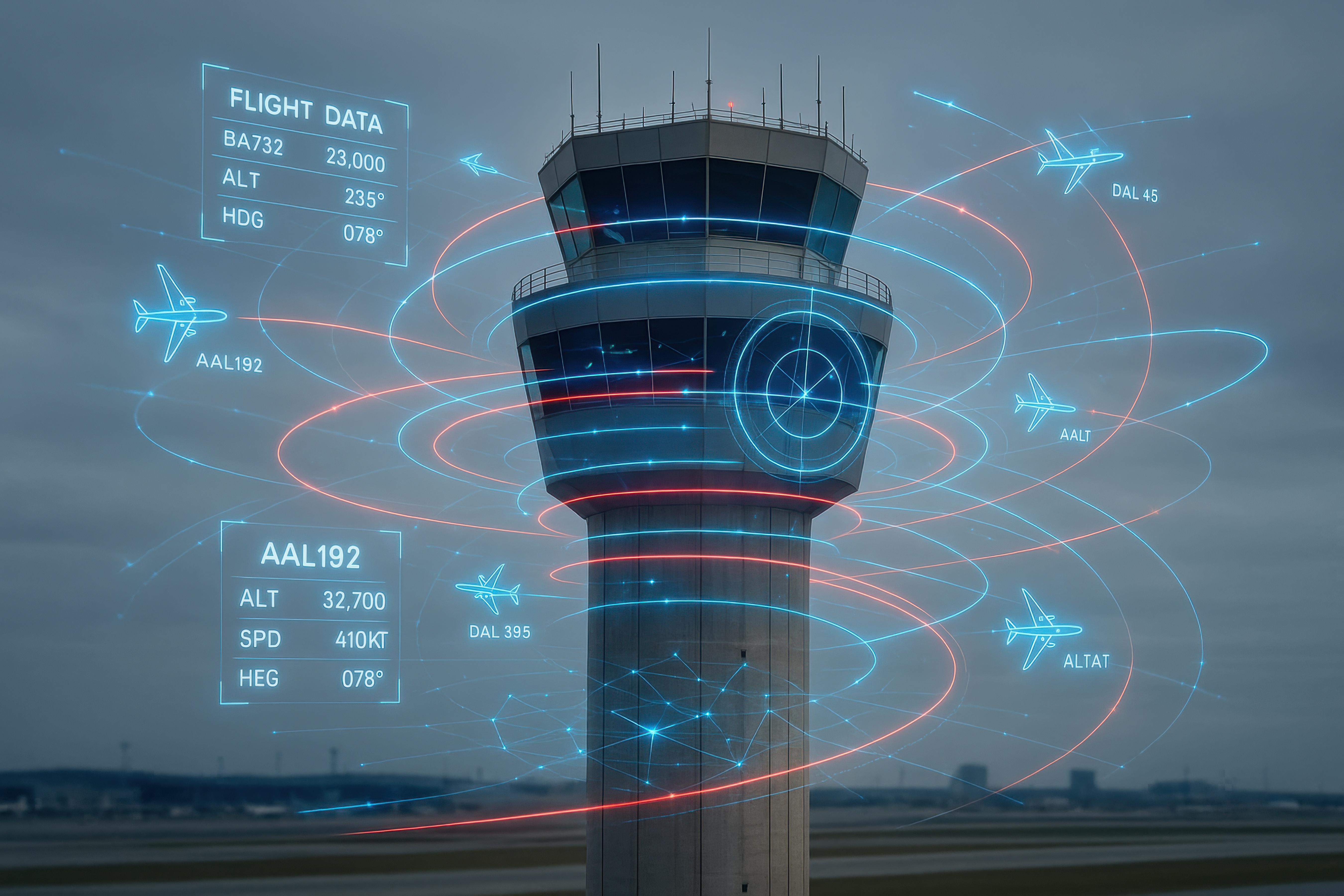

With millions of passengers flying daily and air traffic volumes reaching unprecedented levels, the aviation industry faces a critical challenge: traditional air traffic control systems are hitting their operational limits. Legacy infrastructure designed for a more predictable era now struggles to manage the complexity of modern airspace, where commercial flights, drones, and military aircraft must co-exist safely and efficiently.
Quantum computing emerges as the breakthrough solution to this escalating crisis. Unlike classical computers that process data sequentially, quantum computers leverage qubits to analyze multiple scenarios simultaneously, enabling real-time optimization of complex variables.
Early pilot programs demonstrate remarkable results: a 70% increase in airspace density, 30% reduction in flight clearance times, and up to 15% decrease in delays. This isn't theoretical, it's happening now, transforming how we manage the skies.
Why Air Traffic Control Needs Quantum Computing
Current Limitations of Traditional Air Traffic Systems
Today's air traffic management relies heavily on legacy systems built decades ago. These classical computing infrastructures process information sequentially, creating bottlenecks when managing multiple aircraft simultaneously. Air traffic controllers must make split-second decisions based on incomplete data, operating reactively rather than proactively. As flight volumes grow and unmanned aerial vehicles (UAVs) enter commercial airspace, these systems struggle to maintain safe separation distances while optimizing routes for efficiency.
The integration of drones and electric aerial vehicles adds another layer of complexity. Traditional systems weren't designed to manage three-dimensional airspace with thousands of autonomous vehicles operating at varying altitudes. Controllers face immense pressure to prevent collisions, minimize delays, and optimize fuel consumption all while processing limited data sets that fail to capture the full picture.
The Data Processing Challenge
Modern aviation generates massive data streams from radar systems, satellites, weather sensors, aircraft transponders, and ground-based infrastructure. Classical computers analyze this information one variable at a time, making it impossible to truly optimize for multiple factors simultaneously weather patterns, airspace congestion, fuel efficiency, arrival schedules, and safety margins.
This sequential processing creates a fundamental bottleneck. When an unexpected event occurs severe weather, equipment failure, or airspace closure recalculating optimal routes for hundreds of affected aircraft can take minutes or hours. By the time a solution arrives, conditions have changed, requiring yet another recalculation. This reactive cycle perpetuates inefficiency and increases operational costs across the entire aviation ecosystem.
How Quantum Computing Transforms Air Traffic Control
Real-Time Flight Path Optimization
Quantum algorithms revolutionize route planning by evaluating thousands of possible flight paths simultaneously.Rather than analyzing routes sequentially, quantum computers leverage superposition to consider weather patterns, airspace restrictions, fuel efficiency, and arrival schedules in parallel, identifying optimal solutions in seconds.
The OneSky Urban Air Mobility pilot program demonstrated quantum computing's transformative potential, increasing airspace utilization by approximately 70% while processing optimization problems 10 times faster than conventional computers. This means more aircraft can safely occupy the same airspace without compromising safety margins.
Research shows quantum route optimization can reduce fuel consumption by up to 15% and proportionally decrease greenhouse gas emissions. During emergencies or disruptions, quantum systems enable dynamic rerouting in real-time, automatically recalculating optimal paths for all affected aircraft based on current conditions.
Enhanced Traffic Flow Management
One of quantum computing's most powerful applications is predicting and mitigating potential traffic bottlenecks before they occur by analyzing historical patterns and real-time data at lightning speeds. Rather than waiting for congestion to develop, quantum systems forecast peak times and proactively suggest alternate routes or adjusted schedules.
Airbus testing with quantum technology partner QC Ware demonstrated 400% faster analysis compared to classical computing systems alone. This enables coordination of 100+ aircraft simultaneously, each flying to multiple destinations daily while maintaining tight schedules and minimizing ground time. The system optimizes all routes collectively rather than individually, creating a harmonized traffic flow that reduces systemic delays.
Advanced Collision Avoidance and Safety
Quantum computers excel at real-time integration of multiple data sources radar, satellites, aircraft sensors, and weather systems. Quantum algorithms for pattern recognition and anomaly detection help air traffic controllers quickly identify safety risks such as aircraft deviations or system malfunctions.
Quantum annealing methodology enables optimization of safe separation between vehicles in three-dimensional airspace, critical for managing mixed operations involving commercial aircraft, UAVs, and military flights. The technology calculates optimal spacing that maximizes capacity while maintaining regulatory safety margins, even in congested airspace.
Predictive Maintenance and System Reliability
By using quantum machine learning algorithms, air traffic controllers can create more accurate models for forecasting traffic patterns and weather, enabling proactive planning and resource allocation that reduces congestion and delays. Beyond traffic management, quantum algorithms analyze data from aircraft engine sensors to predict potential system failures before they occur.
This predictive capability improves fleet reliability and enhances overall aviation safety by preventing mechanical issues that could compromise flight operations. Airlines can schedule maintenance proactively rather than reactively, reducing unexpected downtime and optimizing resource allocation across their operations.
Quantum-Inspired vs. Quantum Hardware: What Aviation Authorities Need to Know
Quantum hardware uses physical qubits, superconducting circuits or trapped ions cooled to near absolute zero, to perform computations governed by quantum mechanics. It delivers theoretical processing advantages that classical systems cannot match. But current quantum hardware remains unstable, error-prone, and confined to controlled laboratory environments. Deploying it in safety-critical ATC infrastructure today is not feasible.
Quantum-inspired computing applies the mathematical principles derived from quantum mechanics, superposition-like sampling, entanglement-inspired variable correlation, and probabilistic search, to classical HPC and GPU systems. It does not require specialized hardware, cryogenic cooling, or new infrastructure. It runs on existing aviation compute stacks and integrates with current radar, scheduling, and separation systems.
For aviation authorities evaluating near-term deployment, quantum-inspired platforms like BQPhy® deliver measurable optimization gains now: faster route recalculation, congestion prediction, and multi-aircraft coordination without the hardware risk.
The practical guidance is straightforward: monitor quantum hardware developments as a long-term capability, but build operational advantage today using quantum-inspired optimization that your existing infrastructure can support.
Real-World Applications and Pilot Programs
OneSky's Urban Air Mobility Program
OneSky partnered with the Sumitomo Corporation Quantum Transformation Project and Tohoku University to develop a three-dimensional air traffic control system for electric aerial vehicles using quantum annealing. This methodology specifically targets optimization problems involving numerous potential solutions exactly what future urban air mobility requires.
The Phase 1 results validated quantum computing's practical application: safe separation between thousands of UAM vehicles while dramatically increasing simultaneous flight capacity. As quantum hardware improves, these systems will identify hundreds of thousands of optimized flight routes, essential for managing dense urban airspace.
Japan's Quantum Sky Project
The Quantum Sky Project in Japan successfully used quantum computing to develop a three-dimensional traffic control system for electric aerial vehicles, significantly increasing the number of simultaneous flights possible. This innovation demonstrates how quantum technology can revolutionize transportation logistics, particularly in densely populated urban environments where vertical airspace becomes critical infrastructure.
Airbus and Industry Initiatives
Airbus launched its Quantum Computing Challenge to explore aviation applications, focusing on simultaneous routing of 100+ aircraft to multiple destinations while minimizing ground time and maintaining schedule adherence. Major aerospace companies including Boeing and Lufthansa are investing in quantum research, recognizing this technology as fundamental to future aviation infrastructure.
Implementation Challenges and Solutions
Technical and Infrastructure Challenges
Implementing quantum computing in air traffic control faces several key challenges, including the need for robust and reliable communication protocols, specialized hardware requirements, and integration complexity with existing systems. Current quantum computers remain highly sensitive to environmental disturbances, requiring cryogenic cooling, precision calibration, and controlled environment infrastructure not designed into existing air traffic facilities.
Error rates present another significant hurdle. Quantum systems are prone to computational errors, and error correction remains an active research area. The number of stable qubits required for complex air traffic management tasks may exceed current hardware capabilities, though this limitation diminishes as technology advances.
Integration with legacy aviation systems demands specialized expertise in both quantum mechanics and air traffic management. The aviation industry requires professionals who understand quantum algorithms while appreciating the safety-critical nature of flight operations, a rare combination today.
Cost and Investment Considerations
Development and deployment of quantum computing infrastructure require substantial capital investment. Quantum hardware remains expensive, and building the supporting infrastructure adds significant costs. However, cloud-based quantum-inspired platforms like BQPhy® offer interim solutions, running on existing infrastructure without requiring dedicated quantum hardware.
Long-term return on investment becomes compelling when considering fuel savings from optimized routes, reduced delays improving operational efficiency, and enhanced safety preventing costly incidents. Shared infrastructure models, where multiple airports or airlines access centralized quantum systems, can distribute costs and accelerate adoption.
Regulatory and Safety Certification
Aviation operates under stringent regulations enforced by authorities including the FAA, EASA, and ICAO. Quantum computing solutions must undergo rigorous testing and certification before deployment in operational environments. This process ensures new systems meet established safety standards and don't introduce unforeseen risks.
Phased implementation provides a practical pathway beginning with non-critical applications like scheduling optimization, then gradually expanding to real-time flight operations as systems prove reliable. Collaborative development between quantum technology experts and aviation regulators ensures solutions meet industry requirements while pushing technological boundaries.
Transforming the Future of Air Traffic Control with BQP
BQP's BQPhy® quantum-inspired simulation platform bridges this gap delivering the computational power needed to optimize routes, predict congestion, and manage complex multi-agent airspace environments in real time.
BQP integrates quantum optimization, AI-driven prediction, and simulation-based validation to help aviation authorities, OEMs, and aerospace innovators:
- Optimize air traffic flow and flight routing across multi-layered airspace.
- Accelerate AI training for autonomous flight and predictive safety analytics.
- Secure aviation networks through quantum-safe communication protocols.
- Enable real-time decision-making for next-generation air mobility systems.
With simulation-driven quantum algorithms, BQP is already helping aerospace stakeholders prepare for the quantum-ready future without waiting for large-scale quantum hardware maturity.
Conclusion
Quantum computing represents the next evolution in aviation infrastructure, addressing fundamental limitations that constrain current air traffic management systems. Real-world pilot programs validate theoretical benefits, demonstrating dramatic improvements in capacity, efficiency, and safety. While implementation challenges remain, hardware maturity, costs, integration complexity, and regulatory requirements diminish as technology advances and industry commitment deepens.
Major aerospace companies, aviation authorities, and technology providers are investing heavily in quantum solutions, ensuring continued progress toward operational deployment. For aviation stakeholders, monitoring quantum computing developments isn't optional, it's essential for understanding how the industry will manage tomorrow's skies.
The technology promises not just incremental improvement but fundamental transformation in how we coordinate aircraft, optimize routes, and ensure safe passage through increasingly crowded airspace. The quantum revolution in aviation has begun, and its impact will reshape air travel for generations to come.
FAQs
What is quantum computing in air traffic control?
Quantum computing in air traffic control uses quantum algorithms to evaluate thousands of routing and scheduling scenarios simultaneously rather than sequentially. This enables real-time optimization of flight paths, safe separation, and airspace capacity across complex multi-aircraft environments that classical ATC systems cannot manage at the required speed or scale.
How does quantum air traffic optimization reduce delays and fuel burn?
Quantum optimization evaluates weather patterns, congestion, fuel efficiency, and arrival slots in parallel rather than one variable at a time. This simultaneous analysis identifies routes that minimize holding patterns, shorten flight times, and reduce fuel consumption. Pilot programs including the OneSky Urban Air Mobility initiative demonstrated up to 70% higher airspace density and significantly reduced clearance times compared to classical optimization approaches.
Are there real-world pilots using quantum computing for air traffic today?
Yes. OneSky's Urban Air Mobility program in Japan demonstrated 70% higher airspace utilization and 10 times faster optimization than classical systems. Airbus testing with quantum partner QC Ware showed 400% faster traffic analysis when coordinating 100 or more aircraft simultaneously. Japan's Quantum Sky Project further validated three-dimensional traffic control for electric aerial vehicles in dense urban airspace.
Can quantum computing work with existing ATC infrastructure?
Quantum and quantum-inspired solutions integrate as decision-support layers alongside existing ATC systems rather than replacing them. They ingest radar, weather, and schedule data from current infrastructure and return optimized routing recommendations. This allows aviation authorities to introduce quantum capabilities incrementally, starting with non-critical scheduling applications before expanding to real-time operational decision support.
What are the main challenges in deploying quantum air traffic systems?
The primary challenges are quantum hardware stability (current systems require cryogenic cooling incompatible with existing ATC facilities), computational error rates that require active correction, integration complexity with legacy aviation systems, regulatory certification timelines under FAA, EASA, and ICAO frameworks, and the specialist expertise required to bridge quantum algorithm development with aviation safety requirements.
How can aviation authorities start experimenting with quantum optimization?
The most practical entry point is cloud-based quantum-inspired platforms like BQPhy®, which run on existing HPC and GPU infrastructure without requiring dedicated quantum hardware. Authorities can begin with offline optimization studies, digital twin simulations of airspace scenarios, and pilot projects on non-critical scheduling tasks before expanding to real-time operational applications.
How does quantum computing improve collision avoidance in complex airspace?
Quantum algorithms process real-time data from radar, satellites, aircraft sensors, and weather systems simultaneously to calculate safe separation distances across three-dimensional airspace. This is critical for mixed operations where commercial aircraft, UAVs, and military flights share altitude corridors. Quantum optimization methods calculate spacing that maximizes capacity while maintaining regulatory safety margins, identifying potential conflicts faster than sequential classical computation allows.
What is the difference between quantum computing and quantum-inspired optimization for ATC?
Quantum computing uses physical qubits in specialized hardware cooled to near absolute zero to perform computations governed by quantum mechanics. Quantum-inspired optimization applies mathematical principles derived from quantum theory to classical HPC and GPU systems, delivering significant performance gains without specialized hardware. For aviation authorities, quantum-inspired platforms like BQPhy® are deployable today on existing infrastructure, while full quantum hardware deployment remains a longer-term development horizon.
.png)
.png)

.svg)
.svg)
.svg)
.svg)