



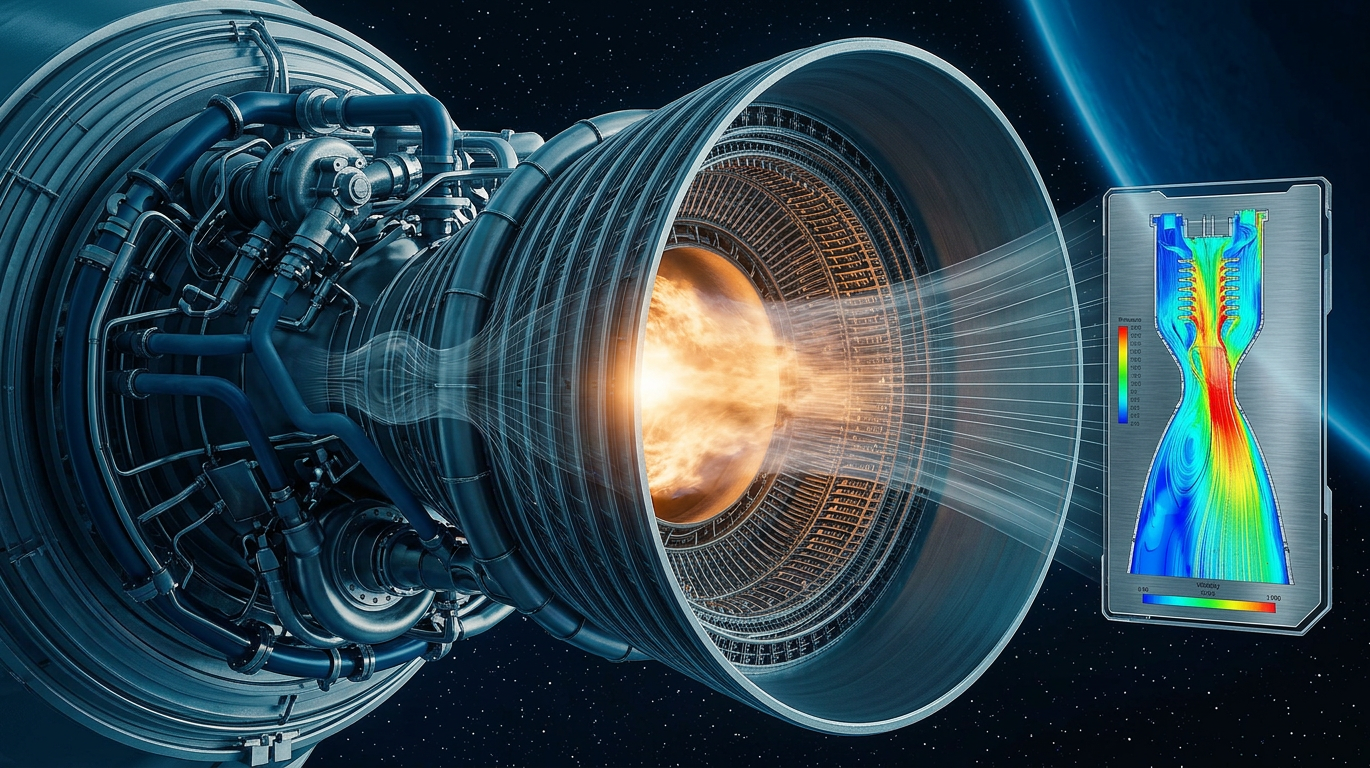

The nozzle is where propulsion performance is either captured or lost.
Everything upstream combustion efficiency, chamber pressure, propellant choice determines the energy available at the nozzle throat. What happens from the throat to the exit plane determines how much of that energy actually becomes thrust.
A poorly optimized nozzle does not just underperform. It compromises the entire propulsion system's efficiency, and that penalty compounds across every second of burn time.
The problem is not that engineers do not understand nozzle physics. They do. The problem is that nozzle design is a multi-physics, multi-constraint optimization problem that classical solvers are structurally unequipped to solve at full fidelity within a real program timeline.
BQP's hybrid quantum-classical platform changes what is computationally achievable on your existing HPC, without replacing your simulation stack.
The Multi-Physics Reality of Nozzle Design
A rocket nozzle is not a geometry problem. It is a coupled system problem where aerodynamics, thermodynamics, structural mechanics, and manufacturing constraints interact simultaneously and where optimizing one variable in isolation degrades the system.
What Engineers Are Actually Solving
Expansion ratio and thrust coefficient. The nozzle expansion ratio determines the pressure ratio across the nozzle and sets the thrust coefficient directly. But expansion ratio is not a free variable. It is bounded by exit plane mass, structural limits, aerodynamic drag during ascent, and atmospheric back-pressure at sea level.
An over-expanded nozzle at sea level suffers flow separation. An under-expanded nozzle in vacuum leaves specific impulse on the table.
Contour geometry. Bell nozzles, truncated ideal contour (TIC), thrust-optimized parabolic (TOP), and aerospike configurations each present different trade spaces between length, mass, and performance. The contour that minimizes nozzle length for a given thrust coefficient is not the same contour that minimizes flow separation risk or structural mass. The globally optimal contour depends on all three objectives simultaneously.
Thermal management. Nozzle walls operate at extreme thermal gradients. Regenerative cooling channels routed through the nozzle wall must carry enough coolant flow to maintain wall temperatures below material limits but the cooling channel geometry itself affects the structural stiffness of the nozzle shell.
Film cooling injection patterns create a thermal boundary layer that protects the wall but reduces effective specific impulse. Every thermal decision has a propulsion and structural consequence.
Structural margins under dynamic loading. The nozzle operates under combustion pressure, thermal expansion, vibration from turbopump operation, and aerodynamic side loads during transient start and shutdown. Every structural margin must be satisfied simultaneously across these load combinations, not just under nominal steady-state conditions.
Why This Exceeds Classical Optimization Capacity
When these sub-problems are solved sequentially aerodynamics first, then thermal, then structural the result is a locally optimized design that is globally sub-optimal. The interaction terms between subsystems are ignored, and the coupled solution is never found.
When they are solved simultaneously using classical multi-objective optimizers, the computational cost scales exponentially with the number of coupled variables. Genetic algorithms require large populations and hundreds of generations to approximate the Pareto front on problems of this dimensionality and even then they find a local approximation, not the global frontier.
This is the class of problems described in detail under quantum optimization problems in engineering: high-dimensional, tightly constrained, with coupling between subsystems that makes classical search fundamentally inefficient.
How BQP's QIO Solver Navigates the Nozzle Design Space
BQP's Quantum-Inspired Optimization (QIO) solver approaches the nozzle design problem differently not by adding more compute, but by searching the design space more intelligently.
The Quantum Tunneling Mechanism
Classical evolutionary algorithms, genetic algorithms, simulated annealing, differential evolution all share a common failure mode in high-dimensional constrained problems. They converge toward fitness peaks in the objective landscape and cannot escape them. The population clusters around a local optimum and the search stalls. Adding more compute extends the search slightly but does not solve the structural problem.
QIO draws from the principle of quantum tunneling. In quantum mechanics, a particle can pass through an energy barrier it would not classically have enough energy to surmount. Translated into optimization: where a genetic algorithm's population stalls at a local fitness peak, QIO has a mechanism to pass through that barrier and continue searching. The result is that QIO finds regions of the design space that classical methods never reach including the globally optimal nozzle contour under the full coupled constraint set.
Benchmark Performance
The performance gap is quantified on standard engineering optimization benchmarks:
- Ackley function: QIO converges in 100 iterations. Genetic algorithms require 2,000 a 20× difference.
- Rosenbrock function: QIO needs 200 iterations versus 1,000 for GA.
- Rastrigin function: QIO converges in 100 iterations versus 200 for GA.
Each evaluation in a nozzle design loop requires a CFD solve, a thermal analysis, and a structural check. A 20× reduction in required evaluations is a direct and proportional reduction in compute cost and calendar time which is the mechanism behind the ROI of quantum optimization for propulsion programs.
Multi-Objective Nozzle Optimization in Practice
BQP's Optimization Solver handles multi-objective problems natively. For nozzle design, this means the solver simultaneously optimizes across:
- Thrust coefficient (maximize)
- Nozzle structural mass (minimize)
- Wall thermal margin (maintain above threshold)
- Flow separation risk (minimize across operating altitude range)
- Nozzle length (minimize for packaging constraints)
Rather than collapsing these into a weighted scalar sum which forces engineers to pre-commit to trade-offs they may not fully understand QIO explores the full Pareto front. The output is a set of non-dominated solutions showing exactly what thrust coefficient you sacrifice for each kilogram of structural mass saved, or what length reduction costs in terms of thermal margin. Engineers make the final trade decision with complete information, not a compressed approximation of it.
From Contour to Cooling Channel: Where BQPhy® Adds Value in the Design Sequence
Nozzle optimization is not a single-step problem. It spans multiple design phases, and BQPhy® adds distinct value at each stage.
Contour Optimization at Preliminary Design
At preliminary design, the primary question is which nozzle architecture and expansion ratio delivers the best system-level performance given the mission constraints. This is a high-dimensional trade study and the stage where the design freedom exists to find solutions that are meaningfully better than classical methods discover. QIO's ability to explore more of the design space with fewer evaluations is most valuable here, where each candidate requires a full multi-physics evaluation and the number of plausible architectures is large.
Cooling Channel Routing at Detailed Design
At detailed design, the nozzle geometry is largely fixed and the optimization focus shifts to cooling channel layout, film cooling injection pattern, and wall thickness distribution. These are discrete and continuous mixed-variable problems exactly the class where genetic algorithms converge prematurely.
QIO handles mixed-variable problems with the same tunneling-based search, finding cooling configurations that meet thermal limits with lower coolant mass flow which directly improves engine-level specific impulse.
Structural Sizing Under Multi-Load Cases
Structural sizing of the nozzle shell must satisfy margins under multiple simultaneous load cases: combustion pressure, thermal expansion differential, turbopump vibration spectrum, and aerodynamic side loads during transient operations.
BQPhy® treats each load case as a simultaneous hard constraint not a sequential check. The output is a nozzle structure that is sized correctly across all load combinations in a single optimization pass, rather than iterated manually across each case.
This approach to design optimization in engineering treating multi-load, multi-physics problems as unified optimization problems rather than sequential checks is what separates quantum-inspired methods from the legacy iteration workflows most propulsion teams currently use.
Integration: BQPhy® Inside Your Existing Nozzle Design Workflow
Most propulsion teams have established simulation pipelines CFD codes (OpenFOAM, Fluent, or in-house solvers), structural FEA (Nastran, Abaqus), and thermal analysis tools, often orchestrated through MATLAB or Python. BQPhy® does not ask you to replace any of it.
How the Integration Works
BQPhy® sits as an optimization layer above your existing evaluation functions. Your CFD solver, thermal model, and structural checker remain exactly as they are. The QIO optimizer decides which design candidates to evaluate, calls your existing tools to evaluate them, receives the results, and generates the next set of candidates. The only component that changes is the optimizer.
Three integration paths are supported:
- MATLAB Integration for teams whose nozzle performance and structural models are MATLAB-based
- Python SDK for teams running Python-orchestrated multi-physics pipelines
- REST APIs for enterprise environments integrating BQPhy® into a broader simulation orchestration platform
Integration is week-scale. You do not need to rebuild your simulation pipeline to access a fundamentally better optimizer.
The Program-Level Case for Better Nozzle Optimization
Nozzle design decisions made at preliminary design freeze propagate through the entire vehicle. A nozzle contour that is 2% sub-optimal in thrust coefficient is 2% sub-optimal for every second of every burn across the vehicle's operational life. On a launch vehicle flying 30 missions per year, that loss is not recoverable after freeze.
The engineering case for quantum-inspired optimization in nozzle design is not about exotic future hardware. It is about extracting the performance that already exists in the design space performance that classical optimizers are leaving on the table because they cannot search the space efficiently enough to find it.
The teams currently adopting quantum-inspired optimization for aerospace and defense are doing so precisely because the design windows are finite and the compounding value of a better-optimized nozzle is too large to defer.
BQP's no-obligation Proof of Concept is designed to make this concrete on your actual nozzle geometry. Not a benchmark. Not a demo. A result on your problem.
Schedule a no-obligation Proof of Concept
Frequently Asked Questions
What makes nozzle contour optimization different from other propulsion design problems?
Nozzle contour optimization is uniquely difficult because performance, thermal, structural, and manufacturing constraints are all sensitive to the same geometric variables. Changing the contour curvature at any station affects the pressure gradient, wall heat flux, structural bending stiffness, and manufacturability simultaneously. This coupling density makes it one of the highest-dimensionality constrained problems in propulsion design and one of the worst fits for classical sequential optimization workflows.
Can BQPhy® optimize both the external nozzle contour and internal cooling channel geometry in the same run?
Yes. BQPhy®'s QIO solver handles mixed continuous and discrete variable problems in a unified formulation. External contour parameters (expansion ratio, bell curve coefficients, exit cone half-angle) and internal cooling channel parameters (channel width, depth, pitch, inlet conditions) can be included in the same optimization problem, with thermal and structural constraints applied simultaneously across both variable sets.
How does BQPhy® handle the altitude-varying performance requirement sea level versus vacuum optimization?
Multi-point optimization across operating conditions is a native capability of the BQPhy® Optimization Solver. Sea-level thrust coefficient and vacuum specific impulse can be included as simultaneous objectives with altitude-dependent constraint sets. QIO finds the nozzle geometry that best satisfies both operating conditions rather than optimizing for one and accepting degraded performance at the other.
Does BQPhy® work with our existing CFD solver for nozzle flow analysis?
Yes. BQPhy® integrates as an optimization layer above your existing CFD solver whether that is OpenFOAM, Fluent, an in-house Navier-Stokes code, or a reduced-order model. Your CFD solver remains the physics evaluator. BQPhy® only replaces the optimizer that decides which geometry candidates your CFD solver evaluates next.
At what fidelity level does BQPhy® operate conceptual sizing, preliminary design, or detailed design?
BQPhy® is fidelity-agnostic. It interfaces with whatever evaluation function you provide from a reduced-order thermodynamic model at conceptual sizing to a full Reynolds-Averaged Navier-Stokes CFD solve at detailed design. The same QIO optimizer works across fidelity levels, and many teams use it at multiple stages: low-fidelity sweeps at preliminary design to identify the best architecture region, then high-fidelity optimization within that region at detailed design.
What is the typical compute cost compared to running the same optimization with a genetic algorithm?
The compute cost reduction scales with problem dimensionality. On standard benchmarks, QIO requires 5× to 20× fewer evaluations than genetic algorithms to reach equivalent or better solution quality. For a nozzle optimization problem where each evaluation requires a full CFD solve, this translates directly to 5× to 20× less wall-clock time and HPC cost on the same infrastructure, with no hardware changes required.
.png)
.png)



.svg)
.svg)
.svg)
.svg)