



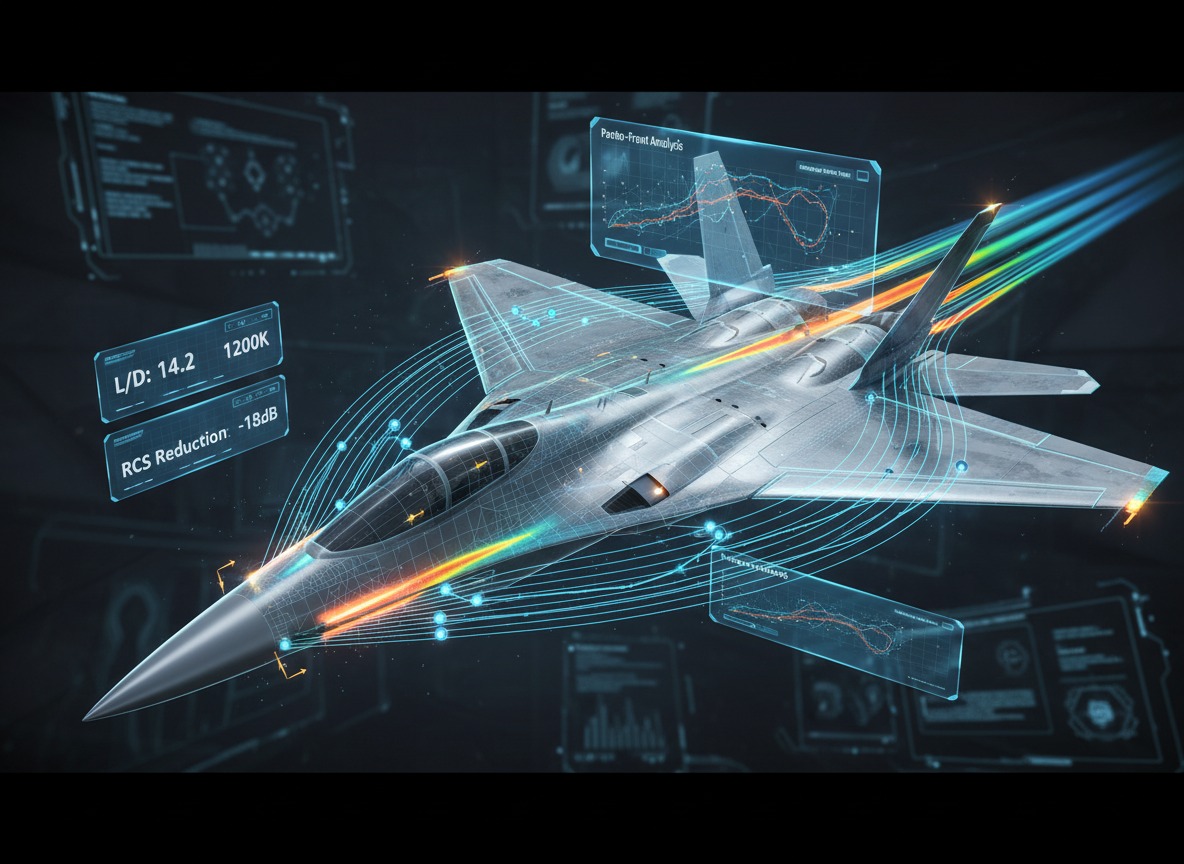

Wing aerodynamics at supersonic speeds demand simultaneous control of compressibility, structural load, and thermal stress.
Optimization here is not a single-variable problem. Coupled constraints define every viable design decision. These interactions sit at the core of challenges in aerospace design where thermal, structural, and aerodynamic limits converge across the same geometry.
Execution determines whether performance gains survive physical limits.
You will learn about:
- How aerodynamic, structural, and thermal constraints define the fighter wing design envelope
- Three optimization methods, including quantum-inspired, genetic algorithm, and gradient-based approaches, with execution steps for each
- Key metrics that determine whether an optimized wing design is structurally and aerodynamically viable
Every method discussed here runs on classical HPC infrastructure without requiring quantum hardware.
What are the Limitations of Fighter Jet Wing Performance?
Optimization begins by identifying the dominant constraints that bound every design decision for fighter jet wings.
1. Aerodynamic Constraints
At supersonic speeds, compressibility and skin friction generate drag that swept wings only partially mitigate. Low aspect ratio reduces induced drag penalty but limits overall aerodynamic efficiency at cruise.
2. Structural Limits
Root bending moment constrains planform geometry directly; weight limits force lightweight design solutions throughout. Low aspect ratio improves structural robustness, but weight and planform area remain hard boundaries.
3. Thermal Loading
Viscous heating at supersonic speeds increases Von Mises stress beyond what pressure loads alone produce. Thermal stress remains comparable to pressure stress up to Mach 1.75, then magnifies significantly above it.
4. Wing Loading Effects
High wing loading reduces turn performance by requiring greater thrust to sustain lift at maneuver conditions. This constraint directly balances lift generation capacity against available thrust throughout the flight envelope.
Together, these constraints define the feasible design space within which any optimization method must operate — making fighter wing design an inherently multi-objective optimization problem where aerodynamic, structural, and thermal objectives compete simultaneously.
What Are the Optimization Methods for the Fighter Jet Wing?
Three methods apply directly to fighter jet wing optimization, each suited to different problem structures and design objectives. For a broader view of how these methods are deployed across vehicle programs, see aerospace optimization techniques covering defense and commercial applications.
Method 1: Quantum-Inspired Optimization Using BQP
BQP applies quantum-inspired optimization algorithms, including superposition-inspired search and tunneling, to classical HPC infrastructure without requiring quantum hardware.
For fighter jet wings, BQP addresses high-dimensional coupled variables such as composite layup and aerodynamic shape, where classical solvers lose efficiency. The platform's deployment across quantum-inspired optimization for aerospace and defense programs establishes the execution baseline for wing-level applications.
BQP performs best on quantum optimization problems where design variables are tightly coupled and classical methods require more than 50 iterations to find candidate solutions.
Step-by-Step Execution for This Component Using BQP
Step 1: Define Wing Design Variables as QUBO Inputs
Map coupled wing variables, chord distribution, sweep angle, composite layup, into a Quadratic Unconstrained Binary Optimization formulation.
Step 2: Encode Aerodynamic and Structural Constraints
Translate root bending moment limits, weight targets, and lift requirements into penalty terms within the QUBO problem structure.
Step 3: Initialize Quantum-Inspired Search on HPC
Deploy BQPhy on classical HPC or GPU infrastructure using existing engineering optimization software. No quantum hardware is required at any stage of execution.
Step 4: Run Superposition-Inspired Variable Exploration
BQP explores multiple design configurations simultaneously using quantum-inspired search, reducing convergence cycles versus classical population methods.
Step 5: Apply Tunneling to Escape Local Optima
Quantum tunneling behavior allows the solver to bypass suboptimal design regions that trap gradient-based and classical evolutionary methods.
Step 6: Iterate Until Convergence Threshold Is Met
Continue solver iterations until design variables stabilize. Classical candidacy typically requires more than 50 iterations before BQP advantage activates.
Step 7: Extract and Validate Optimal Wing Configuration
Output the optimized wing geometry and layup. Validate against aerodynamic and structural constraints before advancing to high-fidelity aerospace simulations for CFD confirmation.
Practical Constraints and Failure Modes with BQP
QUBO formulation quality directly determines solution quality. Poorly encoded constraints produce outputs that violate structural or aerodynamic feasibility boundaries.
BQP requires HPC or GPU infrastructure for execution. Teams without existing high-performance compute environments cannot deploy BQPhy without infrastructure investment.
Method 2: Genetic Algorithms
Genetic algorithms engineering optimization evolves populations of wing designs through selection, crossover, and mutation across successive generations to identify optimal configurations.
For fighter wings, GAs handle aerostructural 3D optimization including internal structural layouts, where the search space is complex and noisy. For a direct performance benchmark against quantum-inspired methods, see GPU-optimized QIO vs Genetic Algorithm results across comparable design problems.
Genetic algorithms perform best when parallel CFD evaluations are available, and the design space cannot be reliably differentiated.
Step-by-Step Execution for This Component Using Genetic Algorithms
Step 1: Initialize Wing Design Population
Generate an initial population of approximately 100 individual wing designs, varying twist, chord, taper, and sweep parameters.
Step 2: Evaluate Fitness Using CFD Simulation
Run CFD on each individual to compute the lift-to-drag ratio and structural load. Maintain population diversity to avoid premature convergence.
Step 3: Apply Tournament Selection for Parent Pairing
Select parent designs using tournament selection, favoring higher fitness scores while retaining design diversity across the population.
Step 4: Execute Crossover and Mutation Operations
Combine parent wing parameters via crossover and introduce mutations to generate the next generation of candidate designs.
Step 5: Run Parallel CFD Across New Generation
Deploy parallel CFD evaluations across the new generation. GA computational cost is negligible compared to CFD execution time.
Step 6: Repeat for Up to 100 Generations
Iterate selection, crossover, and evaluation until convergence or the 100-generation limit is reached.
Step 7: Output Optimal Twist, Chord, and Taper Configuration
Extract the highest-fitness wing design from the final generation. Confirm structural and aerodynamic feasibility against design constraints.
Practical Constraints and Failure Modes
Genetic algorithms require thousands of CFD evaluations. Without a parallel compute infrastructure, total optimization runtime becomes prohibitive for fighter wing geometries.
Premature convergence occurs when population diversity collapses early. Narrowing parameter ranges before sufficient exploration produces suboptimal and potentially infeasible wing designs.
Method 3: Gradient-Based Methods
Gradient-based optimization computes steepest descent directions from CFD-derived gradients and iteratively adjusts wing surface control points toward lower drag configurations.
This method applies directly to fighter wing airfoil shape and 3D drag minimization, where continuous, differentiable design variables are available. Teams combining gradient-based refinement with global search can reference quantum optimization algorithms for how both approaches are structured within the same design pipeline.
Gradient-based methods perform best in viscous 3D flow drag minimization, where 50 to 100 CFD cycles are computationally acceptable.
Step-by-Step Execution for This Component Using Gradient-Based Methods
Step 1: Define Control Points on Wing Surface
Parameterize upper and lower airfoil surfaces and chord distribution using control points as the primary design variables.
Step 2: Run Baseline CFD Simulation
Execute initial CFD simulation to establish lift and drag values for the unoptimized wing geometry.
Step 3: Compute Steepest Descent Gradient Direction
Calculate gradient of the objective function using direct differentiation or adjoint variable methods to identify the direction of maximum drag reduction.
Step 4: Update Wing Shape Along Gradient
Apply the update rule sn+1 = sn - β ∇f, adjusting control point positions by the computed gradient step.
Step 5: Remesh and Re-Run CFD Simulation
Regenerate the computational mesh for the updated wing geometry and rerun CFD to evaluate the new lift and drag values.
Step 6: Iterate Until Optimization Convergence
Repeat gradient computation and shape update for 50 to 100 cycles or until objective function changes fall below the convergence threshold.
Step 7: Validate with VLM or TPM
Confirm the optimized wing geometry using the Vortex Lattice Method or Thick Panel Method as part of a simulation-driven optimization workflow before committing to the final design.
Practical Constraints and Failure Modes
Gradient-based methods converge to local optima, not global solutions. Complex fighter wing geometries with multimodal design spaces produce trap regions that steepest descent cannot escape.
Computing gradients for 3D viscous flow is computationally expensive. High per-iteration cost limits the number of design variables that can be practically optimized in a single run.
What are the Key Metrics to Track During Fighter Jet Wing Optimization?
Selecting the right performance metrics determines whether optimization output translates into a physically viable fighter wing design.
1. Lift-to-Drag Ratio
L/D ratio measures the aerodynamic efficiency of the wing across its operating speed range. It directly governs fuel consumption, combat range, and sustained maneuverability, the core performance outcomes of fighter wing optimization.
2. Oswald Efficiency Factor
Oswald efficiency quantifies induced drag relative to the theoretical minimum for a given lift coefficient and aspect ratio. As lift requirements increase during high-angle maneuvers, wings with optimized Oswald efficiency carry lower induced drag penalties.
3. Root Bending Moment
Root bending moment measures the structural load applied at the wing-fuselage junction under aerodynamic and inertial forces. It defines the structural weight required to sustain the wing, making it a direct constraint on overall fighter weight feasibility.
Together, these three metrics determine whether an optimized wing design is both aerodynamically efficient and structurally viable for production.
Frequently Asked Questions About Fighter Jet Wing Optimization
1. Does quantum-inspired optimization require quantum hardware to run?
No. BQP runs entirely on classical HPC and GPU infrastructure using quantum mathematical principles. Teams can deploy BQPhy within existing compute environments without quantum hardware. See BQP's optimization platform for deployment details.
2. Why do genetic algorithms require so many CFD evaluations for wing optimization?
Each design in a population of 100 requires full CFD evaluation across up to 100 generations. Parallel CFD execution is required to make GA-based optimization practical. See GPU-optimized QIO vs Genetic Algorithm for runtime comparisons.
3. What causes gradient-based methods to fail in fighter wing shape optimization?
Gradient descent converges to the nearest local optimum in multimodal design spaces. For escaping these trap regions, quantum optimization algorithms provide a global search alternative.
4. Which metric most directly constrains structural feasibility during fighter wing optimization?
Root bending moment sets the lower bound on structural weight at the wing root. Any design violating this threshold is structurally infeasible regardless of aerodynamic performance. See high-fidelity aerospace simulations for validation workflows.
.png)
.png)

.svg)
.svg)
.svg)
.svg)