



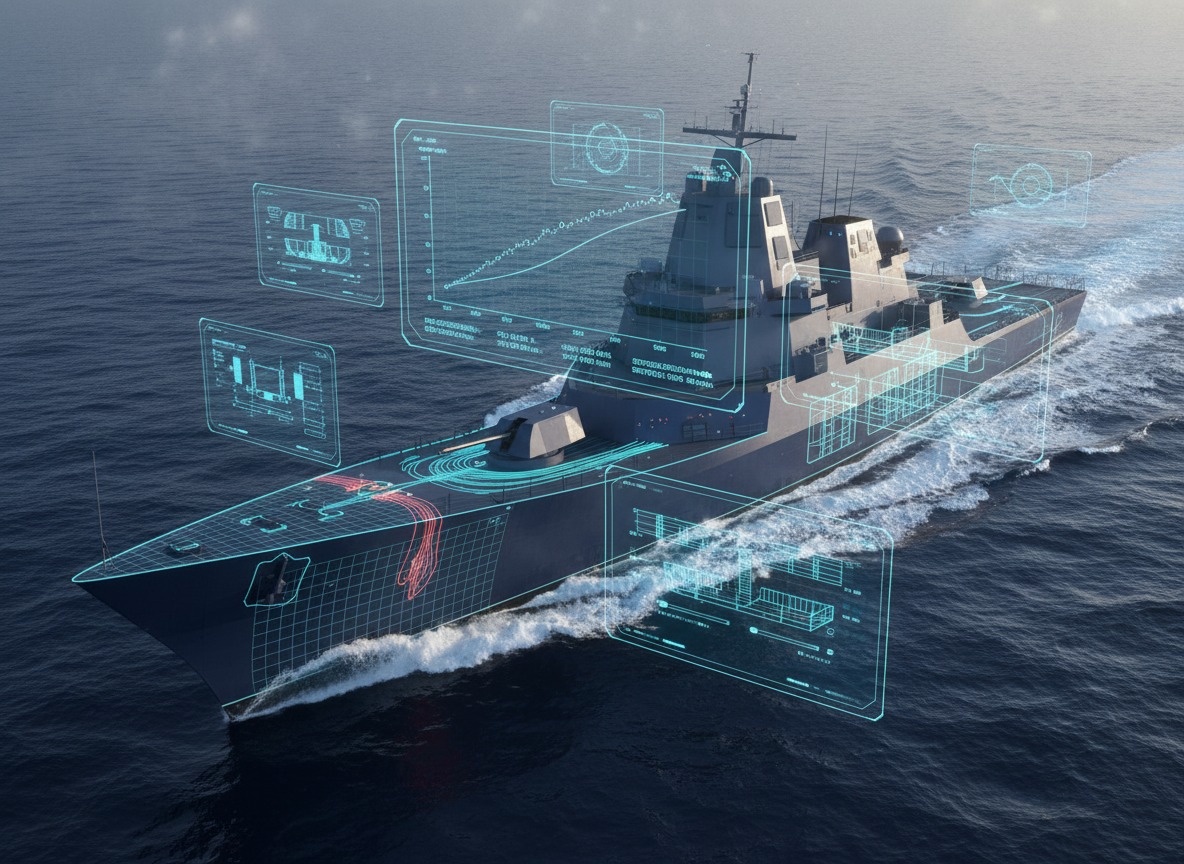

Naval hull performance depends on managing resistance, seakeeping, and structural trade-offs simultaneously.
Optimization requires resolving competing constraints across hull form parameters before any method is applied. Selecting the wrong method wastes computing cycles. These coupled interactions reflect the broader challenges in aerospace design where structural, hydrodynamic, and performance constraints must be mapped before any solver iteration begins.
Constraint identification precedes method selection.
You will learn about:
- How wave-making resistance, frictional resistance, and seakeeping define the design envelope
- Which optimization methods apply to naval hull geometry and when to use each
- Step-by-step execution using BQP, Genetic Algorithm, and Particle Swarm Optimization
Engineers ready to reduce resistance by 8 to 26% need structured method selection, not generic solver guidance.
What are the Limitations of Naval Hull Performance?
Optimization starts by identifying dominant constraints; hull form parameters define the boundaries before any solver is applied.
1. Wave-Making Resistance
Wave-making resistance increases sharply with Froude number. At Fn greater than 0.25, resistance climbs non-linearly with speed. Full hull forms with block coefficients near 0.85 are particularly constrained at higher transit speeds.
2. Frictional Resistance
Frictional resistance scales directly with wetted surface area. Hull geometry changes that reduce wave drag often increase wetted surface. This trade-off constrains the solution space for any resistance-focused optimization.
3. Seakeeping Performance
Block coefficient (CB) and midship coefficient (CM) directly affect pitch motion and motion sickness index. Optimizing for resistance alone degrades seakeeping. Both coefficients must be treated as coupled variables, not independent parameters.
4. Structural and Geometric Constraints
Draft-to-beam ratios impose hard boundaries on hull geometry. Displacement hull beaching craft, for example, face transit speed limits near 11 knots and beaching gradients of 1:40. Structural constraints eliminate large regions of the design space before optimization begins.
Together, these constraints define the feasible design envelope within which any optimization method must operate.
What Are the Optimization Methods for Naval Hull?
Three methods cover the range of naval hull optimization problems, from global topology search to multi-speed resistance reduction. For a broader context on how these methods are structured across defense engineering programs, see aerospace optimization techniques covering structural and fluid dynamics applications.
Method 1: Quantum-Inspired Optimization Using BQP
BQP applies quantum-inspired algorithms to classical HPC infrastructure, simulating quantum optimization behavior without requiring quantum hardware.
For naval hull optimization, BQP's quantum-inspired evolutionary approach explores complex hull topology with higher parallel search efficiency than conventional solvers. The platform's deployment across quantum-inspired optimization for aerospace and defense programs establishes the execution baseline for hull-level multi-physics problems.
BQP fits best when the hull design space is high-dimensional and classical solvers show convergence instability or premature local optima.
Step-by-Step Execution for This Component Using BQP
Step 1: Parameterize Hull Design Variables
Define block coefficient, midship coefficient, draft, and beam as the primary optimization variables with hard structural bounds applied.
Step 2: Initialize Population Using Superposition-Inspired Search
Generate an initial population emulating quantum superposition, distributing candidates across the full design space rather than clustering near a known solution.
Step 3: Evaluate Resistance and Seakeeping Fitness
Run each candidate hull through resistance and seakeeping evaluation. Fitness function must capture both wave-making resistance and motion sickness index simultaneously.
Step 4: Apply Entanglement-Inspired Update Operators
Update candidate solutions using entanglement-like operators that preserve diversity. This prevents premature convergence common in classical evolutionary solvers.
Step 5: Iterate to Convergence on Optimal Hull Form
Repeat evaluation and update cycles until resistance and seakeeping objectives meet defined thresholds. Track convergence per iteration.
Step 6: Validate Optimal Hull Against Structural Constraints
Confirm the converged hull satisfies draft-to-beam ratios and displacement requirements before advancing to high-fidelity aerospace simulations and full CFD validation.
Practical Constraints and Failure Modes with BQP
Computational resource reduction is claimed for complex hull topologies, but no verified naval hull-specific benchmarks are currently available in public literature.
BQP naval hull application data remains limited; results from aerospace and structural domains do not directly transfer without domain-specific fitness function tuning.
Method 2: Genetic Algorithm (GA)
GA encodes hull offsets, length, beam, and draft as chromosomes and evolves candidate populations toward minimum resistance and seakeeping targets.
GA fits naval hull optimization because it handles non-differentiable regions and nonlinear displacement constraints that gradient-based methods cannot process reliably. For a direct performance comparison between GA and quantum-inspired methods at equivalent problem scales, see GPU-optimized QIO vs Genetic Algorithm benchmarking results.
GA performs best on multi-objective problems combining seakeeping and resistance, particularly for hull forms derived from S60 and Wigley hull families.
Step-by-Step Execution for This Component Using Genetic Algorithm (GA)
Step 1: Encode Hull Offsets and Principal Dimensions as Chromosomes
Define L, B, draft, and sectional offsets as chromosome variables. Apply displacement as a hard constraint from the start.
Step 2: Initialize Hull Population
Generate an initial population spanning the feasible hull form space. Diversity at initialization reduces the risk of early convergence to suboptimal forms.
Step 3: Evaluate Seakeeping and Resistance via CFD or Potential Flow
Score each hull candidate using seakeeping metrics, pitch, heave, roll, and resistance calculations. Potential flow methods reduce cost at early generations.
Step 4: Apply Selection, Crossover, and Mutation
Select top-performing hull candidates. Apply crossover to exchange hull geometry segments. Mutation perturbs individual offsets to maintain population diversity.
Step 5: Handle Nonlinear Constraint Violations
Penalize or discard candidates that violate displacement or structural constraints. Constraint handling must be explicit, not assumed through fitness weighting alone.
Step 6: Validate Optimal Hull Form
Once convergence is achieved, validate the optimal chromosome against full CFD simulations and seakeeping simulation before accepting the design.
Practical Constraints and Failure Modes
GA can trap in local optima when population diversity collapses without sufficient mutation rate or population size tuning.
Nonlinear constraint handling requires explicit implementation; implicit penalty functions often fail in high-dimensional hull optimization runs.
Method 3: Particle Swarm Optimization (PSO)
PSO moves a swarm of hull design candidates through the solution space, with each particle updating velocity toward its personal best and the global best found so far.
PSO applies directly to naval hull resistance reduction across multiple speed regimes, using surrogate models such as Kriging to reduce CFD evaluation cost per iteration. Teams applying PSO results to broader defense vehicle programs can reference quantum optimization problems for how multi-speed surrogate optimization is structured within larger design pipelines.
PSO performs best at Froude numbers between 0.3 and 0.6, where documented resistance reductions reach 12.5% at Fr=0.3, 26.09% at Fr=0.4, and 25.88% at Fr=0.5.
Step-by-Step Execution for This Component Using Particle Swarm Optimization (PSO)
Step 1: Parameterize Hull Using Sectional Area Curve Shift
Define hull design variables around SAC shift and principal dimension ratios. This parameterization supports multi-speed resistance evaluation within a single design vector.
Step 2: Initialize Particle Swarm Across Design Space
Distribute particles across the feasible hull design space. Initialization spread determines how well PSO samples both low and high resistance regions.
Step 3: Evaluate Multi-Speed Resistance via CFD
Compute total resistance for each particle at target Froude numbers. Evaluate at Fr=0.3, 0.4, and 0.5 to capture multi-speed performance simultaneously.
Step 4: Construct Kriging Surrogate Model
Build a Kriging surrogate from initial CFD evaluations. The surrogate replaces direct CFD for subsequent iterations, reducing computational cost significantly.
Step 5: Update Particle Velocity Toward pbest and gbest
Update each particle's velocity using personal best and global best hull configurations. Balance exploration and exploitation through inertia weight tuning.
Step 6: Iterate Surrogate-Guided Optimization
Run PSO iterations against the surrogate. Add high-uncertainty points back to CFD evaluation to improve surrogate accuracy in critical regions.
Step 7: Validate Resistance Reductions Against Full CFD
Confirm surrogate-predicted resistance reductions using full CFD at the optimal hull configuration before finalizing the design.
Practical Constraints and Failure Modes
High-dimensional hull problems increase CPU time sharply; surrogate models are necessary, not optional, for PSO to remain computationally viable.
Surrogate accuracy degrades in sparse regions of the design space; insufficient initial CFD sampling produces unreliable resistance predictions.
What are the Key Metrics to Track During Naval Hull Optimization?
Resistance, seakeeping, and powering metrics together determine whether the optimized hull design is operationally viable.
1. Resistance Metrics
Total resistance quantifies calm-water powering requirements, decomposed into wave-making and frictional components across target speed ranges. Resistance reduction of 8 to 26% is the documented outcome range for successful naval hull optimizations; values below this range indicate suboptimal convergence.
2. Seakeeping Metrics
Seakeeping metrics capture pitch motion, heave, roll response, and motion sickness index across representative sea states. These metrics matter because resistance-optimized hulls can fail operationally if seakeeping performance degrades below mission requirements.
3. Powering Efficiency
Effective power and propulsive efficiency translate hydrodynamic resistance gains into actual fuel and propulsion system impact. Powering metrics connect hull optimization outputs to propulsion system design requirements and lifecycle operating cost.
Frequently Asked Questions About Naval Hull Optimization
1. What is the role of the block coefficient in naval hull optimization?
Block coefficient directly affects wave-making resistance and seakeeping response. Full hulls near CB 0.85 face higher resistance at elevated Froude numbers and must enforce displacement constraints throughout. See quantum optimization algorithms for constraint-handling approaches.
2. How does the Froude number affect which optimization method to select?
At Fn greater than 0.25, wave-making resistance dominates and multi-speed evaluation methods perform best. PSO with surrogate modeling delivers 12.5 to 26% reductions at Fr=0.3 to 0.5. See GPU-optimized QIO vs Genetic Algorithm for regime-specific comparisons.
3. When should the Genetic Algorithm be used instead of PSO for hull optimization?
Use GA when the problem involves nonlinear constraints, non-differentiable design regions, or coupled seakeeping objectives. PSO converges faster on smooth resistance-only problems. See CFD simulations for evaluation cost context across both methods.
4. What causes premature convergence in naval hull optimization runs?
In GA, an insufficient mutation rate collapses population diversity. In PSO, over-weighting the global best pulls particles toward a single region too early. BQP's entanglement-inspired operators are specifically designed to address this failure mode. See BQP's platform for deployment details.
.png)
.png)

.svg)
.svg)
.svg)
.svg)