


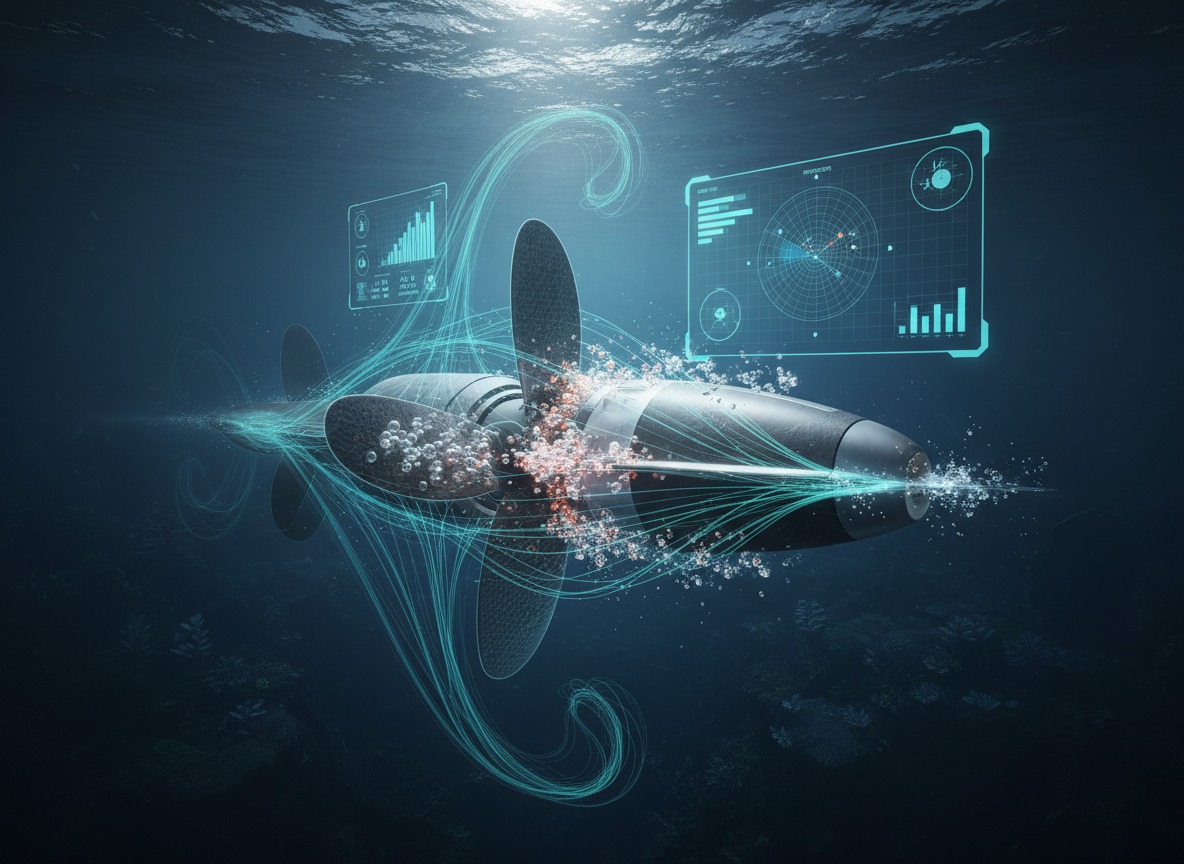

Submarine propeller optimization operates under physics constraints that make conventional design frameworks insufficient.
Acoustic performance drives every design decision before efficiency is considered. The feasible design space is narrow, defined by cavitation margins, noise thresholds, and behind-hull flow conditions. These interactions represent some of the most demanding challenges in aerospace design where competing physical constraints must be fully mapped before any optimization method is selected.
Constraints come first. Methods follow.
You will learn about:
- How acoustic signature, cavitation, and hydrodynamic trade-offs define submarine propeller design limits
- How Quantum-Inspired Optimization, Particle Swarm Optimization, and Genetic Algorithms are applied in practice
- Step-by-step execution workflows for each method, with relevant failure modes and tracking metrics
Each method is evaluated against submarine-specific constraints, not surface-ship analogues.
What are the Limitations of Submarine Propeller Performance?
Submarine propeller optimization begins by identifying dominant constraints, and in this domain, acoustics outweigh nearly every other factor.
1. Acoustic Signature Constraints
Acoustic signature is the primary design constraint, prioritized above propeller efficiency in all submarine configurations. Tip-vortex cavitation and trailing-edge noise generate broadband hull pressure fluctuations that make noise minimization the non-negotiable design boundary.
2. Cavitation Limitations
Tip-vortex cavitation requires a tip-relieved blade design, producing a broadband hump near 50 Hz in hull pressure spectra. Sheet cavitation must also be minimized. Trailing-edge noise is not neglected, even when tip-vortex effects dominate design constraints.
3. Hydrodynamic Efficiency Trade-offs
Skewed blade geometry minimizes cavitation while maximizing thrust across operating speeds and depths, but tip relief reduces overall efficiency. Maximum efficiency for optimized submarine propeller models reaches approximately 0.665, a ceiling imposed directly by acoustic and cavitation constraints.
These three constraint categories define the feasible design envelope for any submarine propeller optimization effort.
What Are the Optimization Methods for Submarine Propellers?
Three methods address the multi-objective nature of submarine propeller design, balancing efficiency, cavitation, and acoustic pressure pulses simultaneously. For broader context on how multi-objective evolutionary and quantum-inspired methods are structured across defense programs, see aerospace optimization techniques covering fluid dynamics and propulsion applications.
Method 1: Quantum-Inspired Optimization Using BQP
BQP applies quantum-inspired algorithms, including QGA and QPSO, on classical HPC infrastructure without requiring quantum hardware.
For submarine propeller optimization, BQP maps multi-objective design variables across a structured search space, applying quantum-inspired search to explore high-dimensional propeller geometries efficiently. The platform's deployment across quantum-inspired optimization for aerospace and defense programs establishes the execution baseline for propeller-level multi-objective problems.
BQP is best suited for propulsion system design where large parametric spaces and competing physical constraints require simultaneous multi-objective evaluation.
Step-by-Step Execution for This Component Using BQP
Step 1: Parameterize Blade Geometry Variables
Define pitch, skew, rake, chord, and thickness as the primary design variables for the quantum-inspired search space.
Step 2: Map Acoustic and Thrust Objectives to QUBO
Set optimization objectives, minimize noise and cavitation and maximize thrust coefficient, and translate constraints into a QUBO-compatible problem structure.
Step 3: Initialize Quantum-Inspired Design Population
Generate an initial population of blade configurations using superposition-inspired initialization via BQP solvers, covering broad design space.
Step 4: Execute Iterative QPSO Search
Update particle positions using quantum-behaved PSO, learning correlations across blade geometry parameters to guide convergence toward acoustic feasibility.
Step 5: Evaluate Candidates via CFD or BEM
Assess hydrodynamic performance and cavitation behavior for each candidate design using CFD simulations or boundary element method solvers.
Step 6: Select Non-Dominated Pareto Designs
Identify Pareto-optimal solutions from the guided search output, focusing on designs that satisfy both acoustic and thrust constraints simultaneously.
Step 7: Validate Top Designs in High-Fidelity Simulation
Run final candidates through high-fidelity aerospace simulations to confirm performance before committing to geometry.
Practical Constraints and Failure Modes with BQP
Problem mapping quality directly affects output. Poorly structured QUBO formulations reduce search quality and compromise cavitation constraint handling. Evaluation budget is a hard limit. Insufficient CFD evaluations during iteration produce Pareto fronts that do not reflect true acoustic performance boundaries.
Method 2: Particle Swarm Optimization
Particle Swarm Optimization is adapted for multi-objective propeller design, simultaneously handling cavitation constraints and hull pressure pulse targets.
PSO fits submarine propeller optimization specifically because it handles behind-hull non-uniform inflow conditions and cavitation area constraints within its fitness evaluation framework. For a direct performance comparison between PSO-based evolutionary methods and quantum-inspired approaches, see GPU-optimized QIO vs Genetic Algorithm benchmarking results across comparable constrained design problems.
PSO performs best for constrained marine propeller design, demonstrating earlier convergence than NSGA-II across benchmark propeller test cases.
Step-by-Step Execution for This Component Using Particle Swarm Optimization
Step 1: Initialize Swarm Across Blade Parameter Space
Assign random positions and velocities across eight geometry parameters, including pitch, skew, and chord distribution.
Step 2: Configure Inertia Weight and Learning Factors
Set dynamic inertia weighting to balance early exploration of acoustic design space with later exploitation of efficient solutions.
Step 3: Update Velocities Using Personal and Global Bests
Incorporate personal best and global best positions with disturbance terms to prevent early convergence to acoustically infeasible extremes.
Step 4: Evaluate Thrust, Torque, and Cavitation via CFD
Run each particle configuration through CFD solvers to extract thrust coefficient, torque coefficient, and cavitation area ratio simultaneously.
Step 5: Apply Non-Dominated Ranking with Tournament Selection
Rank particle solutions using non-dominated sorting and apply tournament selection to manage hull pressure pulse constraint violations.
Step 6: Monitor Pareto Front Development Through Iterations
Track Pareto front evolution across iterations to confirm convergence toward the acoustic-efficiency trade-off boundary.
Step 7: Extract Final Blade Geometry for Fabrication
Select the preferred non-dominated solution from the final swarm state based on mission-specific acoustic priority weighting.
Practical Constraints and Failure Modes
Premature convergence to acoustic or efficiency extremes is a known failure mode. Increasing swarm size improves coverage of the constrained design space.
Multi-objective constraint violations occur when pressure pulse limits conflict with thrust requirements. Proper tournament selection parameters must be tuned before production runs.
Method 3: Genetic Algorithms
Genetic Algorithms evolve populations of blade designs through selection, crossover, and mutation, producing robust solutions for thrust and efficiency optimization.
GA applies across the full design progression from open-water conditions to behind-hull evaluation, using deme-based subpopulations and three-level optimization structure for submarine configurations. Teams applying GA results to full propulsion system programs can reference quantum optimization algorithms for how multi-level evolutionary search is structured within larger defense design pipelines.
GA performs best when moving from open-water propeller series optimization toward complex behind-hull multi-physics conditions requiring RANS or BEM integration.
Step-by-Step Execution for This Component Using Genetic Algorithms
Step 1: Generate Deme Subpopulations from Blade Parameters
Initialize deme subpopulations encoding pitch, skew, chord, and rake, distributing initial diversity across the blade geometry space.
Step 2: Evaluate Open Water Thrust and Efficiency
Run each population member through an open-water solver to extract thrust coefficient and efficiency as first-level fitness values.
Step 3: Apply Crossover and Mutation Operators
Evolve the population through crossover and mutation, advancing higher-fitness blade geometries toward the next generation.
Step 4: Narrow Design Space for Behind-Hull Evaluation
Select top-performing open-water designs and advance them to behind-hull flow evaluation as the second optimization level.
Step 5: Run Multi-Objective RANS or BEM Assessment
Evaluate hull-propeller interaction, non-uniform wake effects, and acoustic feasibility using RANS or BEM solvers at the multi-objective level.
Step 6: Converge Population to Thrust and Diameter Targets
Match the converging population against required thrust coefficient and diameter constraints to satisfy submarine-specific operational requirements.
Step 7: Validate Final Designs with Hydrodynamic Testing
Confirm top GA solutions through hydrodynamic testing protocols before advancing to detailed design.
Practical Constraints and Failure Modes
Without interactive guidance or machine learning integration, GA can produce solutions inferior to expert manual design in specific industrial submarine cases.
All GA outputs require validation cases. Convergence to thrust targets does not guarantee acoustic compliance without explicit noise constraint inclusion in fitness functions.
What are the Key Metrics to Track During Submarine Propeller Optimization?
Together, these three metric categories determine whether any optimized design is viable for submarine deployment.
1. Hydrodynamic Performance Metrics
This category measures thrust coefficient (Kt), torque coefficient (Kq), and open-water efficiency (η) across the operating envelope. Hydrodynamic metrics determine how effectively the propeller converts shaft power to thrust, the baseline against which acoustic trade-offs are measured.
2. Cavitation Extent Metrics
Cavitation extent metrics measure cavitation area ratio and cavity volume across the blade surface and tip regions during operation. These metrics directly indicate proximity to performance breakdown. Exceeding cavitation thresholds destabilizes both the acoustic signature and the propulsive efficiency simultaneously.
3. Acoustic Noise Metrics
Acoustic noise metrics measure hull pressure fluctuation amplitudes and broadband noise levels across the frequency spectrum generated by the propeller. For submarines, acoustic metrics are the final viability gate. No design advances regardless of hydrodynamic performance if acoustic thresholds are violated.
Frequently Asked Questions About Submarine Propeller Optimization
1. Why does acoustic signature take priority over efficiency in submarine propeller design?
Acoustic detection risk determines mission survivability regardless of thrust efficiency. Efficiency losses from tip relief are accepted trade-offs. See quantum technology in defense for how acoustic constraints shape defense system design priorities.
2. How does tip-vortex cavitation constrain the optimization process?
Tip-vortex cavitation forces tip-relieved blade geometry, directly limiting maximum efficiency. Cavitation margins must be satisfied before efficiency targets are pursued. See CFD simulations for cavitation modeling approaches.
3. When should Particle Swarm Optimization be chosen over Genetic Algorithms for this application?
PSO is preferred when early convergence speed and cavitation constraint handling are priorities. GA suits a structured multi-level design progression from open-water through behind-hull conditions. See GPU-optimized QIO vs Genetic Algorithm for convergence comparisons.
4. What makes Quantum-Inspired Optimization applicable to submarine propeller design?
BQP explores high-dimensional blade geometry spaces up to 20x faster than traditional methods across acoustic, cavitation, and thrust parameters simultaneously. See BQP's platform for deployment details.
.png)
.png)

.svg)
.svg)
.svg)
.svg)