Results
Optimization Solver
Optimization Solver

Airfoil Shape Optimization Using Surrogate model & QIO

Contact Us
Thank you! Your PDF will get downloaded automatically.
Oops! Something went wrong while submitting the form.
Challenges
  • Aerodynamic optimization requires repeated evaluation of drag coefficient (Cd)
  • CFD or experimental evaluations are computationally expensive
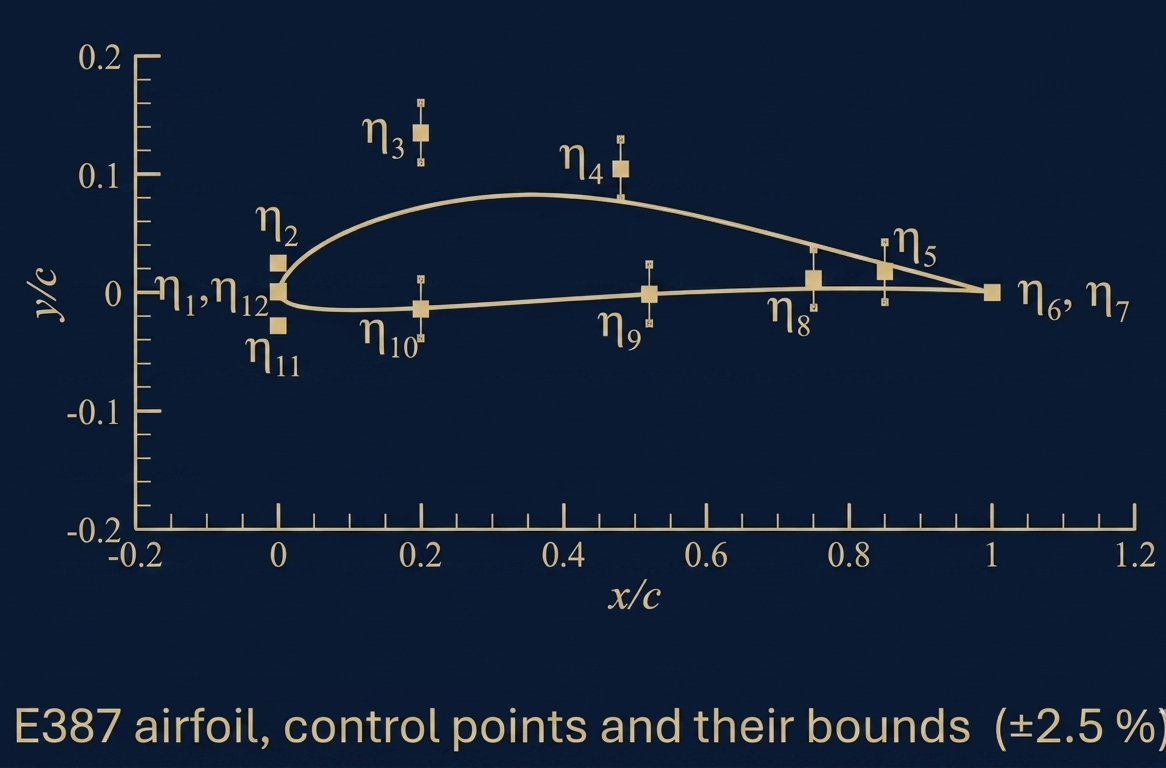
  • Design space defined by multiple control parameters with tight bounds (±2.5%)
  • Optimization landscape is non-convex and sensitive to initialization

Results

High compute cost with slow and unstable convergence in classical workflows.
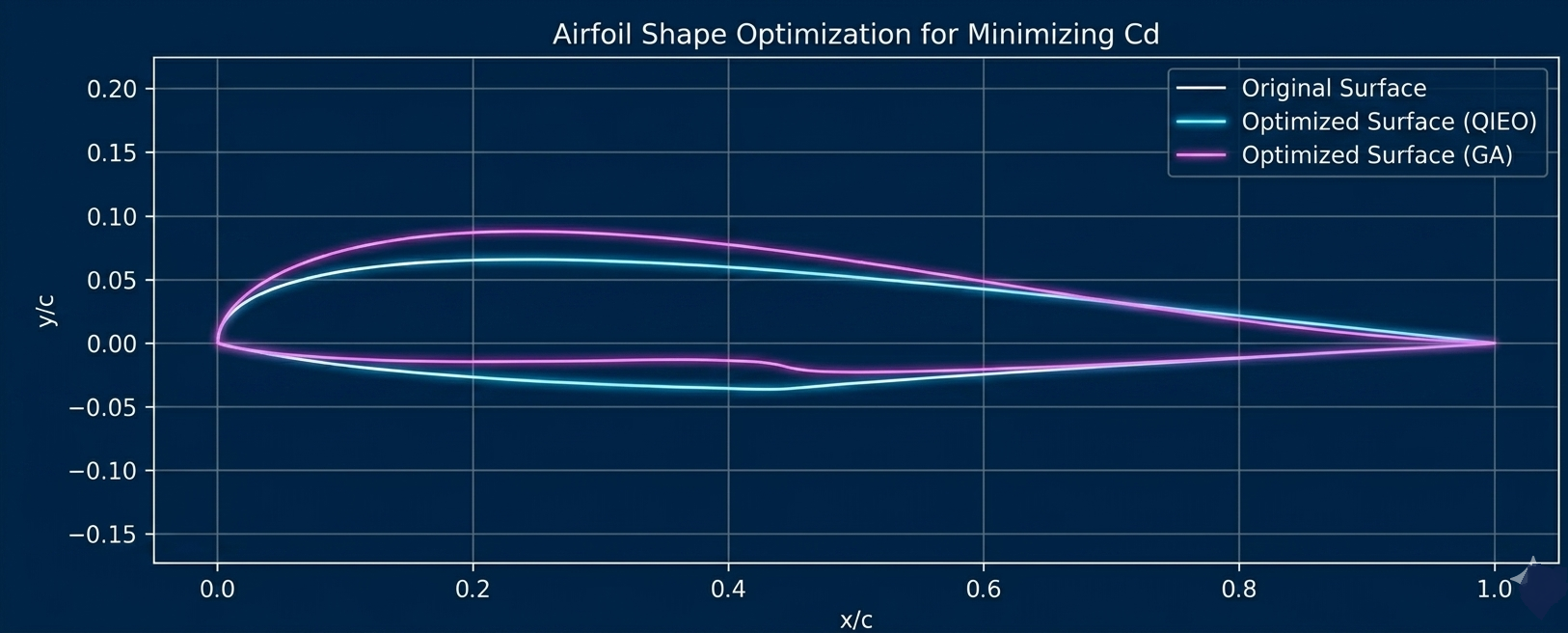
Airfoil Optimization Performance

  • Final Fitness (Cd):
    • QIO: 0.014341
    • GA: 0.014342
  • Function Evaluations:
    • QIO: 990
    • GA: 2053

Design Outcome

  • Optimized airfoil shape shows improved surface characteristics
  • QIO achieves comparable or better performance with significantly lower compute
  • → ~2× fewer evaluations with QIO

Validation on Benchmark Function

Tested on Goldstein–Price function (non-convex benchmark):
  • Global Minimum:
    • Reference: 3.0
    • QIO: 2.99995
    • GA: 2.99989
  • Design Variable Accuracy:
    • QIO closer to optimal solution

Accelerating Aerodynamic Optimization with Surrogate modelling & QIO

Prediction Accuracy

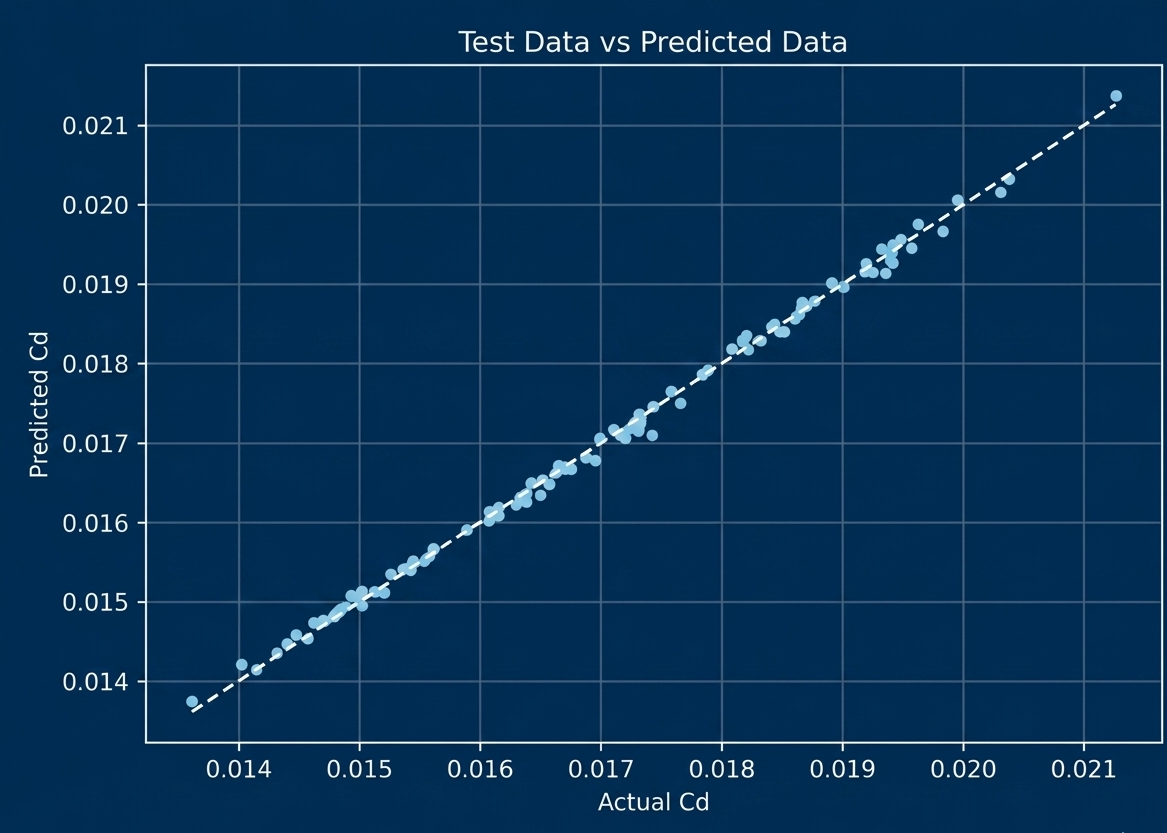
High-Fidelity Surrogate (R² = 0.996)
Compute Efficiency
52% Reduction in Evaluations (990 vs 2053)
Optimization Quality
Near-Global Optimum Convergence (2.99995)
Go Beyond Classical Limits.
Explore with a commitment-free Proof of Concept.
Schedule Call
Get in touch for a no obligation proof-of concept
Schedule a Call
More to Explore
SEE ALL
Optimization Solver
Airfoil Shape Optimization Using Surrogate model & QIO
Achieved high-accuracy drag prediction with R² = 0.996 and improved design convergence|| Faster exploration • Reduced evaluation cost • Stable optimization
Check Out
Optimization Solver
Optimized Gate Allocation: Operational Resilience for Airline Gate Scheduling
BQPhy’s QIO solver delivers up to 3X faster convergence than Classical Algorithms for dynamic airport gate assignments, while consistently producing conflict-free schedules.
Check Out
Physics-Based Solver
Quantum CFD Achieves 100× Circuit Compression
BQPhy's QCFD algorithm, Classiq’s compiler and NVIDIA GPU simulators enabled 100× circuit-depth reduction and successful scaling to the 2D Poisson equation for quantum-accelerated PDE solving.
Check Out